

Why Young Justice Changed A Major Moment In DC's Teen Titans Mythos
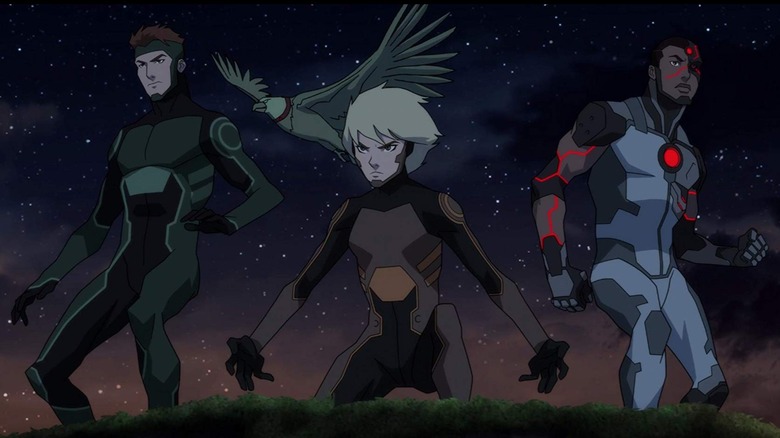
The most famous Teen Titans story is Marv Wolfman and George Pérez's 1984 arc, "The Judas Contract." The Judas is the earth-moving girl Tara "Terra" Markov, a spy working with Deathstroke/Slade Wilson to destroy the Titans. The much-beloved 2003 "Teen Titans" cartoon loosely adapted Terra's story for its second season. Then, in 2017, "Judas Contract" received a more beat-for-beat animated movie adaptation.
When Cartoon Network picked up "Young Justice," co-creators Greg Weisman and Brandon Vietti knew they'd have a hard time following up "Teen Titans." So, they made a different kind of show. "Young Justice" is a superhero spy thriller that hews to semi-realism, rather unlike the anime-flavored action comedy of "Teen Titans."
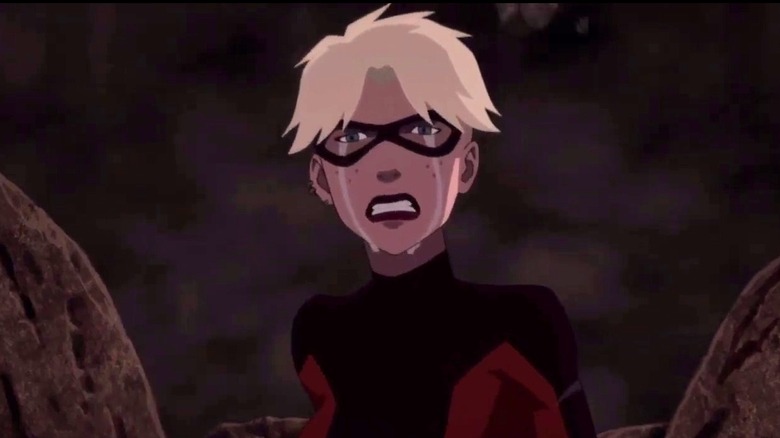
"Young Justice" also held off on adapting Terra or "The Judas Contract" until its third season in 2019, then flipped the classic story on its head. In the "Young Justice" season 3 finale "Nevermore," Terra (Tara Strong) turns triple agent, betraying Slade (Fred Tatasciore) and choosing the heroes over him. When interviewed by DC.com in 2021, Weisman explained that they wanted to do something new:
"We felt that the 'Judas Contract' had been done authentically multiple times in animation, and we wanted to provide a twist that would suit our version of the character and highlight the abuse Tara Markov had suffered, while showing the possibility of Terra's redemption instead of her death."
Vietti added that this change was a "double twist" for fans familiar with Terra's story. "Young Justice" redeeming Terra, and letting her live through it, is the culmination of a shift in her characterization across iterations. Wolfman & Pérez's original Terra was a buck-toothed femme fatale, proudly evil and scornful of redemption. "The Judas Contract" deserves its classic status, but its simplistic and villainous Terra has come under scrutiny over the decades.
Terra's betrayal in the Judas Contract is the defining Teen Titans story
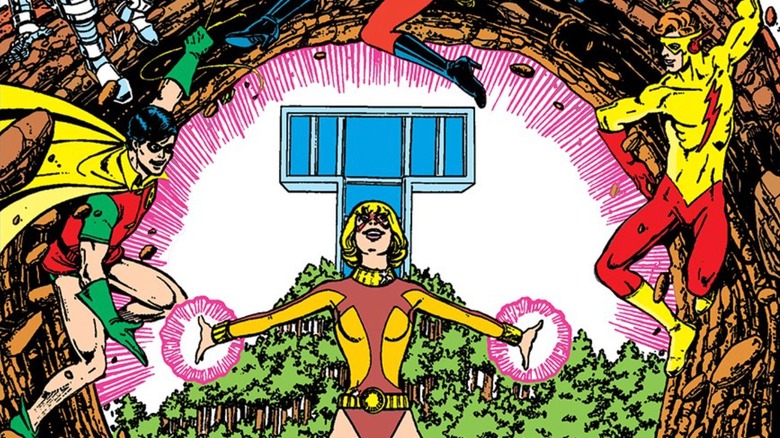
Wolfman and Pérez's "Teen Titans" is often compared to Chris Claremont's "X-Men," a contemporary comic and another superhero soap opera. Terra was Wolfman twisting these comparisons, as he wrote in a foreword for "The Judas Contract." He wanted to debut a hero like the plucky new X-Girl Kitty Pryde and then reveal her as a villain.
Enter Terra, introduced in "New Teen Titans" #26. Hailing from the fictional country Markovia, she's the king's illegitimate daughter (exiled for her terrakinetic powers) and sister of superhero Geo-Force/Brion Markov. Terra joins the Titans after they rescue her from a terrorist group supposedly holding her under duress... but something is off. Terra's wisecracks seem more venomous than good-natured. (For "Avatar: The Last Airbender" fans, Terra is basically Toph but secretly evil.) She's also insistent that the Titans trust their secret identities with her.
Issue #34 finally drops the bomb that Terra is working with Deathstroke, but her teammates only learn this in the "Judas Contract" finale. The book frames Terra as vile and born rotten; she hates the Titans for using their abilities to help others and thinking she was ever their friend. She ultimately loses control of her powers and buries herself alive, the comic condemning her to the last word.
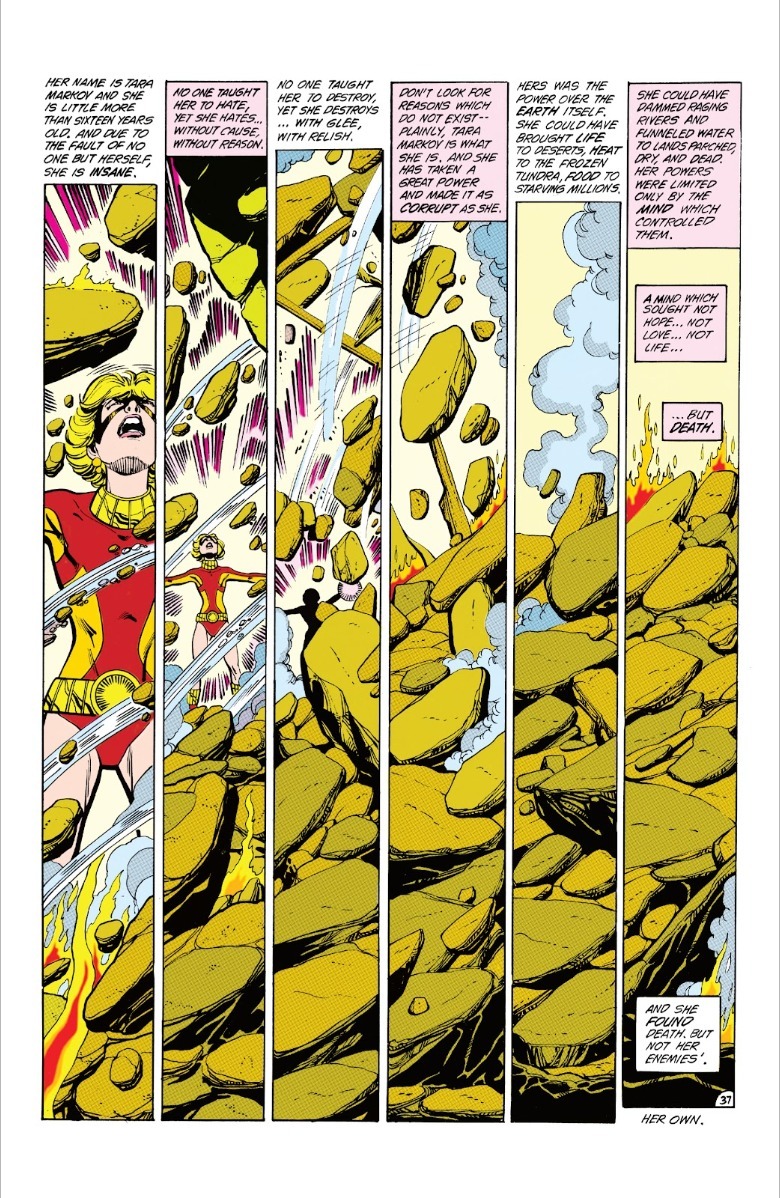 DC Comics
"We wanted [Terra] to be as much a viper in the garden as we could," said Pérez, when interviewed about his career for "Modern Masters Volume 2: George Pérez." "Comic convention," as Wolfman put it in his "Judas Contract" foreword, dictated that the Titans' goodness would rub off on Terra. "Judas Contract" stamps out that hope for the Titans and readers who'd grown fond of the hero that Terra was pretending to be.
The Teen Titans' Terra: misunderstood or pure evil?
Letting Terra live and die as a villain was a bold choice, but other bits of her characterization show the story's age. She's not just working with Slade, she's sleeping with Slade, even though she's 16 and about 40 years his junior. Pérez called this "statutory rape" in "Modern Masters," but the comic never depicts it like that and refutes that Slade ever twisted Terra.
Slade is instead the respectable one, fighting the Titans to honor his son Grant (who died after fighting them), while Terra is doing it because the goodie-two-shoes disgust her. Terra's promiscuity is tied into the twist of her being evil; Pérez wanted readers to think "Whoa, good God! This little girl is a sl*t!" when she revealed herself in makeup and a nightgown before Slade.
Aimed at a young audience, the 2003 "Teen Titans" kept Slade's grooming as subtext. (Him seizing remote control of Terra's body armor conveys a violation.) The "Judas Contract" movie shows Terra (Christina Ricci) trying to seduce Slade (Miguel Ferrer), but makes it very clear that he's manipulating her. She ultimately brings a cave down on both of them; Terra dies once more in despair, but it's a tragedy, not comeuppance, because she did have the spark of goodness that the comic one didn't.
I don't intend to throw the late Mr. Pérez under the bus, but to illuminate why adaptations have pushed back against his and Wolfman's characterization of Terra as pure evil. Reframing Terra's dynamic with Slade as an abusive master-apprentice relationship turns her into a more realistic character; there are lots of young people who've been groomed by predatory adults. A teenage girl so evil she makes a hardened mercenary look good? Only in comic books!
How different Teen Titans stories have handled Terra
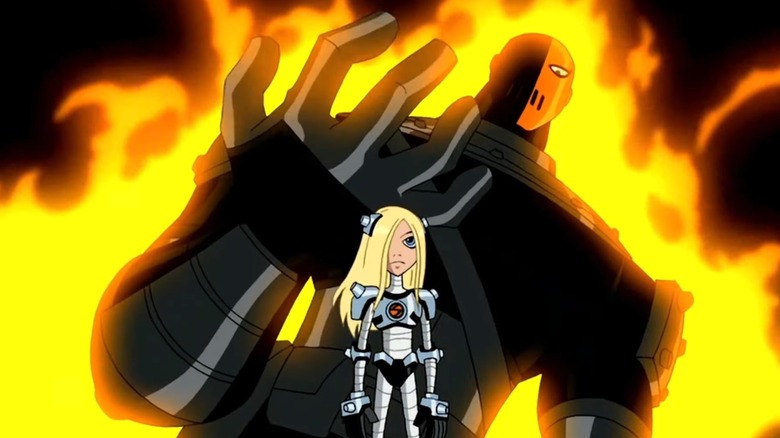
"Teen Titans" '03 creator Glen Murakami wanted to make Terra a "more conflicted" character, not tell a "black and white" story like the comic. This Terra (Ashley Johnson) isn't lying about wanting the Titans as friends, but she fears them rejecting her because she can't control her powers. Slade (Ron Perlman) uses that fear to convince Terra to join him.
Across the Terra arc, each episode written by Amy Wolfram, she goes from befriending the Titans to trying to murder them to sacrificing herself for them. This rote redemptive ending is the story Wolfman and Pérez were trying not to tell, but the whole thing turns Terra from the evil caricature wrapped in a (great) plot twist from "The Judas Contract" into a character of depth. She's an insecure and desperate person who feels like she can't back out of a deal with the Devil.
While Terra's debut and downfall was the defining arc of "Teen Titans" season 2, "Young Justice" had a much bigger cast, leaving Terra's story among a sea of subplots. This one explores Terra's royal Markovian heritage; her brother Geo-Force spends the first half of season 3 searching for her. Her disappearance and rescue was a set-up to place a mole among the heroes, but "Nevermore" revealed the heroes knew all along Terra was a spy — and also that Deathstroke's abusive father-style training had given her Stockholm syndrome. So, they wanted to offer her the chance to learn and choose good. Completing the flip, Geo-Force is the Markov who goes bad in "Young Justice," which Vietti called a "be-careful-what-you-wish-for" twist.
"The Judas Contract" is a problematic favorite of mine, but I sympathize with writers like Wolfram and Weisman giving Terra a chance that her creators never did.