

5 Forgotten '90s Horror Movies That Still Hold Up Today
Throughout the 1980s, horror was dominated by slashers. Thanks to the success of John Carpenter's "Halloween" in 1978, and the equal success of Sean Cunningham's acknowledged knockoff "Friday the 13th" in 1980, small studios scrambled to put their own stalk-and-kill murder pictures into the hopper. In 1984, Wes Craven released "A Nightmare on Elm Street," and a new canon of horror monsters was officially born. By then, there had already been two additional "Halloween" sequels and three more "Friday the 13th" movies. Michael Myers, Jason Voorhees, and Freddy Krueger became Gen-X's Dracula, Frankenstein, and the Wolf Man. And those are just "the big ones." There were hundreds of imitators besides, making the 1980s the decade of slashers.
As the trend petered out, however (as all trends eventually must), horror seemed to lose focus. Many genre fans look back at the post-slasher era of the 1990s — before the release of Wes Craven's "Scream" in 1996 — as a shapeless and sprawling time. There were no dominant trends, and there didn't seem to be a central ethos to bind horror together.
This, however, made horror all the more exciting. With no trends to follow, filmmakers could get creative. Slashers became self-aware (see: "Wes Craven's New Nightmare"), movies became more stylized (see: "The Crow"), and deconstruction caused the genre to be occasionally silly (see: "Dead Alive"). There was nothing horror couldn't do. The following films may be obscure, but they reveal that the 1990s were breaking open, that slashers were breaking free, and that filmmakers, in a very exhilarating way, didn't know what they were doing. Just like Roger Corman's Frankenstein, horror was unbound. Let's explore.
Prom Night III: The Last Kiss (1990)
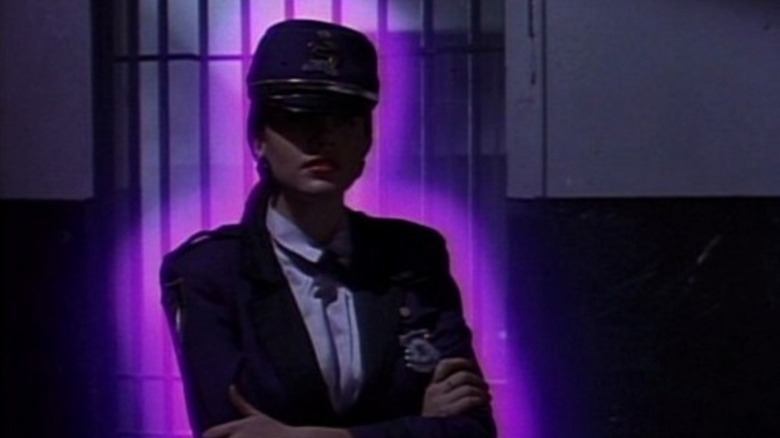
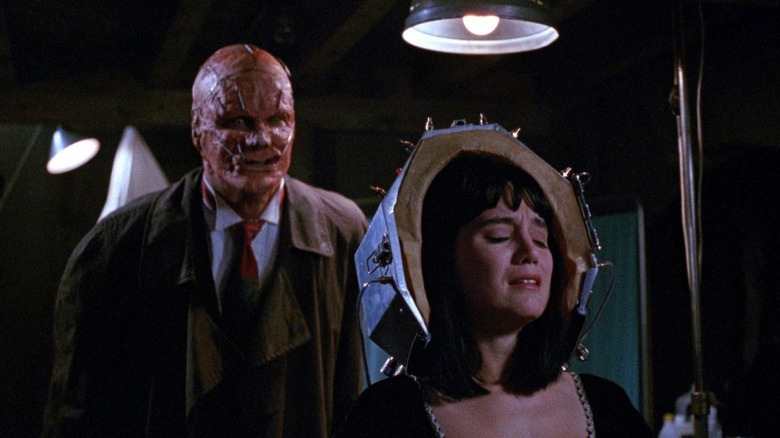
Many people like to point to the 1980 film "Prom Night" as one of the lesser jewels in Jamie Lee Curtis' slasher crown (the others being "Halloween" and "Terror Train"). Additionally, there are many fans of the ultra-salacious and deliciously titled "Hello Mary-Lou: Prom Night II" from 1987. The sequel was more psychedelic than the first, featuring the revenge of the supernaturally resurrected Mary Lou, and her demonic possession of a local teen.
Less celebrated, but just as amazing, is Ron Oliver's "Prom Night III: The Last Kiss" from 1990. By this point in the series, the old-world slasher elements had fallen away, and the series had become a semi-surreal murder spree about a vengeful ghost who escapes from Hell to wreak bloody mischief. Mary Lou, originally murdered in 1957, is played by Courtney Taylor, and we are introduced to the character in Hell, suffering in torment. It seems that Hell is just an endless aerobics class you can never leave. She manages to slip out, however, and return to her high school to get revenge on ... well, on whoever enters her field of vision. She can magically manifest 1950s iconography and uses it to kill. A man gets stabbed through the hands with ice cream cones from a malt shop.
"Prom Night III" has a great sense of humor, clever kills, and a weird, near-cartoon aesthetic that denotes how dead slashers really were. If you know and like "Hello Mary Lou," by all means, keep going, as this sequel is at least as crazy and fun as its predecessor, perhaps even more so. But stop before "Prom Night IV," as that one sucks.
Silent Night, Deadly Night 4: Initiation (1990)
The original "Silent Night, Deadly Night" from 1984 was a simple, marvelously tasteless idea. The filmmakers concocted an idea of a serial killer in a Santa Claus suit, and then backward engineered a story to explain how that might happen. The 1984 attracted a lot of ire from critics and from tongue-clucking morality groups, feeling that a killer Santa was too vicious an idea, even for a horror movie. The film was a mild hit and spawned a few sequels, each one following the same family of killer Santas.
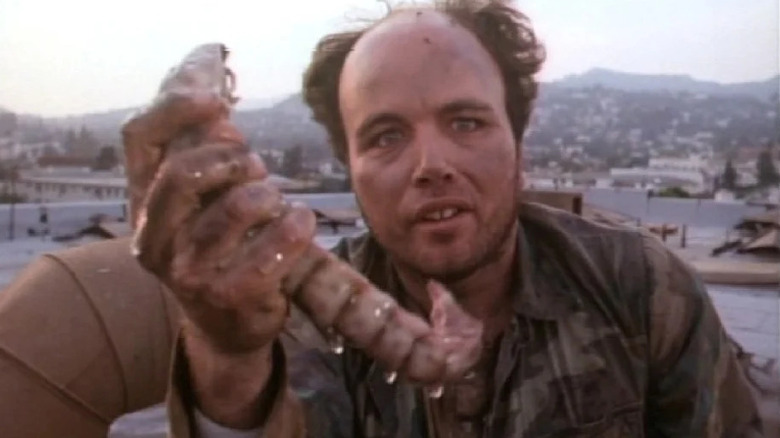
The most interesting sequel, however, has nothing to do with Santa at all, and only barely mentions Christmas. Brian Yuzna's "Silent Night, Deadly Night 4: Initiation" is actually about a young reporter named Kim (Neith Hunter) who is investigating a series of spontaneous human combustions when she stumbles into a cult of bug-worshipping feminist witches. They are celebrating an ancient holiday and aim to induct her into their cult. I suppose that counts as "holiday horror," although there is nary a Christmas tree, Santa, or yule log in sight.
More notably, there are terrifying creature effects by Screaming Mad George. Yuzna and George worked together on several movies, including 1989's "Society" and 2000's "Faust: Love of the Damned," and the effects are creative and nightmarish in all three. "SNDN 4" features a four=foot cockroach, many slimy, gross bugs, and a surreal scene wherein Kim's fingers somehow get knotted together while a snake invades her navel. If "Prom Night III's" cartoon nightmare tone was your bag, go a little darker with "Silent Night, Deadly Night 4."
Popcorn (1991)
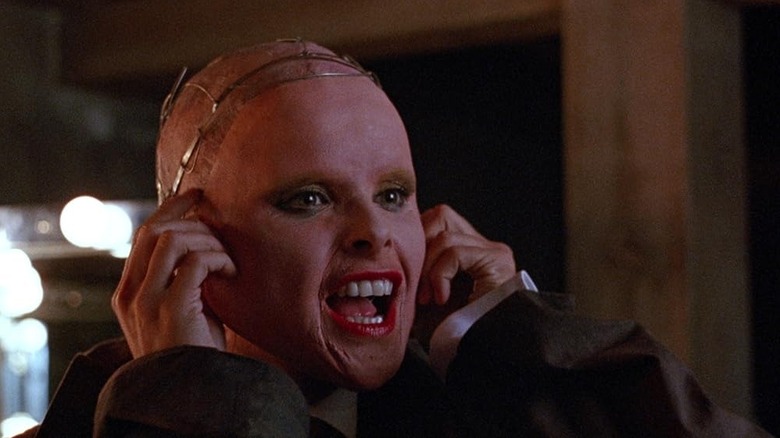
The 1990s still had a few clever slashers up its sleeve, although by the 1990s, the genre had become self-aware. Too many kids had seen too many slashers to take the genre seriously, as they all knew what to do if they were to find themselves in a slasher movie scenario. And while Wes Craven's "Scream" addressed this issue directly — the characters in that film were all slasher fanatics — Mark Herrier's "Popcorn" beat it to the punch by five years. "Popcorn" is about a group of college kids who aim to restore an old movie theater for the express purpose of hosting an all-night horror-thon. Their efforts are rewarded with giant crowds of creative horror fans who arrive in costume, wearing masks, and generally being raucous.
Naturally, there is a killer on the loose at the all-night screening, skulking through the hallways, bathrooms, and projection booth of a theater. The killer (whose identity I shan't reveal) has a mask-making machine (similar to the one in "Mission: Impossible") that allows them to look like anyone.
"Popcorn" turns horror fandom on its ear, putting it right on the screen. It's a horror movie about horror movies, a slasher about slashers. We, as horror fans, aim to see mayhem on the big screen, and we enjoy sharing that experience communally in theaters. "Popcorn" merely brings the mayhem, in a William Castle sort of way, into the audience as well. "Popcorn" aims to victimize us as we watch the film unspool. It's a meta-text about the theatrical experience, and is all the more brilliant for it. And luckily, if you watch it at home, it's still a blast.
Body Melt (1993)
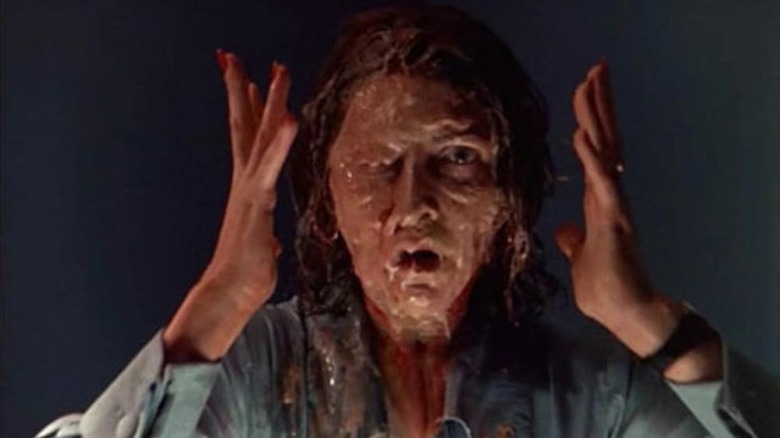
Philip Brophy's 1993 Australian horror film "Body Melt" is marvelously disgusting. As the title denotes, it's about people melting into puddles of goo ... and little else. The plot is haphazard and doesn't explain much, but it does at least explain why there seems to be an epidemic of people melting. It seems that a local health products manufacturer wants to test out a new strain of super-vitamins on the denizens of a small community outside of Melbourne. The vitamins cause the human body to mutate, melt, and explode in creative, disgusting ways. A man's intestines climb out of his mouth. A woman's unborn infant explodes. And, yeah, plenty of people melt.
Because that wasn't enough to sustain the whole film, there is also a subplot about two irascible, horny dudes who aim to become wealthy sperm donors. They get lost in the desert, however, and spend the film on a hillbilly's family farm. While there, they witness two hillbillies kill kangaroos to eat their adrenal glands (!), and one of the men tries scoring with a young woman with a giant forehead and massive musculature. Naturally, it will be revealed that they are all incestuous cannibals.
"Body Melt" is notable for its shapelessness and for how slimy and gloriously revolting it is. The gore effects are just as clever as they are off-putting, and even the most hardened genre veteran will find something to make them recoil. After so many years in the horror trenches of the 1980s, the genre had become stale and predictable. Something safe, and even comforting. Films like "Body Melt" exist to remind horror fans that, yes, you can still be grossed out. Or, at the very least, there are gross things you've still never seen.
Stir of Echoes (1999)
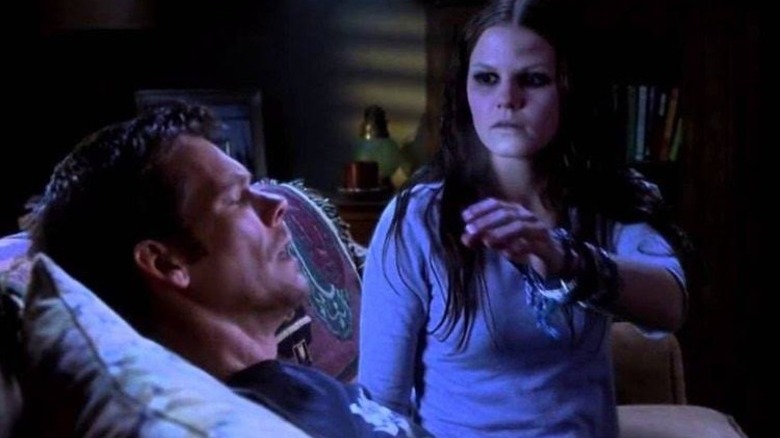
Based on the novel by Richard Matheson, David Koepp's "Stir of Echoes" is an unsung classic. The film stars Kevin Bacon, and he reminds us that he is one of the best actors of his generation, falling deep into the role of Tom Witzky, a working-class Chicago dude who gets in over his head in supernatural shenanigans. The neighborhood is a big character in "Stir of Echoes," and all the locals know a little bit too much about one another. One night at a party, Tom volunteers to be hypnotized, just for fun. When he awakens, however, he finds that he can see and sense ghosts. He is stalked in his dreams by eerie visions he cannot understand. It all relates to the ghost of a young girl he kind of recognizes.
Koepp has long been a screenwriter of notable genre films and super blockbusters. He penned "Death Becomes Her," "Jurassic Park," "Mission: Impossible," "Spider-Man," and many others. "Stir of Echoes" was only his second film as a director (after "The Trigger Effect"), and he proved to be an expert at creating an atmosphere of dread and a dream-like haze of guilt and violence. It helps that he was working with Kevin Bacon, who was wholly devoted to the role and who is believable as an ordinary guy who begins to fall apart. Koepp and Bacon would work together again on the 2020 film "You Should Have Left." In between the projects, Koepp also directed the bike-messenger thriller "Premium Rush," which was also one of the better films of its year.
"Stir of Echoes" is legit scary, too, and its secrets unfold in an increasingly panicked way. The truth is just aching to escape.