

Conan O'Brien Had A Gruesome Cameo In A Batman Movie
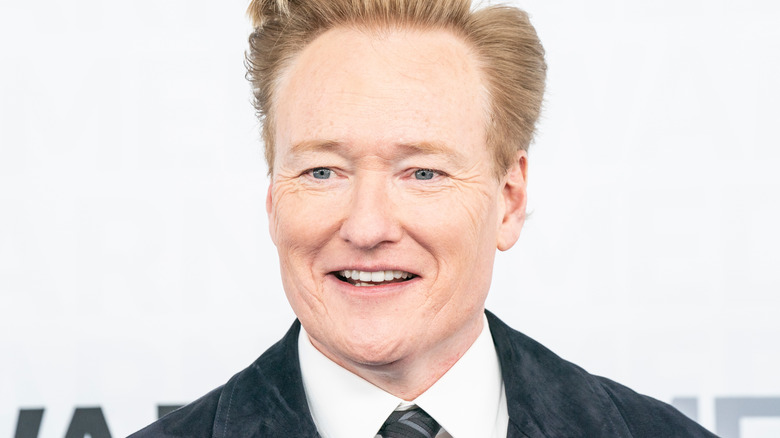
Most know comedian Conan O'Brien for his career as a late night talk show host (or his "Simpsons" writing), but he's got experience performing in scripted entertainment too. One of those experiences even took him to Gotham City — and I'm not talking about his appearance as the Riddler in "The Lego Batman Movie."
O'Brien had a voiceover cameo in the animated film "Batman: The Dark Knight Returns," adapted from Frank Miller's foundational 1986 comic. The animated "Dark Knight Returns," directed by Jay Oliva, was released in two parts — first in 2012, then in 2013 — giving it breathing room to adapt the comic almost beat for beat. The story is set in a dark future where a retired Bruce Wayne (Peter Weller) becomes Batman again to confront a troubled Gotham City. Batman's return, naturally, rouses the Joker (Michael Emerson) too.
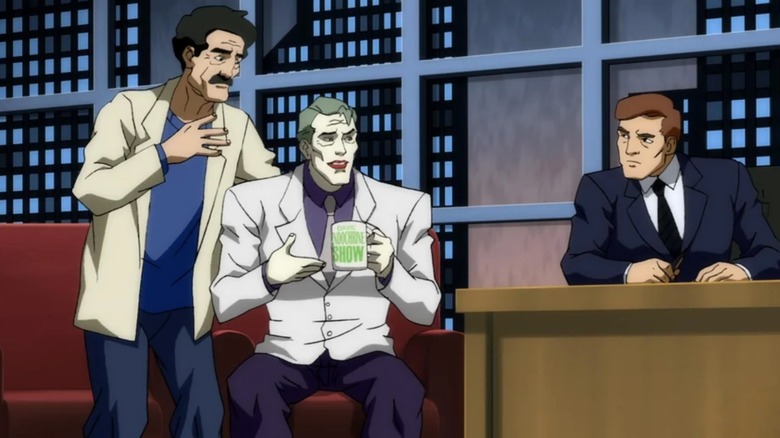
Imprisoned at Arkham Asylum, The Joker convinces his ... naive psychiatrist, Dr. Wolper (Michael McKean), that he's a tormented man driven to act out by Batman's vindictive obsession. So, Wolper books the Joker on a late night show to tell his story. The Joker floods the studio with his Joker Venom, and the audience all die laughing. The animated movie had some fun by casting a real late night host (O'Brien) as the show's host, David Endocrine.
"The Dark Knight Returns" isn't just a superhero comic; it's a satire of 1980s America. Television is a motif in the book; the comic returns again and again to talking heads discussing Batman's impact on Gotham. Bruce is even watching TV, stupefied by the countless reports of violence across Gotham, when the Bat stirs inside him again. You know how "Batman v. Superman" featured a montage of pundits discussing Superman? That's one of the movie's many bits of owed influence to "Dark Knight Returns."
In The Dark Knight Returns, the Joker kills Conan O'Brien
In the comic, the Joker's late night massacre is cross-cut with a sequence of Batman and Robin fighting a SWAT team; one row of panels follows the Joker, the next follows Batman, repeat. Miller frames the Joker, Wolper, etc., in small panels shaped like a TV screen, and places their dialogue not in traditional speech bubbles but rather text boxes above the panels. This compartmentalization of space creates a complex page but not a messy or cramped one.
The movie instead lets the Joker's "interview" play out in full, because in a movie, it's better to let suspense build. Think of Alfred Hitchcock saying you can create suspense by showing a ticking bomb under a table. In this scene, the Joker is the bomb. In the comic, there's another psychiatrist appearing on the show with Joker and Wolper. Joker kisses her, and her face contorts into a rictus grin. Then, one of Joker's "helpers" snaps Wolper's neck as the studio is poisoned.
The movie changes this sequence; the Joker asks if he can keep the show's coffee mug, and Endocrine says he can. Joker then breaks the mug, slashes Wolper's throat with it, then jokes, "So long as you won't miss it." Cue the Joker Venom entering the studio. The movie gives Endocrine an extended death scene where he tries, and fails, to hold his breath while taking in everyone else's dead, smiling faces. O'Brien thus caps his performance with a crazed laugh worthy of the Joker himself.
Each chain of events works perfectly in its specific medium. Wolper's neck snap foreshadows how the Joker himself goes at the end of the issue, but the coffee mug death is more striking and dynamic, like animation should be.
The Dark Knight Returns created the modern Joker
Frank Miller, who was mugged while living in New York City, infused "Dark Knight Returns" with a tough-on-crime worldview that reads as reactionary today. Endocrine and Wolper represent the liberal media and psychiatrists who whitewash criminals like the Joker. In a 2016 interview with IGN, Miller revealed that he and Alan Moore once had a long debate about the Joker. Moore, according to Miller, saw the Batman and Joker as mirrors of each other.
You see that in Moore and Brian Bolland's "Batman: The Killing Joke," which suggests Batman and Joker are both insane men twisted by one bad day. In "The Killing Joke," the Joker is a human being with a history and feelings beyond sadism, and so he contains the capacity for redemption. This feels discordant with other modern interpretations of the Joker, where he's (as Miller described him to IGN) a "Satanic" evil:
"[The Joker is] evil incarnate, and he's so malicious that it goes beyond anything we could understand. That's what's so terrifying about him, is that he simply wants to do as much harm and damage as he possibly can."
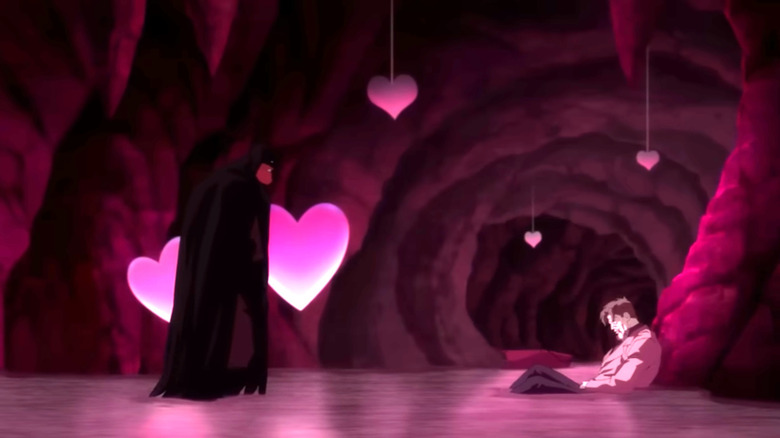
"The Dark Knight Returns" also queercodes the Joker (he pointedly wears lipstick, and Emerson gives him a fey voice), thus popularizing the concept that Joker is in love with Batman. Joker so despaired over Batman's retirement that he became catatonic. Once he catches a news broadcast of Batman's return, he wakes up with a smile and calls Batman "darling." (The animated movie wisely turns this scene into the cliffhanger ending of "Part 1.")
"The Killing Joke" is often ranked as the definitive Joker story. Although I'd argue that later Jokers, like Christopher Nolan and Heath Ledger's or Scott Snyder's, are more indebted to "The Dark Knight Returns."