

One Batman Comic Took The Superhero's Name Very Literally With A Wild Horror Twist
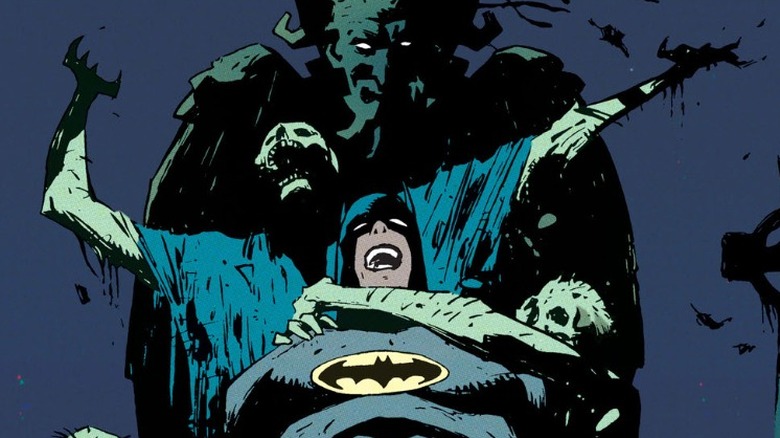
Batman, due to his lack of superpowers and his recent movies' adherence to the Christopher Nolan template, has a reputation among casual fans as the "realistic superhero." Yet that belies almost 90 years of comic history steeped in fantasy. Many Batman stories explore the supernatural, and one of the most quietly influential is 1990's "Dark Knight, Dark City," a three-issue story ("Batman" #452-454) written by Peter Milligan and drawn by Kieron Dwyer. All three issues boast covers drawn by Hellboy creator Mike Mignola for extra eeriness.
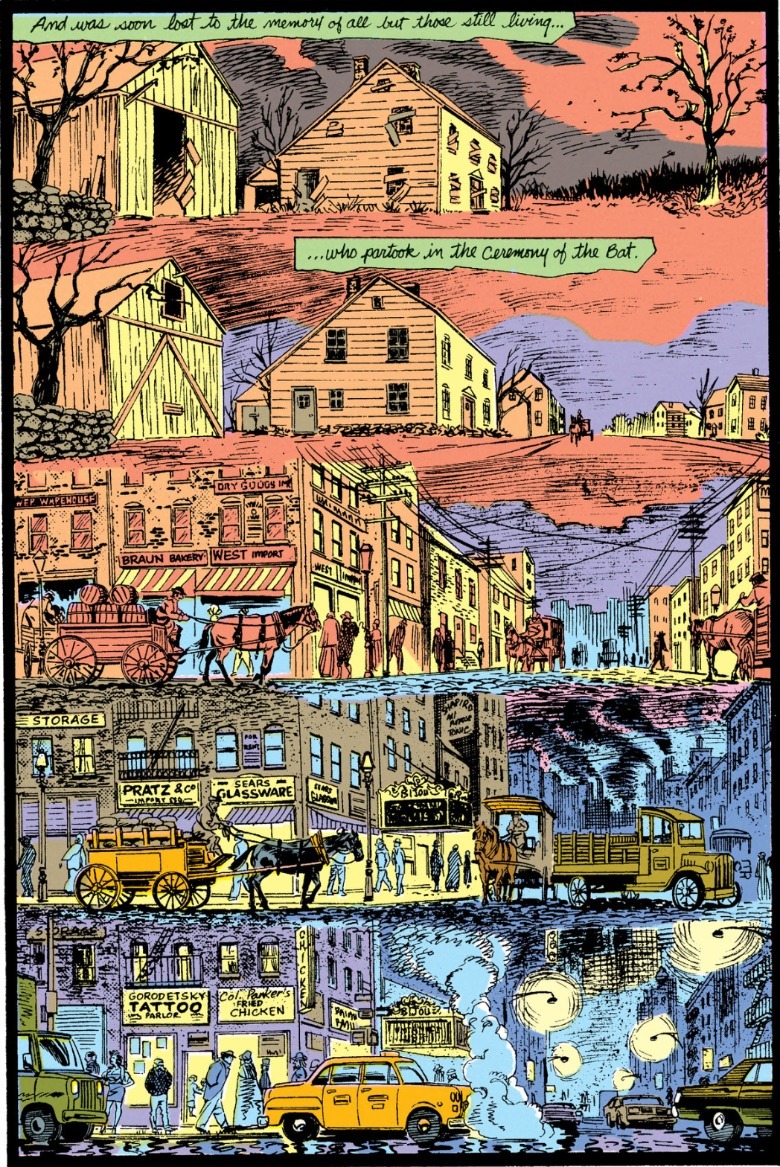
Some Batman stories open with mood-setting of the Dark Knight surveying Gotham from a skyscraper or gargoyle perch, some begin with an action sequence of him taking down criminals, some begin by recounting Bruce Wayne's tragic origin. This one starts in the 1760s, as robed men huddle in a farmhouse basement, part of the settlement that will evolve into Gotham City. These men — including future Founding Father Thomas Jefferson — are gathered for a horrible and occult ritual, "The Ceremony of the Bat." This ceremony is intended to summon a bat demon, Barbathos, and bind it to their will via human sacrifice. Nerves, a scuffle, and the sight of a large bat in the basement's shadows leave the cultists running. They bar the cellar entrance and the Ceremony stands incomplete ... but was something brought over from the other side?
The comic returns to the ritual intermittently, recounted as the journaled confession by one of the cultists, Jacob Stockman. Meanwhile, in the present, Batman trails the Riddler. Eddie Nygma is on a rampage, leaving riddles (and bodies) across Gotham, but Batman still can't see the big picture. The story's denouement reveals the Riddler discovered Stockman's diary and set about recreating the conditions for the Ceremony of the Bat — with Batman as the sacrifice.
In Batman: Dark Knight, Dark City, the Riddler tries occult sacrifice
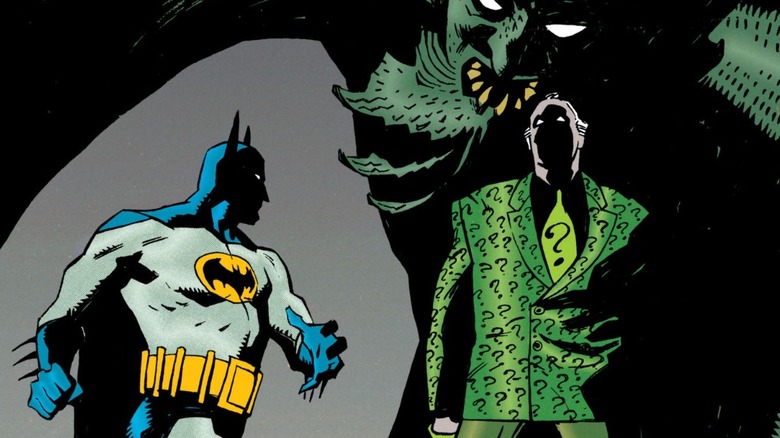
The Ceremony of the Bat demands six conditions: the offering must have kissed a hanged man, bathed in blood, frolicked with the dead, slain a wild dog, slit an unbaptized child's throat, and do a sabbath dance before the Devil (though a goat suffices as a Satanic stand-in). Some of these are easily accomplished by the Riddler, like dumping blood on Batman. Others take some creativity; there's no way Batman would kill a baby, so the Riddler abducts newborns, stuffs a small ball down one's throat, and leaves Batman to perform a life-saving tracheotomy.
How come "The World's Greatest Detective" doesn't put this together before the Riddler explains it all? The Ceremony of the Bat was buried by the ones who attempted it and left undiscovered. When Batman realizes the Riddler is luring him to Stockman's Square, built where Stockman's old farmhouse once stood, he's clueless as to the significance of the location. Yet it might be the most important point in Gotham, because Barbathos was summoned ... but unbound to any man, and so left in limbo. The demon was trapped in the basement along with a screaming Dominique (the woman intended as his offering). As Gotham built up in the decades that followed, the lingering dark influence spread.
 DC Comics
The Batman-led segments of "Dark Knight, Dark City" are chronicled by a narrator claiming to be Gotham City itself. By the end of the story, it's clear that the narrator is Barbathos, the city's soul. When the Riddler hears this voice and asks if it is Gotham or Barbathos, the voice replies there is no difference. The Riddler will not be it's master, though. It is a dark city, and Batman is the dark knight it created.
How Barbathos has returned in later Batman stories
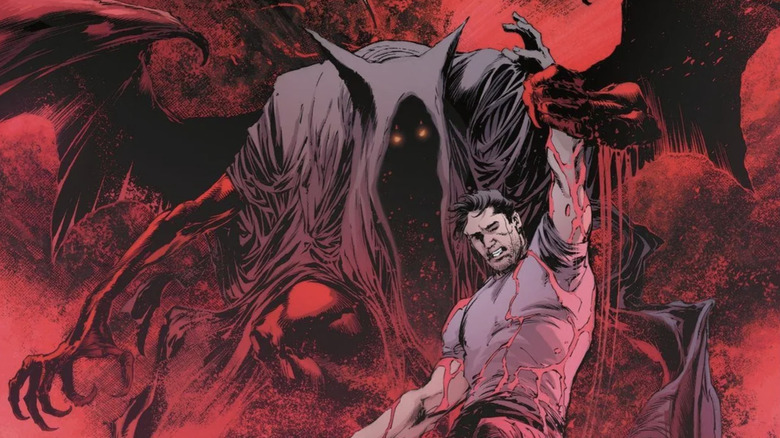
"My blood and seed mixed with the mortar, my breath in the mud and the sewers and the buildings great and small. My spirit in every brick, in every inch of timber. The whole city a bent and misshapen echo of my own desolation," Barbathos intones. It has maneuvered Gotham's history to bring forth its rescuer: Batman.
If you're expecting Batman to fight a monstrous bat demon, "Dark Knight, Dark City" is a more subtle story than that. It's about how memories linger in physical places, and how cities are built on top of those memories. Jefferson's appearance isn't just a historical in-joke, it ties the evil buried under Gotham to the sins — slavery, colonialism, and misogyny (including the Salem Witch Trials, as Batman podcast "The Black Casebook" noted) — that laid the foundation of America.
Batman freeing the demon is more an exorcism, and a wrong righted. Bruce lays Dominique's skeleton to rest at Wayne Manor and ponders what Barbathos told him, concluding it doesn't matter; he already knew that Gotham City killed his parents. We're all shaped by the places where we live, thus the "darkness and desolation" of Barbathos and Gotham rests in Bruce Wayne, Gotham's favorite son.
Like Barbathos' darkness spreading through Gotham, "Dark Knight, Dark City" has influenced later Batman stories. Writers like Grant Morrison, Scott Snyder, and Ram V have all reused and reinterpreted Barbathos (whose name was later spelled "Barbatos"). Snyder's "The Court of Owls" revealed a secret society has controlled Gotham for centuries, while "Endgame" suggested the Joker might be an immortal curse upon Gotham. You don't get those stories without "Dark Knight, Dark City."