

15 Best Animated Movies Of The 2000s, Ranked
We may receive a commission on purchases made from links.
Between the litany of ambitious feats in cel animation, the consolidation of CGI animation as a viable technology for features, and the rapidly-increasing sophistication of stop-motion, the 2000s were an incredible decade for animated film across the board.
This ranking of the 15 best animated movies released in the 2000-2009 period looks back on a transformative era for the animation medium and attempts to pinpoint its most extraordinary achievements across a variety of techniques, styles, and nationalities.
The one ground rule, with apologies to the anime Christmas miracle of "Tokyo Godfathers," the enduring super-ness of "The Incredibles," and numerous other incredible movies, is that only one film per director is allowed — strictly because some delimitation was required to narrow down such a wide field.
Waking Life

In "Waking Life," Richard Linklater proposes that a movie can be a dream. The suggestion is both formal and ideological: In his first foray into animation prior to the underrated sci-fi thriller "A Scanner Darkly," the American indie reverend uses rotoscoping — a rarely-used technique in feature-length animation — to approximate the feeling of an oneiric state, more faithfully and effectively than any contemporary this side of David Lynch. But "Waking Life" is also a dream in the sense that it imagines a wider, deeper, freer scope of possibility for cinema.
Ostensibly, the movie tells the story of a young man (Wiley Wiggins) navigating an unending lucid dream state, in which he continually comes across an array of singular characters who engage him in discussions about the nature of consciousness, life, and existence. But "Waking Life" is so unencumbered by the rules of standard narrative cinema that it only barely counts as having a "story." Linklater is interested in using the fluidity of the animated medium to charge gleefully into every corner of his imagination, putting forth a statement of belief in film's power to (literally) animate emotional and philosophical inquiry. We have yet to see another movie quite like it.
Azur & Asmar

Ancestral forms of animation are alive and well in the oeuvre of Michel Ocelot, a French filmmaker with a style you couldn't mistake for anyone else's. Ocelot has drawn upon the largely ostracized techniques of cutout animation and silhouette animation for visual inspiration in the majority of his films, and in some cases practiced the real thing himself. Even his work in "traditional" animation — like 1998's peerless "Kirikou and the Sorceress," which would be on this list if it didn't just miss the cut by two years — looks and moves like nothing else in the business.
All of this idiosyncrasy makes "Azur & Asmar," Ocelot's first stab at computer-generated animation, a uniquely momentous treat. The story, an original fairytale penned by Ocelot himself, tells of two young men (Cyril Mourali and Karim M'Riba) raised together, who get separated by circumstances and then meet again on a competing quest to find and marry the legendary Djinn-fairy. But the main attraction is the gusto with which Ocelot subverts the rules of CGI animated cinema, employing the sharpness of digital graphics to create a deliberately, entrancingly uncanny version of his signature texture-filled 2D tableaux.
Lilo & Stitch

The early 2000s were a trying time for Disney Animation. With CGI animation on the rise and the formula of those '90s Renaissance megahits all but depleted, the studio found itself segueing from the runaway success of its post-"Little Mermaid" era into a time of corporate, artistic, and philosophical uncertainty. It was precisely this uncertainty that enabled some of Disney's most original, unique, and uncommonly affecting animated films ever, chief among them "Lilo & Stitch" — which originally wasn't supposed to be a movie.
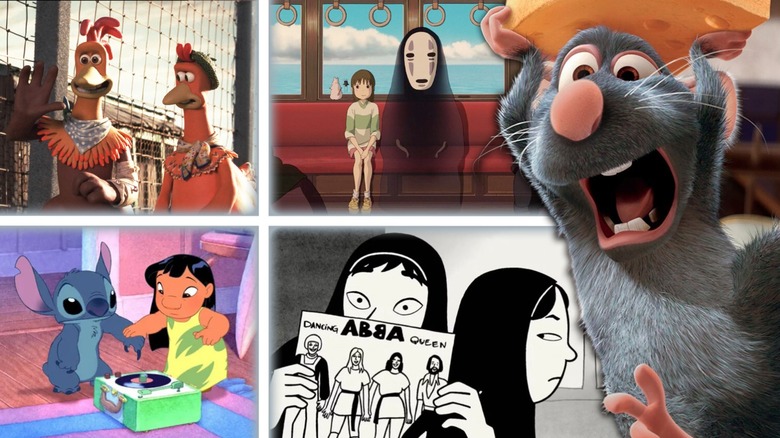
Chris Sanders and Dean DeBlois' vintage-style, watercolor-painted cartoon about a lonely Hawaiian girl (Daveigh Chase) and her pet alien (Sanders) is such an established cultural institution that it's easy to miss what a bold swing it once was. But that's the magic of "Lilo & Stitch." It's such a fun, charismatic, honest, and primally affecting little sci-fi adventure that you don't even stop to think about how extraordinary it is for a Disney movie to be tackling real-life grief, dysfunctional child development, working-class struggle, cultural imperialism, anti-Native racism, and oppressive state oversight over marginalized families. That it exists at all is a gift, let alone that it's so wonderful.
Mary and Max

Given only the smallest of Oscar-qualifying runs and otherwise dumped straight into home media by IFC Films, "Mary and Max" barely existed at all in the United States at the time of its 2009 release. It wasn't until years passed, and animation fans gradually discovered Adam Elliot's directorial debut, that American audiences came to the same conclusion already reached by its native Australian public right from the get-go: Here was one of the most incomparable animated films of all time.
A black-and-white claymation concoction full of designs expressive enough for newspaper cartoons, "Mary and Max" wields the presumed innocence of English-speaking animated cinema as a blunt instrument, peppering the decades-long story of the titular transpacific pen pals (voiced beautifully by Toni Collette and Philip Seymour Hoffman) with shocking moments of darkness, grotesquerie, and despair. But it's all a roundabout way of using stop-motion to find friendship in a cruel world. Ultimately, "Mary and Max" is the honest, unfettered story of a connection; in its two very different protagonists trying their best at life, it finds a microcosm for us all.
Coraline

"Coraline" is one of the most terrifying horror films of the 21st century. That it ever gets discussed as anything but evinces something wrong in the way we think and talk about horror movies — as though, by aiming their devices at the sensibilities of younger viewers, they were relinquishing the privilege of getting under the skin of jaded adults. Quite the opposite: "Coraline" is so effective at evoking the fear of growing up in the headspace of an overwhelmed child that it makes you feel like one, no matter how many "serious" slashers and gorefests you've seen since you were young enough to play with dolls.
The first full-length feature from Laika and the fourth from director Henry Selick, "Coraline" is the auspicious meeting between a master of the medium and a brave new studio eager to show off. As a work of animation, it's wondrous: The dual worlds of Coraline (Dakota Fanning) brim with detail, intention, impossible vividness, so enveloping in their tactility that they outpace the eye's ability to rationalize. As horror, meanwhile, it's more gutturally unnerving by the minute than most horror movies manage to be in their entirety.
The Triplets of Belleville

There's something so hermetically, hauntingly pure about "The Triplets of Belleville" that it's almost hard to believe it exists even as you're watching it. With its dense, tracey, sepia-tinted mélange of CGI and traditional animation applied to a nearly dialogue-free tale of urban action-slapstick, it suggests a platonic refinement of "animated film" as a concept: This is what we all want from feature animation yet so seldom, if ever, get.
If that sounds like impossibly high praise, just take a gander at any one scene, bask for even a mere few seconds in Sylvain Chomet's rambunctious art nouveau aesthetic sensibility, and you'll find yourself similarly in awe at the realization that movies can actually be like this. There's nothing to "The Triplets of Belleville" but the virtuousness of art, color, and movement, and that's enough to pack its 78 minutes with endless delight. It helps that, by focusing on a perky elderly woman (Monica Viegas) who teams up with a trio of aged cabaret singers to rescue her beloved grandson (Michel Robin) from mobsters, the movie hits upon one of the fundamental unspoken truths of cinema: We all crave more good stories about old ladies.
Chicken Run

Anarchy is both ethos and prima materia in "Chicken Run," the first feature film of Aardman Animations — and, like in any successful revolution, discipline and technical rigor are the foundations underneath the mayhem. It's still stunning, a quarter-century later, to gawk at the movie's physical comedy, made at once cartoon-bouncy and ballet-sharp by the studio's signature marriage of goofy designs and painstaking photographic precision. It's even more stunning to gradually take in how genuinely radical and wholehearted "Chicken Run" is as an anti-authority, anti-capitalist statement.
The achievement becomes more laudable when you factor in that, given the depth of the technical breakthrough it would inevitably represent, "Chicken Run" could have just coasted on being a perfect mindless cartoon. But that was never the way Aardman ran. After honing their craft for decades in short helpings of sophisticated, grown-up-friendly comedy, Peter Lord and Nick Park had not only the logistical requirements but also the conceptual ebb-and-flow of claymation down pat. "Chicken Run," released in 2000, was both a victory lap and a takeoff towards new heights. The perfect movie, in other words, to ring in animation's 21st century.
Mind Game

Masaaki Yuasa films have the power to make you conscious of how many dull, arbitrary rules almost every other movie is constantly following. His gigantic, irrepressible creativity has repeatedly resulted in some of the most singular films of the 21st century so far — "animated" and "Japanese" qualifiers intentionally omitted — but, even by those standards, his 2004 feature film debut "Mind Game" is next-level stuff.
Take a scroll through various movie databases and you will find that the plot of "Mind Game" is frequently described in the broadest, most puzzling terms: There is a "loser" (Koji Imada) with a crush on his childhood friend (Sayaka Maeda), and he "travels to heaven and back." That vagueness is required by a constitutional refusal to fit descriptions, but that very refusal also makes "Mind Game" a textbook instance of a "just trust and dive in" movie. Yuasa blends styles, genres, tones, settings, ideas, degrees of realism and diegesis, and still somehow packs it all into a whole that feels cohesive and propulsive — all courtesy of his steadfast commitment to his own muse, and his team's breathtakingly fluid animation. Watch it and expand your mind.
Blood Tea and Red String

How's this for auteur theory: a stop-motion animated film created over the course of 13 years by a single indefatigable artist, pulling septuple duty as its writer, director, designer, cinematographer, editor, VFX artist, and solitary animator. The depth of personal accomplishment alone would make "Blood Tea and Red String" a must-watch film. But even more extraordinary is the fact that, while doing all that lonesome work over such an epic timespan, Christiane Cegavske somehow managed to concoct an indelible masterwork — a transfixing, bone-chilling fairy tale inhabited by the ghosts of Władysław Starewicz, Maya Deren, and the Brothers Grimm alike.
How could anyone have been so fully aware of where each shot, each scene, each cut would fall in while moving figurines around by herself across more than a decade? It's a mystery matched by the eerie inscrutability of "Blood Tea and Red String" itself. Cegavske's tale of war for possession of a doll is as thrillingly surreal and unassailable as a century-old folktale. But glowing at its center is a paean to the beauty of craftsmanship, made indescribably moving by Cegavske's own Herculean dedication.
WALL-E

As far as Hollywood cinema goes, the 2000s were inarguably the decade of Pixar. At its apogee, the Emeryville, CA studio that invented CGI feature animation was also eager to revolutionize animation at large, harnessing the built-in mass appeal of its tech-novelty blockbusters to get away with broadening the scope of what big-budget American film — animated or not — could be.
This spirit of invention culminated, of course, in the avant-garde enormity of "WALL-E," the most radically experimental film ever to gross over $500 million worldwide. Andrew Stanton's 2008 environmental sci-fi robot romance epic is an utterly sui generis meeting of thought and technology, a mammoth-sized hyperreal cartoon diptych that successfully fuses together whimsical Silent Era-inspired physical comedy and Kubrickian philosophy-through-space-travel, by tethering it all to an improbably irresistible love story between an adorable trash compactor (Ben Burtt) and an angry iPod (Elissa Knight). The Disney buyout, finalized while "WALL-E" was in production, ultimately clipped Pixar's wings just as the studio was taking flight — but Stanton's film remains a glimpse into how high they were once willing to soar.
The Emperor's New Groove

It's tempting to take a page from Patti LuPone at the 2025 GLAAD Media Awards and make these two paragraphs just a demonstrative, non-exhaustive list of quotes. "The Emperor's New Groove" has one of the most impossibly refined comic screenplays of the last half-century, and, as tends to be the case with comedy this plainly fantastic, there's little point in waxing poetic about why funny is funny.
But let's go ahead and do so anyway: "The Emperor's New Groove" is nothing short of a miracle. In the furnaces of a crumbling Disney Animation production, director Mark Dindal and screenwriter David Reynolds somehow fashioned a nonstop 78-minute run of legendary verbal, physical, and metacinematic gags, resurrected the spirit of zero-G hilarity once found in the very best of vintage Looney Tunes shorts, and gave Eartha Kitt and Patrick Warburton the roles of a lifetime. By all accounts, it doesn't make sense.
Persepolis

It was already a brilliant move on the part of Marjane Satrapi to tell her hectic, war-ravaged life story through the comic book medium, rendering decades of intricate personal and political history into starkly austere black-and-white compositions. It was an equally brilliant idea to then turn "Persepolis" the graphic novel into a movie of stringent visual faithfulness, in which the implied kineticism of Satrapi's drawings could be made manifest.
Just as the printed "Persepolis" is unabashedly a comic book, radiant in its own newspaper-strip visual simplicity even as it probes the darkest of thematic territory, the movie version never shies away from being a cartoon. On the contrary, Satrapi understands and mines the irony: She knows that global audiences will expect oppressive dourness, perhaps a tinge of mawkish innocence-lost contrast, in her child's-eye account of the Iranian Revolution and her immigrant bildungsroman in a hostile Austria. Instead, partnered with co-director Vincent Paronnaud, she has fun — with the medium, with her memories, with her own caustic sense of humor, with the farce of it all. "Persepolis" is devastating because it refuses to be simple, and a masterpiece for the same reason.
Millennium Actress

Who is Chiyoko Fujiwara? The question is irresistible precisely because "Millennium Actress" dangles it beyond our reach. A masterpiece for the ages, Satoshi Kon's second and best movie (an exceedingly high honor, given he's one of the greatest filmmakers of all time) does so much while refusing to unspool its central mystery that the intrigue grows exponentially. Here he is, the absolute madman, reckoning with decades of Japanese history and Japanese film history and Japanese history as seen through film — here's another idea, and another one, and another. Fools that you are, expecting "answers" underneath all that, Kon seems to be telling us.
Through all that, Chiyoko (Fumiko Orikasa, Mami Koyama and Miyoko Shōji) only becomes more fascinating: Her experiences mean something, she stands for some aspect of the 20th century, there is some logic to her constant movement between movies and daydreams and reality. But what is it? What are we to glean from her lifelong quest, partitioned into chapters always wobbling away from spatial and temporal coherence? Ultimately, "Millenium Actress" unveils the single uncontrovertible truth of Kon's oeuvre: Some things in this world cannot be verbalized, and it's up to cinema to rise to them.
Ratatouille

Leave aside that "Ratatouille" is an obviously incredible movie everybody loves, and take a moment to pick it apart: What is it supposed to be, exactly? It's a film with the intro and the narrated structure of a "Goodfellas" riff, the tapestry of character-based verbal sparring of a Billy Wilder comedy, the tart urban melancholia of Joan Micklin Silver, the giddy musical and visual splendor of Jean-Pierre Jeunet, the ridiculous French accents of an old Hanna-Barbera cartoon, and the rat-sized action spectacle of literally nothing else. Its story is episodic and low-stakes, and its protagonist is a bit of an arrogant jerk with less an overarching goal than a hesitant hobby.
What in the sauce hollandaise were they thinking? What was the endgame here? If you've seen "Ratatouille," of course, the answer is simple enough: Brad Bird saw an opportunity, and he took it. "Ratatouille" is a great, exuberantly hilarious and unruly film that could only have been made as CGI animation during the most daring phase in Pixar's history. It avails itself fully of its medium in a way no movie before or since has touched, willing the best of cartoon and live-action film history into coexistence by sheer, heedless force of conviction — a fitting level of chutzpah, really, for one of cinema's most affecting statements ever on the importance of making art.
Spirited Away

The fluidity of "Spirited Away" is such that it calls into question why any movie would ever bother to be anything but animated. In a career of classics upon classics, it is the self-evident magnum opus of Hayao Miyazaki, the single film that most fully encapsulates his philosophy and demonstrates his gifts as a once-in-a-generation filmmaker. It may well be the best animated film of all time.
Actually, scratch that adjective: If we were to pick a single work to express the power of movies to a hypothetical alien species, we could do a lot worse than the tale of Chihiro (Rumi Hiiragi) and her trek down the depths of the unknown. There's enough room in it, surely, to contain the whole world: You may yearn to be a worker in the bathhouse, or recoil in horror at the inexplicability of No-Face (Akio Nakamura), or cry for some road not taken prior to your own loss of innocence. "Spirited Away" allows it all — beckoning you, like its brave heroine, to look for yourself in that spirit realm on the other side of the screen.