

Fans Of Netflix's Frankenstein Need To Read This 2025 Horror Fantasy Book
We may receive a commission on purchases made from links.
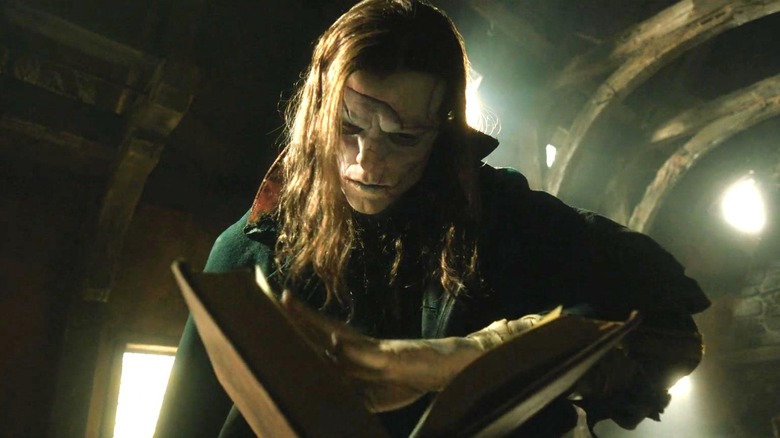
If you're a "Frankenstein" scholar, then you know the Creature is an intelligent, sympathetic being who'd much rather read poetry than terrorize a village. Yet when many people hear "Frankenstein" they think of Universal Horror and a snarling, mindless Monster. (Ignoring that even the James Whale "Frankenstein" films gave Boris Karloff's Creature childish innocence.)
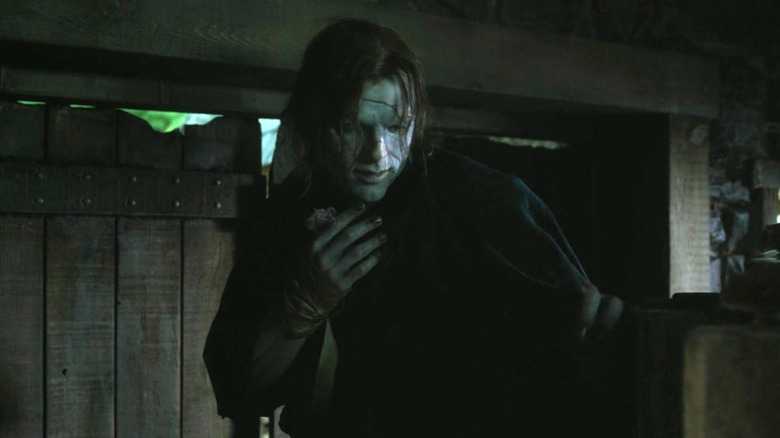
Guillermo del Toro's excellent new "Frankenstein" film, one of the year's best movies, makes the Creature (Jacob Elordi) more sympathetic than ever. Just as del Toro ends his movie with reconciliation of Monster and Maker (Oscar Isaac), he reconciles the novel and past films. The movie opens with the Creature tearing through sailors, but once the Creature tells his tale, those sailors realize he's no true monster. It's the same experience I had as a young man, knowing "Frankenstein" only from the often-duplicated movie iteration, and then learning the truth by reading the novel.
Speaking of reading, del Toro's was not the only "Frankenstein" reimagining I loved this year. The new novel "Once Was Willem" by Mike "M.R." Carey riffs on "Frankenstein," but as dark fantasy, not science fiction. During the 12th century, in small English village of Cosham, young Willem Turling is struck down by fever. His parents make a dark pact with sorcerer Cain Caradoc to bring their boy back. But death leaves its mark; Willem's corpse, reassembled in the chrysalis of a stone grave, walks again with a broad and misshapen body. Rejected by his family and village, the revenant decides he is not Willem Turling, but a new being who once was Willem.
Carey is a talented writer — "The Girl with all the Gifts" is a daring zombie story — but the breezy and fun yet morbid "Once Was Willem" is the most I've enjoyed a book of his yet.
Once Was Willem combines Frankenstein and medieval fantasy
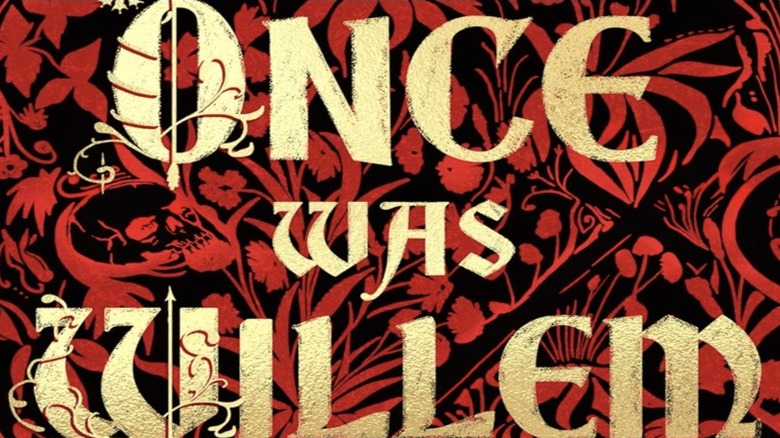
"Once Was Willem" is framed as Willem himself journaling the tale of his undeath, though the story's mood often feels like someone telling you a fairy tale by a campfire. The opening chapter of "Once Was Willem" depicts a medieval fort siege, but the invaders include a bear-ish shapeshifter. Right off, this story is as much fantastical as it is historical. Chapter 15, "Of Morjune, how she would not go to Hell when she was sent," could function as a short horror story-within-a-story, with a complete arc from a witch trial to an eerie haunted house.
The chapter most like "Frankenstein" is Chapter 6, "Which brings me home again to Cosham village." Once-Was-Willem, who is even called a "creature," struggles to speak and is rejected by his birth parents. People run in horror whenever he tries to approach them, even innocently, and he's chased from the village by a pitchfork-wielding mob. Once-Was-Willem leaves his broken father behind, telling him to forgive himself for this calamity sparked by love.
From there, though, "Once Was Willem" becomes not a tragedy or revenge tale like "Frankenstein" is, but an epic adventure. Whereas the Creature was tormented by loneliness, Willem finds peace in the woods. He is kin not only with animals, but also other magical beings in the woods, such as shapeshifting siblings Kel & Anna, and the water spirit Peter Floodfoot.
Like Frankenstein's Creature, Willem comes into conflict with his creator; not his birth father, but Caradoc. The wizard, coveting eternal life, seeks to harvest the children of Cosham and "walk to immortality and omnipotence over their tortured souls." In need of protectors and too poor to hire sellswords, Cosham calls upon the "Monster" they banished.
Once Was Willem begins like Frankenstein, but ends like Lord of the Rings
Carey has endorsed a summary of "Once Was Willem" as "Frankenstein" plus "Howl's Moving Castle," but I think there's another ingredient in this literary recipe: Akira Kurosawa's "Seven Samurai" (or for Western fans, "The Magnificent Seven"). Like that movie, the latter half of "Willem" follows the protectors of a besieged village, laying traps and ambushes. Willem's band even had seven members by the end. As a comic writer, Carey penned an underrated "X-Men" run from 2006 to 2011, and I think his love for those mutants comes through in "Willem." Like the X-Men, Willem's band of seven are supposed "freaks" with great powers, fighting on behalf of those who fear and reject them.
While the optimism and whimsy tip the scales in "Willem," don't think the book is all sunshine. The dominant theme is death, especially the death of children, from Willem himself to Cain's sacrifices to the stillbirth that condemns Morjune, a midwife and healer, as a witch. That's why the Dark Ages setting is so appropriate; this was a period of history where countless children did die all too young. Though Cosham is a God-fearing village, Carey doesn't bind his story to simple Christian theology. He melds the often competing ideas of the afterlife and reincarnation, depicting Hell not as an infernal prison but a möbius strip for souls to begin a new life after one ends.
Carey makes the macabre feel playful, and the inescapable comparison is the work of Neil Gaiman. (Carey even wrote the comic series "Lucifer," a spin-off of Gaiman's "The Sandman.") If recent allegations against Gaiman mean you can't stomach his words anymore, Mike Carey's books — including "Once Was Willem" — might fill that void.