

5 Essential Star Wars Rebels Episodes Everyone Should Watch At Least Once
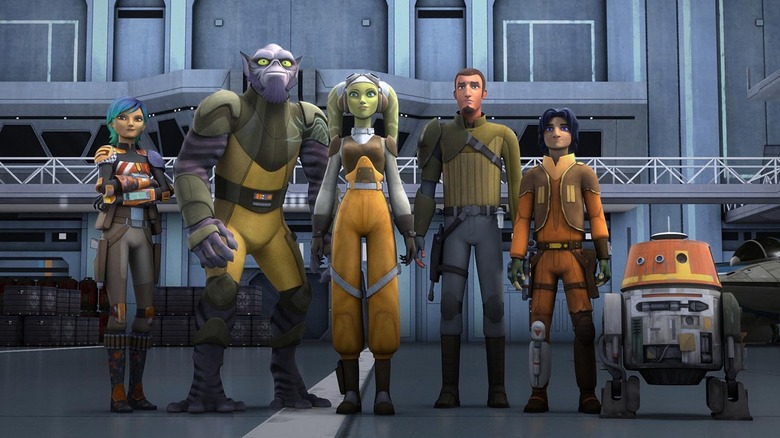
Are the animated "Star Wars" shows more lore-dense and esoteric than the live-action films? Yup! Do they represent some of the best storytelling in a galaxy far, far away? Also yes, doubly so when it comes to "Star Wars Rebels."
Like the Emmy-winning "Andor," "Rebels" moves away from the Skywalkers and their baggage to focus on a ragtag band of plucky freedom fighters who come to play a crucial, if unsung, role in the war against the Galactic Empire five years prior to the original trilogy (or 5 BBY, to be nerdily exact). And while there are plenty of familiar faces on the show, "Rebels" by and large avoids shoehorning in beloved characters for the sake of nostalgia or fan service. If Glup Shitto shows up, it's usually because he's integral to the narrative.
As with other great shows, "Rebels" simply gets better as it goes along. The only drawback to this is that lots of otherwise quality episodes inevitably get left out when you boil the series down to five must-see episodes. For example, season 2, episode 16, "Homecoming," nicely highlights how Twi'lek Rebel Hera Syndulla (Vanessa Marshall) and her father's relationship is strained by their differing approaches to the Rebel cause, while season 3, episode 5, "Hera's Heroes," illustrates precisely what makes "Rebels" Big Bad Grand Admiral Thrawn (Lars Mikkelsen) so unsettling — namely, his ability to weaponize his empathy to harm his enemies. Likewise, the "Rebels" two-part premiere and series finale can go toe-to-toe with many of the live-action "Star Wars" movies, and any episode where Hera's astromech droid Chopper ("Rebels" co-creator Dave Filoni) indulges his chaotic, quasi-homicidal tendencies are a hoot and a half.
So, with those honorable mentions out of the way, here are the episodes that truly speak to what makes "Rebels" special.
The Honorable Ones (season 2, episode 17)
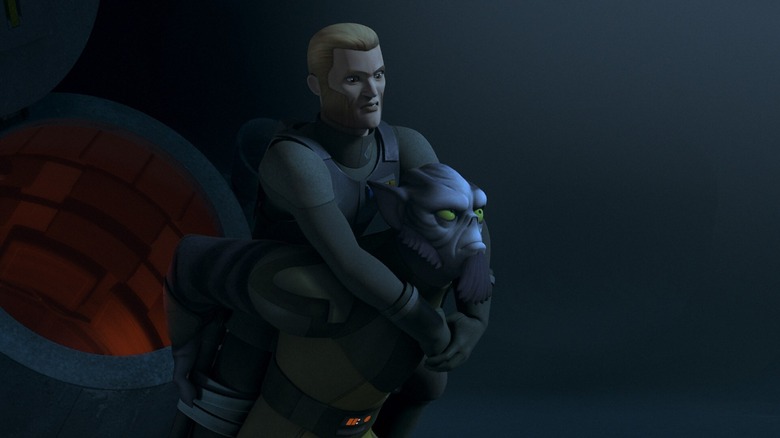
Agent Kallus (David Oyelowo) starts out on "Star Wars Rebels" as your typical nefarious yet borderline incompetent, goose-stepping Imperial for the show's heroes to foil and embarrass over and over. Between the way he looks down his nose at those ranked below him and his comically oversized mutton chops, he's a stuck-up jerk, and watching him get taught one lesson in humility after another is a delight. There's little reason to think he's capable of becoming a better person, either ... until there is.
"Rebels" season 2, episode 17, "The Honorable Ones," follows Kallus and the Lasat Rebel Garazeb "Zeb" Orrelios (Steve Blum) as the pair find themselves stranded together on a desolate, icy moon of the planet Geonosis. (The episode's chilly black-and-blue color palette further emphasizes the severity of their situation.) What ensues is a story in the vein of "Enemy Mine," as Kallus is forced to not only cooperate with one of his sworn enemies to survive but to also acknowledge his own culpability in the Empire's genocide against the Lasats themselves (which he failed to prevent from happening, despite being opposed to it). And while "Rebels" has (not unreasonably) courted controversy for the way it handles Kallus' subsequent redemption arc, the series very much begins his journey to atonement on the right foot.
(And if you thought "Enemy Mine" had a lot of queer romantic subtext, just ask certain "Rebels" fans how they read the whole Zeb-Kallus relationship.)
Twilight of the Apprentice (season 2, episodes 21 and 22)
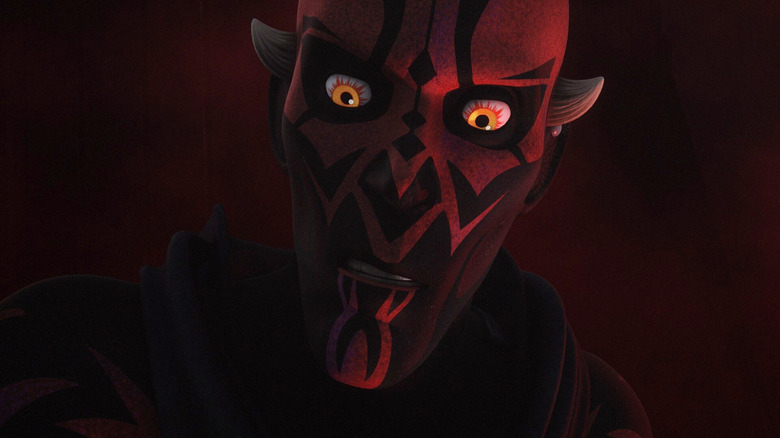
When the animated "Clone Wars" series revealed Darth Maul (Sam Witwer) had survived being cut in half in "Star Wars: Episode I — The Phantom Menace," it didn't just "revive" the Sith Warrior; it also gave him an actual personality. Maul is, essentially, the Charlie Brown of "Star Wars" villains: Every time he's convinced he's found a way to reclaim his lost glory after being left for dead, the universe snatches it away like Lucy picking up the football right before ol' Chuck can kick it.
"Rebels" season 2's two-part finale, "Twilight of the Apprentice," aptly captures Maul's insecurity and desperation to prove himself as he crosses paths with two of the show's leads — Lothal Rebel Ezra Bridger (Taylor Gray) and his Jedi mentor Kanan Jarrus (Freddie Prinze Jr.) — in a mysterious Sith temple on the Sith world Malachor and immediately starts grooming Ezra to become his new apprentice. This theme of student-teacher relationships rears its head to powerful effect in the finale's other major storyline as well, as not-a-Jedi Ahsoka Tano (Ashley Eckstein) is finally forced to confront the terrible truth about the man who trained her when everyone's favorite heavy-breathing Sith lord, Darth Vader (James Earl Jones), shows up on Malachor, too. The pair's resulting confrontation is so emotionally charged and visually captivating that the "Obi-Wan Kenobi" series lifted from it directly, and for good reason.
Trials of the Darksaber (season 3, episode 15)
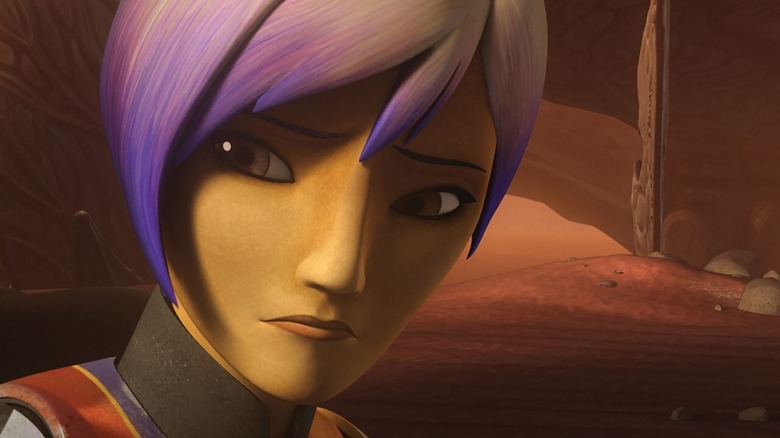
The Darksaber factors heavily into the overarching plot of "The Mandalorian," but it's the animated "Star Wars" shows that really give the ancient Mandalorian relic some emotional weight, especially "Rebels" season 3, episode 15, "Trials of the Darksaber." And while this installment mainly centers on Kanan training his fellow Rebel Sabine Wren (Tiya Sircar) how to wield the eponymous black-bladed lightsaber, this is chiefly an excuse for Kanan to help his Mandalorian compatriot unpack all of that lingering mental trauma she's been holding onto for years.
Sabine, you see, designed weapons as a young student at the Imperial Academy, only for the Empire to turn around and use her work to massacre her own people during its vicious military campaign against Mandalore. The notion of lightsaber sparring as therapy isn't exclusive to "Rebels," of course, but "Trials of the Darksaber" is one of the best examples of a "Star Wars" narrative using action as a vehicle for richer storytelling and character growth. It also gives Sabine more time in the spotlight, all the while inverting the show's typical dynamic by allowing her to lean emotionally on her allies for a change. We even get a brief appearance from the mystical enigma known as the Bendu (Tom Baker), which speaks to the episode's broader message that the line between the darkness and the light is sometimes blurrier than we'd like.
Twin Suns (season 3, episode 20)
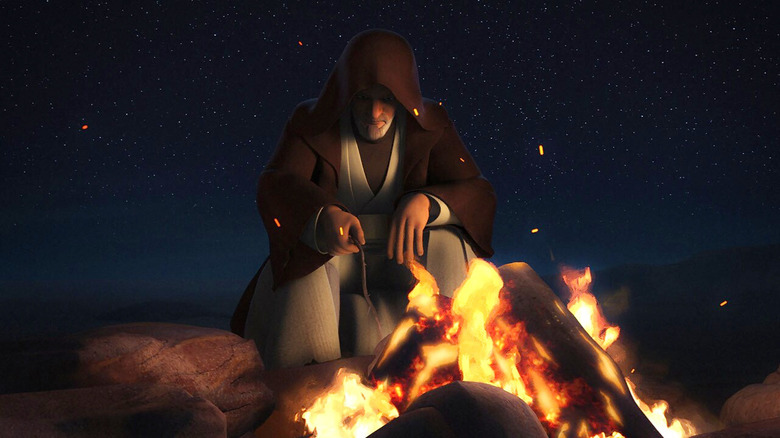
Another crucial element that "Rebels" and "Andor" share in common is that they aren't primarily concerned with "chosen ones" or characters destined to become legends in the "Star Wars" universe. Rather, they offer a reminder that the lives of ordinary individuals matter regardless of whether the history books remember them or their actions have a dramatic, observable impact. One of the more dominant thematic motifs in "Rebels," this concept rises to the surface in season 3, episode 20, "Twin Suns," which itself brings Maul's time on the series to a satisfying and poignant conclusion.
"Twin Suns" follows Ezra as he sneaks away to Tatooine, convinced that it's up to him to track down the long-missing Jedi Obi-Wan Kenobi (Stephen Stanton) and protect him from his old nemesis Maul. Thankfully, though, the episode doesn't try to retcon "Star Wars" canon by revealing that Ezra was secretly Obi-Wan's savior all along; by the time things draw to a close, Ezra is still just some kid who's trying to make the galaxy a better place, and that's all he needs to be. "Twin Suns" is equally compassionate in its treatment of Maul and his final battle with "Kenobi!" (as he's prone to calling "Old Ben"). What their lightsaber duel deliberately lacks in flashiness and fancy choreography, it more than makes up for with its eloquent execution and emotional resonance (with the sharp visual contrast between day and night on Tatooine subtly echoing this clash between the light and the dark).
A World Between Worlds (season 4, episode 13)
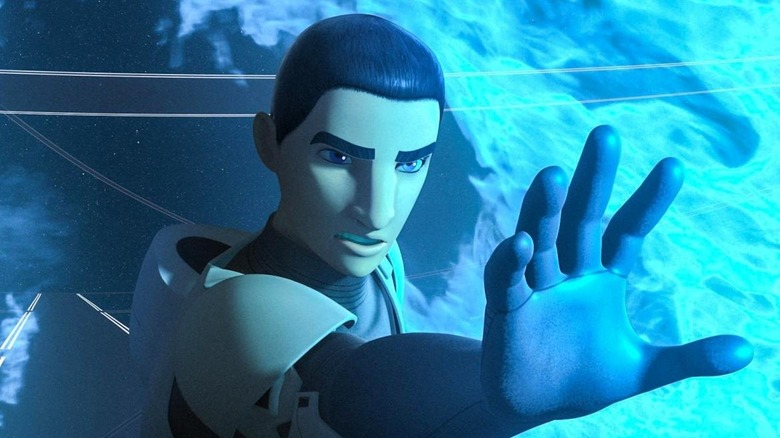
Perhaps the most fascinating wrinkle "Rebels" adds to the mythology of the Force is the World Between Worlds, a Force dimension — rendered as a spellbinding collection of bright, glowing pathways and doors set against the backdrop of a starry void — that links all of time and space together. That, in turn, means that anyone with access to that plane could theoretically reshape history while simultaneously seizing total control of the Force itself. But as high as the stakes are when Ezra unexpectedly finds himself in a fight to stop Vader's boss, Darth Sidious (Ian McDiarmid), from gaining access to the World Between Worlds in season 4, episode 13, "A World Between Worlds," the episode never loses sight of the much more personal conflict at hand.
As much as Sidious (better known as Emperor Palpatine) is determined to use the realm for his own malicious purposes, Ezra is just as tempted to take advantage of the World Between Worlds to undo a tragedy from his own past (one that shall go unspoiled here). And though we do get some timey-wimey hijinks that explain how a character managed to get out of a seemingly inescapable situation in a previous episode, "A World Between Words" is, at its heart, all about the importance of accepting death as a natural part of life and being able to find peace after losing a loved one. Evil space wizards and trippy Force planes aside, that's about as universal as stories get.