

Pluribus Episode 6 Lets A Surprising Cameo Deliver A Shocking Moment
This article contains spoilers for "Pluribus" episode 6.
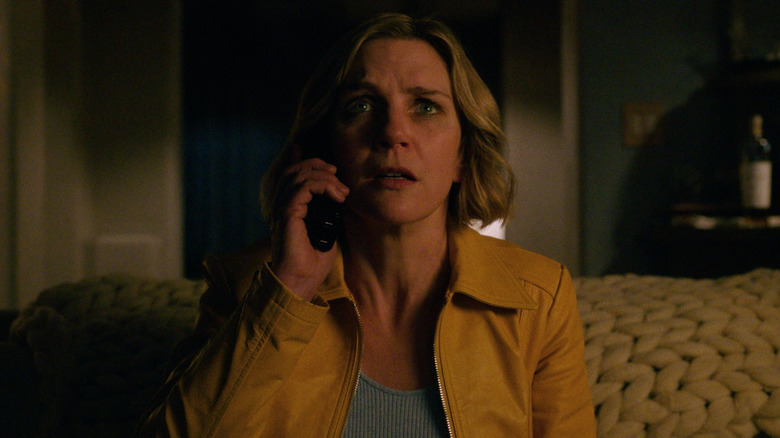
As an effervescent nanny once sang, "a spoonful of sugar helps the medicine go down in a most delightful way." It's an adage that everyone, "Mary Poppins" fans or not, tries to conform to when delivering bad news. For Carol Sturka (Rhea Seehorn) in Apple TV's "Pluribus," life has been one bit of bad news after the other ever since a mysterious extraterrestrial virus transformed the majority of people on Earth into a single hive mind. Carol already has a personal grudge against these Others, seeing as how their joining process was instrumental in the death of Carol's manager and partner, Helen (Miriam Shor). While the Others swear up and down that this death and others like it were unintentional and unavoidable, Carol hasn't been so quick to take the hive at their word. Not only has she been racking her brain for ways to try and combat and reverse the virus, but she's also been hoping to prove that the Others are not as benign as they appear.
In episode 6, Carol has finally found her smoking gun, and it's a doozy: the hive mind folks are literally consuming dead bodies, turning them into a consumable juice. As per the series' approach thus far, this revelation is nuanced and multifaceted. For Carol, it's proof positive that the Others are unethical, inhumane monsters who must be stopped, while for other human survivors like Diabaté (Samba Schutte), it's an uncomfortable truth which isn't so easily condemned, given the food shortages which are occurring due to the Others' refusal to eat anything living. Whether the worse news is the shortages or the Others' juice solution, "Pluribus" gives this shocking information to an actor whose cameo is highly surprising, soothing, and darkly hilarious: John Cena.
John Cena's cameo is a great example of Vince Gilligan's dark comedy

Thanks to the dramatic heights and emotional depths both "Breaking Bad" and "Better Call Saul" went to, showrunner Vince Gilligan is generally viewed as an expert at serialized drama. While this is undoubtedly true, his reputation based on those two masterful series has changed from where it was when he began work on "Breaking Bad." At that point, he was best known as one of the staff writers of "The X-Files," and his work on that show tended toward the darkly comedic. Episodes like "Bad Blood," "Christmas Carol," and "Small Potatoes," which he wrote or co-wrote, stood out from the regular "monster of the week" and "mythology" pack. Thanks to this, he co-created the more comedic (and short-lived) spin-off series, "The Lone Gunmen." His film scripts, like "Home Fries" and "Hancock," all had a humorous bent to them, too.
This is why, when "Breaking Bad" was a new show in its first season, the series was marketed not as a gritty crime drama that it later came to be, but rather as a twisted comedy. The primary image in its marketing wasn't Bryan Cranston as the dark Heisenberg, but rather as a bewildered Walter White in his underwear. As such, John Cena's cameo in "HDP" feels like a throwback to Gilligan's comedic roots. The episode, written by Vera Blasi, is certainly not the first instance of dark comedy in "Pluribus" thus far. After all, Carol casually asking the Others if she might procure a nuclear bomb definitely counts, if nothing else. Yet the cameo is notable for its darkly comedic juxtaposition of Cena's affable patter with the harsh explanation of what the Others are doing with all those human remains.
'Pluribus' is the latest example of John Cena's comedic prowess
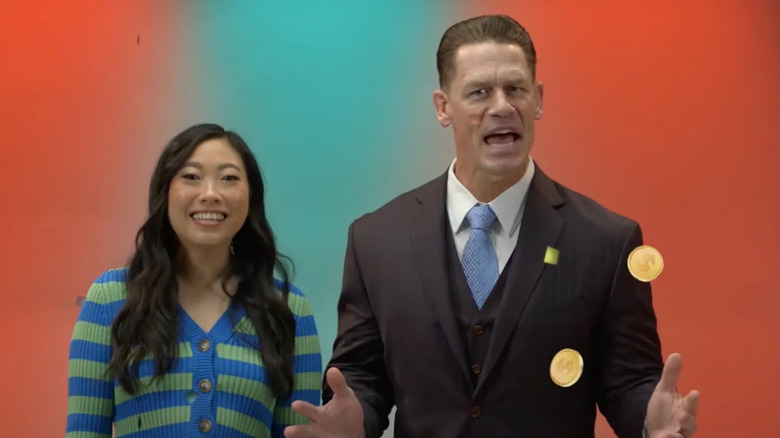
The choice for "HDP" to use John Cena, of all possible celebrities, is a canny one. It's the latest example of what a natural Cena is at comedy. The actor is able to take his natural charm, handsome good looks, and gentlemanly politeness and twist them just the right amount to make them simultaneously wholesome and wicked. His delivery isn't deadpan per se, but he understands how playing dark material as straight as possible allows the contrast to come through the most. Additionally, his natural rhythms as an actor fit super well with the generally upbeat, cheerful attitude of the Others. Thus, while it's shocking to see Cena show up at all, it instantly feels right to see him be taken over, too.
It's this aspect of having Cena play "himself" that gives the cameo its extra bite. Except for the real mayor of Albuquerque, Tim Keller, showing up as himself in the fourth episode (and this hidden "Better Call Saul" prank), Cena is the first major celebrity to appear on the series, and the fact that he's not just one of the most recognizable but one of the most enjoyable actors working today gives the appearance extra weight. It's not just a connection the series has to our real world, but its uncanny valley element makes the show feel that much stranger and uncomfortable. Carol may indeed be a character we may not want to root for, given her volatility, and yet the distressing outlandishness of the world she finds herself in, combined with decades of alien invasion narratives in our culture, only makes her cause more understandable. For now, we'll just have to see what else shows up in the rest of the first season of "Pluribus."