

Decades Before Before Sam Raimi, Spider-Man Conquered European Theaters
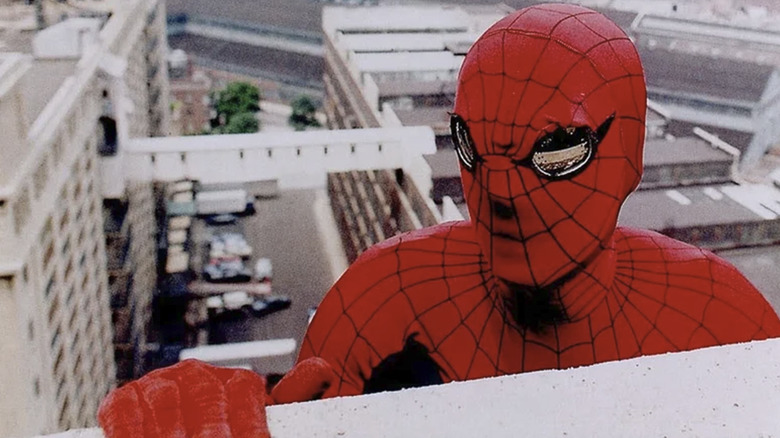
When it comes to the live-action Spider-Men, many people only know of the most recent three: Tobey Maguire in the Sam Raimi trilogy, Andrew Garfield in the Marc Webb movies, and Tom Holland in the Marvel Cinematic Universe. But there was once another live-action Spider-Man, played by Nicholas Hammond in the late 1970s. This iteration of the web-slinger was part of the CBS TV series "The Amazing Spider-Man," which ran for two seasons before being canceled in spite of its decent ratings.
Although the TV show's run was largely limited to the United States, the pilot episode was repackaged and released by Columbia Pictures as a movie (simply titled "Spider-Man") that performed well at the European box office. In fact, the film was popular enough that the studio pulled the same trick two more times. In May 1978, Columbia released "Spider-Man Strikes Back," which combined a two-episode story from the series. Then, three years later, the studio unveiled "Spider-Man: The Dragon's Challenge," which once again took two of the TV show's episodes and stitched them together.
As Hammond explained to the St. Petersburg Times in 1978, the first two episodes post-pilot were "shot with feature release in mind." He also noted that the first "Spider-Man" movie, which had already been released in Europe by that point, was performing strongly in England. This, in turn, resulted in a slight difference in audience attitudes 20 years later when Raimi's "Spider-Man" hit theaters; for many Americans, this was their first time seeing Spidey on the big screen, whereas for certain European viewers, it was their fourth.
The world wasn't ready for live-action Spider-Man in the '70s
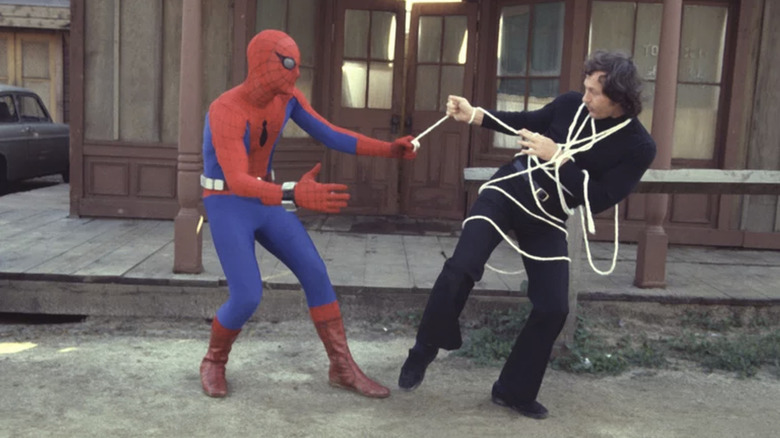
Whether as a movie or a TV show, the '70s "Amazing Spider-Man" failed to impress critics. (Stan Lee wasn't a fan of it, either.) The series was widely regarded as being cheesy, complete with poor writing and even worse visual effects. Most notably, it didn't perform well with adult viewers, who either thought the show was for nerds or were mad at it for being unfaithful to the comics. It was mainly kids who watched this series, but at the time, CBS was more focused on growing its adult audience.
Perhaps the biggest issue with the series was that much of the fun of Spider-Man — like his ability to swing through Manhattan using his webs — was difficult to pull off cheaply in the '70s. And considering that even Raimi's "Spider-Man" struggled to make the superhero swinging from building to building look realistic (something Steven Spielberg actually liked), the '70s version didn't stand a chance. Although let's be real: If you can't get at least some enjoyment from watching fight scenes like this, there's something wrong with you:
Mind you, the show tried its best to make its action scenes as riveting as possible. As Hammond explained in '78, "Every stunt and effect and fight shown on the screen is absolutely real. There's no trick photography, no use miniatures, no horizontal photography. When you see a man 35 stories up, there's a man 35 stories up." There's no doubt that a ton of work and passion went into making this series. Unfortunately, it just wasn't enough to keep CBS on board.