

How Warner Bros. Made Sure Audiences Knew Christopher Reeve's Superman Was Something Special
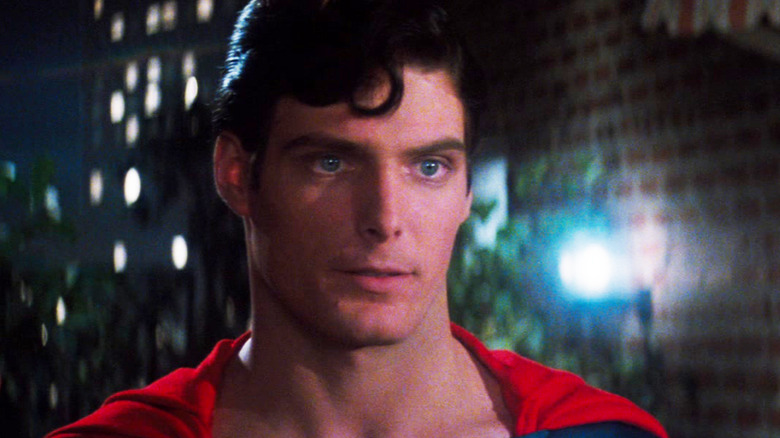
It's strange to imagine a culture wherein a superhero movie has to justify its existence to the masses. Sure, given Marvel's post-"Avengers: Endgame" woes and the fact superhero movies are struggling internationally, such a state of affairs isn't really all that hard to envisage. Back in 1978, however, Warner Bros. had to deal with the opposite of superhero fatigue. The studio was about to unleash Richard Donner's "Superman" on a populace whose only real exposure to superheroes had been via lighthearted TV series. The generation that grew up reading comics knew there was magic in the pages of their Marvel and DC books, but in terms of pop culture, superheroes were nothing like the reliably bankable legends they are today.
This posed a challenge for the Warner Bros. marketing team when preparing "Superman" for its December 1978 debut. As Andrew Fogelson, vice president in charge of Warner Bros.' worldwide promotion of the movie, told the New York Times at the time, "In the earliest stages, we began thinking about what we were going to tell people. We had to guess how a simple marquee — 'Here Comes Superman' — was going to predispose them." According to Fogelson, Warners thought such an announcement would be received positively, but the studio had to simultaneously excite and inform. "We had to be clear from the beginning that this wasn't an animated film," he explained. "It wasn't a remake of the [1950s] television serial. We had to let people know this was a brand new bit of business around what has to be one of the largest folk heroes in American history."
How did they accomplish that goal? With a marketing campaign that not only let people know what they were in for, but which provided a blueprint for blockbuster marketing that's still followed today.
How do you sell an unknown star as Superman?
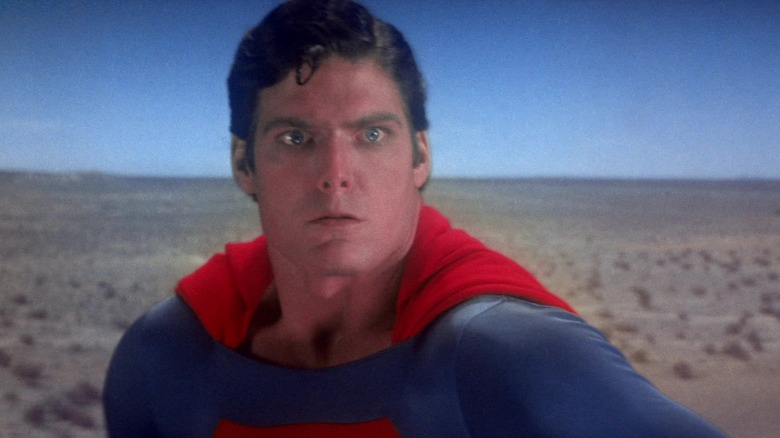
"Superman" starred Christopher Reeve, a man whose portrayal of the Kryptonian is yet to be bested. Per the NYT's December 1978 report, Reeve was cast as Superman because he was a relative unknown compared to other hopefuls such as Robert Redford and, strangely, Neil Diamond. But the Juilliard-grad embodied the Man of Steel regardless. In fact, Reeve embodied every aspect of the character, from Clark Kent — whose diffident manner he based on a Cary Grant performance — to Superman/Kal-El himself. To this day, Reeve remains the gold standard, even in the wake of James Gunn's charming crowd-pleaser "Superman," which similarly starred a Juilliard alum in David Corenswet. As endearingly dorky as Corenswet is, even he is indebted to Reeve, whose performance has proved unbeatable time after time.
Of course, casting an unknown in the lead came with obvious downsides for Warner Bros.' marketing team, who were already up against it. The solution was to add some other big names to the mix. Richard Donner, who had overseen what proved to be a breakout hit for the director with 1976's "The Omen," was already calling the shots, but Marlon Brando's involvement took things to a new level. Brando added serious gravitas, as did composer John Williams, who was coming off the success of his "Star Wars" score. On top of all that, Donner pushed himself and his team to create some groundbreaking special effects, most notably in terms of the flight scenes. The "Superman" crew initially struggled to find a way to make Reeve fly. But after Donner dedicated an entire unit to making such a feat look realistic, the flight scenes not only became some of the best in the movie but also gave the marketing team something extra to sell.
Superman swooped in on a marketing blitz
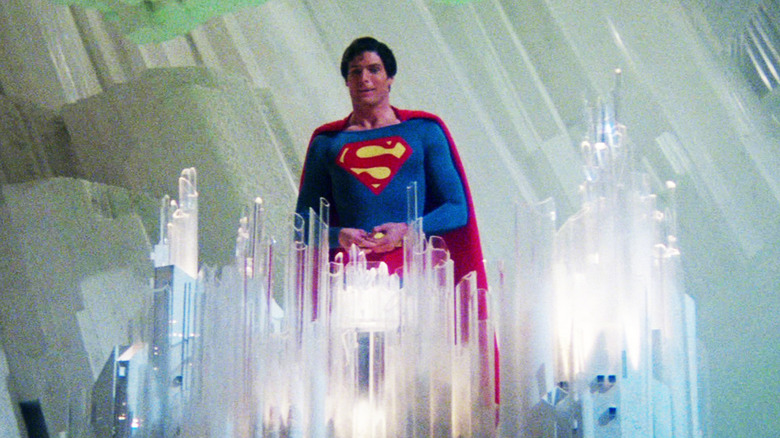
After Richard Donner and his crew's cutting edge special effects made Christopher Reeve's Superman fly, Warner Bros. had something more than star power with which to sell its blockbuster. The studio made the entire tagline of the film "You'll believe a man can fly," and with Marlon Brando being given top-billing alongside Lex Luthor actor Gene Hackman, viewers were very much willing to take their seats to witness such a spectacle. That same tagline also reminded audiences that this was very much not an animated feature.
Elsewhere, TV advertisements eschewed static titles in favor of more dramatic, live-action imagery. According to the NYT's December 1978 report, Andrew Fogelson was pleased with a 30‐second TV spot that, similar to the film's actual opening title sequence, showed the actors' names sweeping through clouds. "It's clearly alive," Fogelson noted, "and not an animation. It looks big and important and spectacular and special. That's the kind of approach we tried to take with everything [we] did."
Meanwhile, a soundtrack album was produced alongside eight paperback novels. What's more, the "Superman" branding was plastered on products from more than 100 different manufacturers. As the NYT noted, with "the super‐grossers" things had changed for the industry. Brando's "The Godfather" had kicked off a '70s trend that continues to this day, whereby studios race to create the next mega-hit, and the marketing is a huge part of that. "Superman" very much continued and even magnified that trend, which was then taken to a whole new level by "Batman" and the summer of "Bat-Mania" in 1989. By that point, though, thanks to Donner and Warner Bros., audiences weren't completely bemused by the idea of a blockbuster superhero movie.