

Working Around Network Censors Gave Batman: The Animated Series An Emmy-Winning Episode
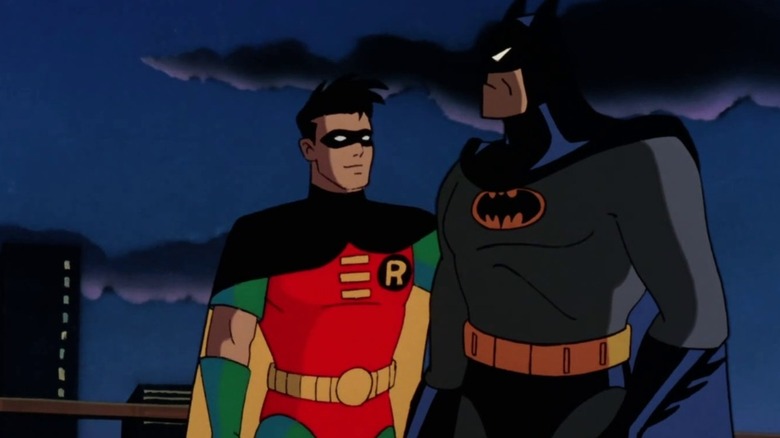
"Batman: The Animated Series" delighted comic fans and Emmy voters, too. In 1993, the series won a Daytime Emmy for Outstanding Writing in an Animated Program for "Heart of Ice," the episode which reinvented the campy Mr. Freeze into a tragic villain. The same year, the series won a Primetime Emmy for Outstanding Animated Program. The winning episode? "Robin's Reckoning, Part I."
The series starred an experienced Batman (Kevin Conroy) and complemented that with a college-aged Dick Grayson (Loren Lester) who had been Robin for years. "Robin's Reckoning" told how Dick had been born into a family of circus acrobats who were murdered by a sabotaged rope. Bruce Wayne took the newly orphaned Dick in, and the rest is history.
It's an episode brimming with drama and pathos, one that gave Robin depth beyond being just a Boy Wonder. There was just one problem with the story: "Batman: The Animated Series" was still a kids show that couldn't explicitly kill characters. In Vulture's oral history of "Batman: The Animated Series," series co-creator Eric Radomski explained:
"When we were looking back at Robin's parents at the circus, when the death happened, we knew they wouldn't let us show it. We couldn't even show the result of it. We just had to get the emotion across that his parents definitively died."
The episode got around this as best it could. As Dick and his parents perform their acrobatics act, the camera cuts back and forth to the rope holding them up gradually snapping. As Mrs. Grayson leaps for her husband to catch her, there's a close-up of the rope giving way, a shadowed shot of the Flying Graysons swinging out of frame on said rope, and then the snapped rope coming back into frame as the circus audience gasps in horror.
Batman: The Animated Series had to get creative with its violence
"Almost every episode, we would get a huge list of things we couldn't do. They were constantly trying to pull back on the amount of violence, which I get. I totally understand that. But, at the same time, it was really frustrating," Radomski's co-creator Bruce Timm added to Vulture. "We wanted to raise the stakes and keep the danger real. That's really hard to do if you a) can't ever kill anybody, and b) can't even get into a serious fistfight."
That meant "Batman" tried to have it both ways. As Conroy put it to Vulture, "Whenever Batman beats anyone up or throws them off a cliff and they hit the ground, there's always what's called the 'stay-alive moan' after so you know the character's not actually dead."
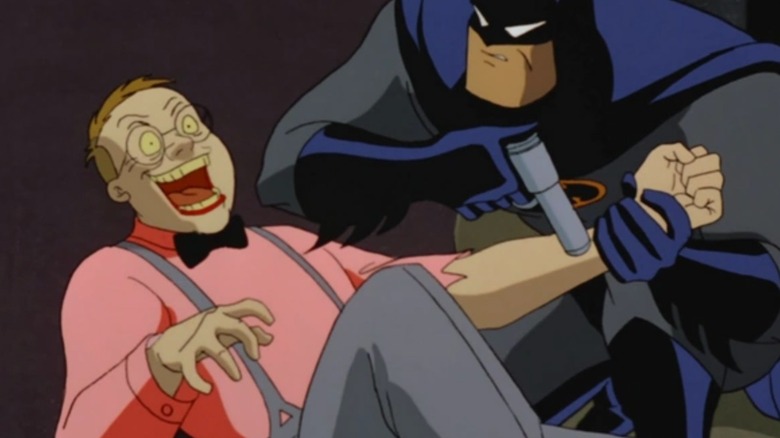
Take "The Laughing Fish," adapted from "Detective Comics" #475-476 by Steve Englehart & Marshall Rogers. In the story, the Joker tries to place a copyright on fish poisoned with his Joker Venom. When copyright office clerk G. Carl Francis says no, the Joker poisons him. In the comic, Francis explicitly dies from this. In the show, Batman inoculates him and assures everyone (including the kids watching) that Francis will "be fine once the antitoxin kicks in."
Some episodes of "Batman" never even got past the censors, like one featuring vampire villainess Nocturna. Limitations can also engender more creative storytelling, though. Take "Dreams in Darkness," where Batman is exposed to the Scarecrow's Fear Toxin and imagines his parents' deaths. The episode couldn't actually show them getting shot, so instead the Waynes disappear down a dark tunnel that morphs into the barrel of a giant gun. It may be a compromise, but it's one of the most evocative depictions of the Waynes' murder.
Robin's Reckoning is one of Batman: The Animated Series' finest hours
As for "Robin's Reckoning," Radomski gave a lot of credit to composer Shirley Walker, whose score absolutely elevated the drama and suspense of the Graysons' death. When the cut rope enters the frame, there's a scare chord that'll make you jump as well as anything Bernard Herrmann ever wrote.
"I think we, as a team, hit a home run with 'Robin's Reckoning,'" said Radomski to Vulture. "It was the height of what we could do as a dramatic animated show and still be entertaining."
"Robin's Reckoning" is indeed one of the best "Batman" episodes. It earns its two-part length, because Robin's origin is only half the story. In the present, he comes face-to-face with Tony Zucco (Thomas F. Wilson), the gangster who killed his parents after the circus refused his extortion attempts.
The episode shows how Batman taking Dick under his wing was much about saving himself as it was saving the boy. When he first adopts Dick, Bruce is dead-set on tracking down Zucco. At Alfred's encouragement, though, he realizes Dick needs a friend, not revenge ("Isn't that what you needed, sir?"). The episode ends with the moment their relationship really begins, when Bruce confides in Dick how he shares the same sorrow and irrational guilt about his parents' murder.
That emotion comes back at the end of "Robin's Reckoning, Part II." Batman admits he tried to ward Robin off of chasing Zucco because he was afraid the fiend would take Robin away, too. The dialogue still has to dance around the topic of death, but that doesn't temper the power of the scene. Whether you read Batman and Robin's bond as brotherly or as father-and-son, "Robin's Reckoning" crafts an exemplary episode out of it.