

Why George Lucas Decided To 'Forget Science' When Creating Star Wars
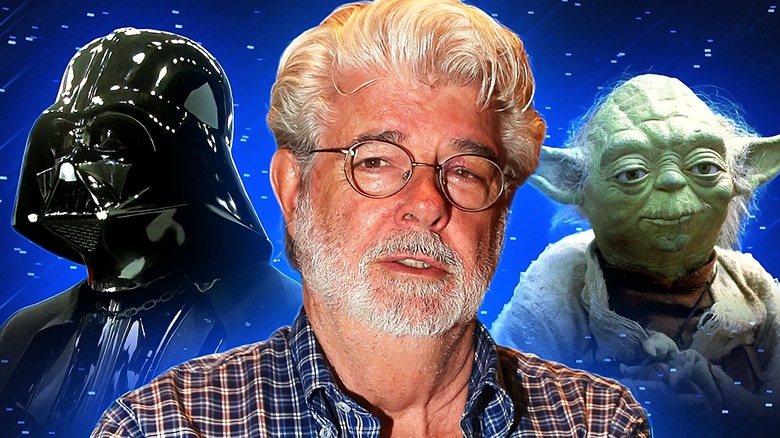
George Lucas made some of the smartest and most important decisions in the history of cinema, like keeping the merch rights for "Star Wars." When it comes to creative decisions, one of the biggest made with the original "Star Wars" was starting the film with a simple "A long, long time ago in a galaxy far, far away ..."
That phrase alone separated "Star Wars" from every other sci-fi movie out there, because it sold the story as more of a fairy tale, a fantasy set in space. By the time the audience is introduced to a princess, a wizard, and an emperor, they already know this is far from "Star Trek" or "2001: A Space Odyssey."
In an interview with Rolling Stone shortly after the release of the first "Star Wars," it was confirmed that phrase came about in no small part due to Lucas having a problem. "I was afraid that science-fiction buffs and everybody would say things like, 'You know there's no sound in outer space,'" Lucas said. "I just wanted to forget science. That would take care of itself."
As Lucas put it, he was afraid of the sci-fi connection because there already was a sci-fi movie he knew he couldn't surpass. "Stanley Kubrick made the ultimate science-fiction movie and it is going to be very hard for somebody to come along and make a better movie, as far as I'm concerned," Lucas said, referring to "2001: A Space Odyssey," which he long considered the better sci-fi movie than his own. "I didn't want to make a 2001, I wanted to make a space fantasy that was more in the genre of Edgar Rice Burroughs; that whole other end of space fantasy that was there before science took it over in the Fifties."
It's not about accuracy, but consistency
As George Lucas put it, the atomic bomb caused a wave of speculative fiction about what would happen under different future scenarios. "I think speculative fiction is very valid but they forgot the fairy tales and the dragons and Tolkien and all the real heroes," Lucas said. This makes sense, considering how much closer Lucas' work on the "Star Wars" universe is to J. R. R. Tolkien than, say, Gene Roddenberry. The prequels, after all, came about because of Lucas' extensive private worldbuilding, for example.
George Lucas' approach to "Star Wars" is not about treating it like hard sci-fi, or even caring about science. Instead, as he once told the Boston Globe, it's about internal logic and consistency. It's not about whether something is supposed to work the way it does in the movies, but about making sure it works the same way all the time.
"Once I designed the science and the physics of the world I was in, I had to stick with that — I couldn't suddenly decide to change it," Lucas said. "That's against the rules of literature. But I kept away from certain things, like teleporting. I didn't want it to be like 'Star Trek' so I said, 'Well, I'm not going to have teleporting in my world.' That's a science-fiction given in television for a reason."
When asked about contradicting scientific reality with things like explosions in space that make noise, Lucas is clear and simple — who cares about logic when you can have fun? "Those are the conceits you do for poetic reasons because you want it to have a visceral experience," Lucas added. "I was telling a story. I wasn't doing a documentary on science."