

Guy Pearce's Gory '90s Horror Western Movie Deserved Better At The Box Office
One of the enduring American monster myths is the Wendigo or the forest spirit that possesses and compels men to become cannibals. Originally a myth of the Algonquian peoples, the Wendigo has become a monster of comic books, horror films, and more, like Stephen King's chilling novel "Pet Sematary."
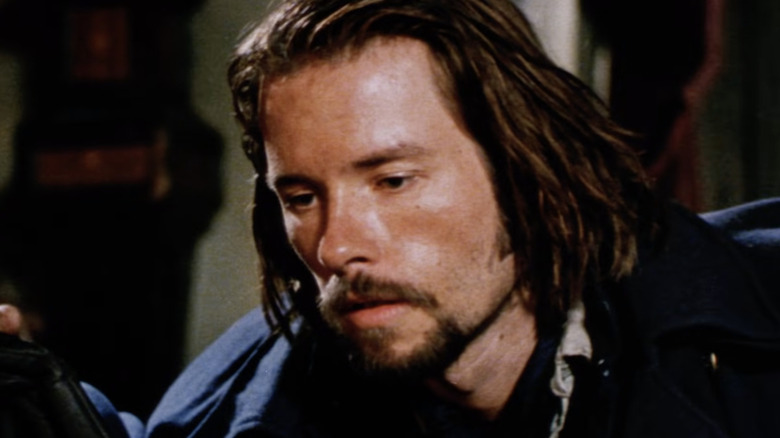
Possibly the strangest Wendigo movie is the 1999 horror western comedy "Ravenous," inspired by real tales of 19th century cannibalism on the frontier like the Donner Party. During the Mexican–American War, Lieutenant John Boyd (Guy Pearce) plays dead during battle. Hidden among a cart of deceased soldiers, Boyd takes an enemy fort. A hero but also a coward, Boyd is then reassigned to a remote outpost in the Sierra Nevada mountains.
Curiously, during Boyd's seizure of the fort, he seemed to gain strength when the blood of the dead dripped down onto his tongue. In that moment, Boyd became an unknowing Wendigo, acquiring the strength of the men whose blood he drank — and he's not the only one on the mountain. A traveler named F.W. Colqhoun (Robert Carlyle) shows up at the fort, claiming to be the survivor of a band of wagon travelers killed and cannibalized by their guide, one Colonel Ives. But "Colqhoun" is Ives and, seizing control of the camp, plots to turn it into a cannibal colony. He recognizes Boyd as a seeming kindred spirit, and the movie becomes a test of whether Boyd will succumb to Ives' pressure and his own Wendigo hunger.
"Ravenous" was a box office bomb in its day, grossing $2 million against a $12 million budget, and it received largely underwhelmed or confounded reviews. But don't take that as a mark against the movie, which has a following to this day. (Any "Yellowjackets" fan should make watching "Ravenous" a priority.)
Ravenous is great in spite of its messiness
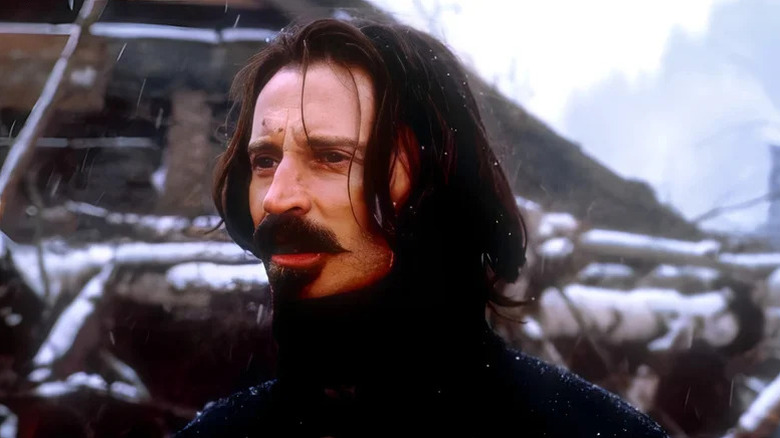
For "Ravenous" to work, Boyd's temptation needs to feel real. When you've got someone as charismatic as Robert Carlyle playing Ives, it sure does. That performance isn't the only way that Carlyle saved the movie.
"Ravenous" had a tumultuous production, and Guy Pearce has called "Ravenous" his worst experience shooting a movie. The film's original director Milcho Manchevski was fired mid-filming with 20th Century Fox moving to replace him with "Home Alone 3" director Raja Gosnell. The cast rejected that, and so Carlyle brought in director Antonia Bird, who he'd worked with on the 1997 crime film "Face." Bird is the credited director of "Ravenous," but was she able to wrangle the mess she'd inherited?
Even a "Ravenous" fan will admit the movie is, tonally, all over the place. After a scene of Ives revealing his true murderous self, the movie breaks out into a chase scene with comical banjo music. If you'll pardon the pun, "Ravenous" bites off a lot and tests how much it's capable of chewing. But that strangeness is a strength, as there's no other movie quite like "Ravenous."
In a 2015 retrospective review for Rolling Stone, critic David Ehrlich showed the kind of praise that has earned "Ravenous" a fanbase. Ehrlich complimented its unique tonal recipe and how, through its setting, it equates manifest destiny colonialism with literal cannibalism... while conceding those qualities are likely what turned off audiences in 1999.
Considering the 1990s saw Anthony Hopkins make Hannibal Lecter into a cinematic icon on the heels "The Silence of the Lambs," I can see why studio execs would invest in cannibal horror. But "Ravenous" was just too weird a movie to ever be a massive hit, even though it's found its supporters with time.