

Blade Runner 2099 Has A Subtle Reference To Ridley Scott's Alien Franchise

Ever since folks (including, presumably, Sir Ridley Scott) took a look at both "Alien" and "Blade Runner" and thought "Hmm, both of these films involve artificial humans...," the two franchises and their respective worlds have been latently linked. To be sure, the relationship between the pair has never reached the stage of things like "Alien vs. Predator" or "Predator: Badlands," in which the "Alien" and "Predator" franchises explicitly cross over. Yet, there have been clues to "Alien" and "Blade Runner" sharing a universe since the latter film was released.
In the original "Blade Runner," for example, Scott re-used a monitor graphic from "Alien" in one insert shot, causing folks to speculate on a potential shared universe. In the intervening years, Scott has subtly encouraged the connection as well. In fact, deep within the special features on the home media release of "Prometheus," an association was implied in an Easter egg audio log entry by the character of Peter Weyland (Guy Pearce), which obliquely refers to the Tyrell Corporation.
Now, though actual crossover has yet to take place, the relationship between the franchises continues apace with the release of this month's "Blade Runner 2099." It does so in a very clever, unexpected way, too, and not with the hiding of some other small Easter egg in the series' numerous environments and vehicles. (Which is not to say one doesn't exist, so keep hunting, hunters!)
Instead, the "Alien" reference in "Blade Runner 2099" is subtle even while being put right in your face. Literally, as it concerns the hood device which the Replicant Blade Runners use to subdue their human prey. This device seems like a gnarly, fascistic element on the surface, but its anatomy and deployment heavily recalls the facehugger from "Alien."
Blade Runner 2099 has its own version of the facehugger
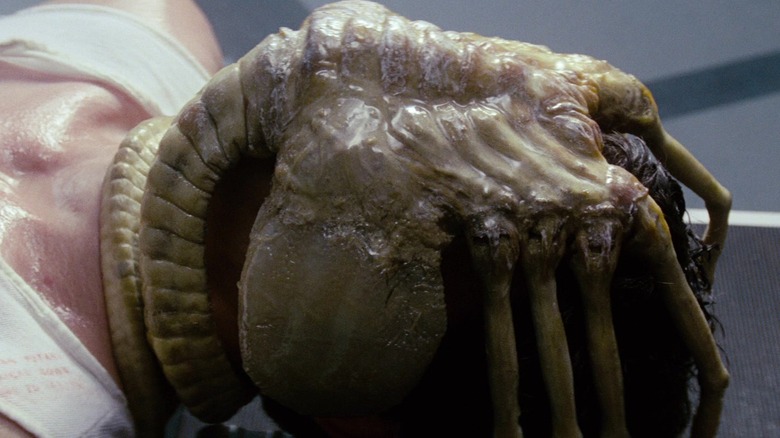
Although the signature scene from Ridley Scott's "Alien" is the chestburster sequence, the earlier attack by a facehugger leaping out of a Xenomorph egg has to be a close second. One could even argue that these moments, in tandem, represent the breakout moment of Ridley Scott's directing career. And while it's clear if it was showrunner Silka Luisa or someone else who decided to include a nod to the facehugger (like Scott, who's an executive producer on the series), the aforementioned "Blade Runner 2099" device is a devilishly clever callback that which fits perfectly within the show's world while doubling as a sly wink to Scott's past.
In "Blade Runner 2099," the Replicant uprising has already come and gone, leaving the remaining illegal (and/or resistant) humans on Earth at the mercy of Replicant Blade Runners. But where human Blade Runners typically "retired" illegal Replicants on sight, Replicant Blade Runners tend to capture humans alive first. To do so, they fit them with a hood device that makes the human unable to see or speak, the latter thanks to a tube instantly forced down their throat, slowly feeding them nutrients during their capture.
This, plus the way the Blade Runners violently slap on the hood and press the tube button, seems to deliberately recall how the facehugger operates. It's a great little touch that helps the series blur the lines of morality, making the Replicants simultaneously more humane than the human Blade Runners while being more violent and dehumanizing. So, in lieu of an eventual (?) proper "Blade Runner" and "Alien" crossover, for now, this is an effective way to ensure these two franchises continue to share so much thematic DNA.
"Blade Runner 2099" is now available to stream on Prime Video.