

If You Liked Colleen Hoover's Verity, Watch Dakota Johnson's Acclaimed 2025 Movie Next
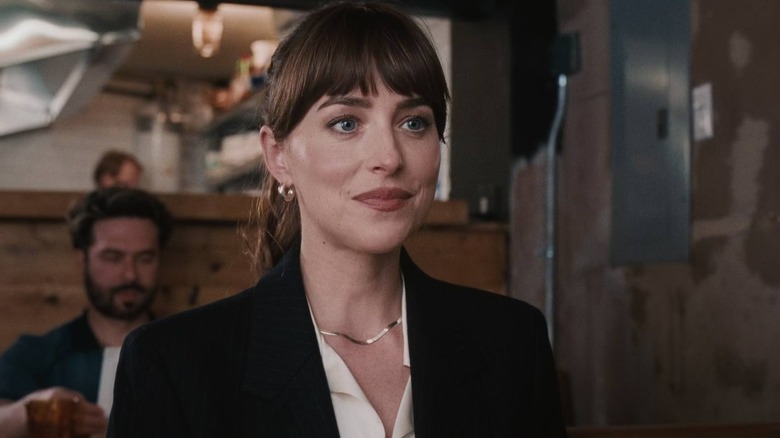
If you liked seeing Dakota Johnson starring in a twisted psychosexual drama like "Verity," which is based on the novel by Colleen Hoover, you might want to check out the more adult romantic drama "Materialists," Celine Song's acidic essay on modern dating from 2025. /Film's Bill Bria said in his review of "Materialists" that it was structured like a typical rom-com, but more heartfelt, full of yearning and depth.
More than anything, though, "Materialists" deals with a deeply cynical approach to romance, just as the title would lead you to believe. It's about how modern matchmaking has become a painfully specialized industry because modern adults have become all too fixated on the superficial qualities — and the earning power — of their potential mates. Johnson plays a cold-hearted matchmaker-for-the-rich named Lucy who has trouble weaning her male clients off of the idea of dating younger women exclusively. The movie itself seems to wince whenever one of Lucy's clients says they desire a woman who is "fit"; those characters might as well be yelling "no fat chicks."
Over the course of the film, Lucy finds herself torn between two potential boyfriends who have both appeared — or reappeared — in her life. On the one hand, she can pursue Harry (Pedro Pascal), an unbearably handsome, unfathomably rich, and suitably tall man who ticks all the boxes on the average dating profile requirement list. On the other hand, she has reconnected with her ex-boyfriend John (Chris Evans), a struggling actor who was always disorganized and never wealthy, but who loved her deeply. Does Lucy choose a life of poverty undergirded by true love, or does she follow her more cutthroat, materialistic instincts, and pursue the wealthy man who can give her a life of luxury?
Materialists addresses the shallowness of modern dating

For long portions of "Materialists," Lucy's choice seems obvious. Harry may not have the same kind of passion as John, but he is definitely interested in Lucy, and he is happy to share his wealth. There is a coldness, however, to his well-moneyed lifestyle, and something vaguely transactional about his love affair. She also becomes startled when she learns a secret about Harry that we won't spoil here. She begins to question if her attraction to him is genuine, or if it just checks the right boxes on a typical dating profile.
As "Materialists" unspools, however, it begins to skew away from the acidic nature of its opening act and begins strolling toward a drama about romantic truthfulness. Lucy is also thrown for a loop when she unwittingly matches one of her long-single clients Sophie (Zoë Winters) with a man who sexually assaults Sophie. Lucy subsequently doubts her every romantic instinct, and a portion of "Materialists" becomes about Lucy trying to reach out to Sophie to make amends. Perhaps she can mitigate her bad romantic instincts by being a genuine friend to this woman.
The ultimate answer is perhaps a little treacly, but Lucy finds herself drawn back to John. The pair had previously broken up over his incapacity for amassing wealth and her frustrations with the boring everyday financial struggles they went through. Now, however, she is beginning to appreciate the nature of human connection, and John looks more and more romantically alluring.
Of course, one could argue that Dakota Johnson, in being torn between Chris Evans and Pedro Pascal, is hardly in an unenviable place. We should all be so lucky to have two devastatingly handsome movie stars equally eager to court us.
What did critics think of Materialists?

"Materialists" was a pretty big hit, making almost $108 million worldwide on a relatively small budget of only $20 million. When the movie hit streaming, "Materialists" became a hit for HBO Max. The film isn't terribly deep in its commentary on the foibles of modern romance and the shallowness therein, but it's at least about something, and it features multiple beautiful people alternately romancing one another. It also, according to our exclusive interview with writer/director Celine Song, was modeled on a film noir, giving the film an alluring, mysterious quality. All those elements put together seemingly were what drew people out in such numbers.
Critics largely liked "Materialists," as evidenced by its 77% approval rating on Rotten Tomatoes, based on 307 reviews. Angelica Jade Bastién, writing for Vulture, felt that the movie didn't delve deeply enough into its own thesis that modern romance is directly tied to capitalism. Indeed, she wrote that, in its last act, the film "pivots to a more conventional romantic narrative of the kind it had promised to upend, if not outright critique."
Stephanie Zacharek, writing for Time Magazine, was more generous, writing that Celine Song is speaking very much to the moment, analyzing what romance means in an ego-driven and money-driven world of Instagram and an easily reduced sense of personal value. "That's the world 'Materialists' takes place in," Zacharek writes, "and Song sees what's funny and what's terrible about it at once—even as she acknowledges that it's human to yearn for beautiful things, and for comfort. She's chosen the perfect actors for this enterprise."
If you want a romance that mixes acid with some thoughtfulness, check out "Materialists."