

Batman: The Animated Series' First Pilot Was An Episode Of DC's Super Friends
We may receive a commission on purchases made from links.
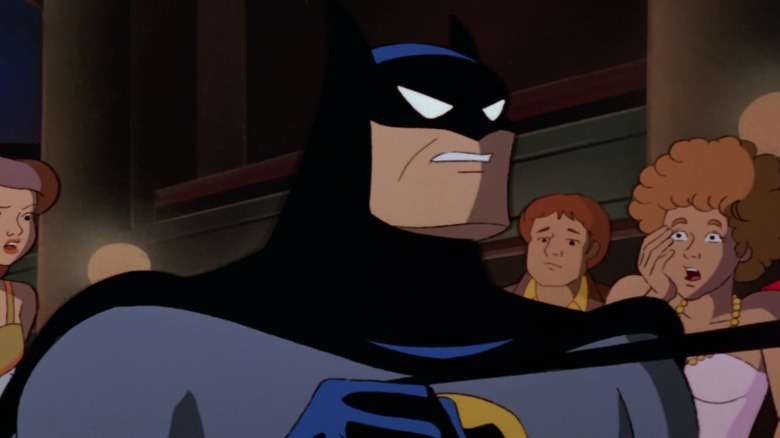
It can't be overstated what an evolutionary leap "Batman: The Animated Series" was compared to previous "Batman" cartoons. Compared to the cheap animation seen in Filmation's "The New Adventures of Batman" or Hanna-Barbera's "Super Friends" franchise, the Fleischer Studios-inspired aesthetic of "Batman: The Animated Series" looks even better. "Batman: The Animated Series" also never underrated the intelligence of its young audience, both in its dialogue and its willingness to let scenes run on atmosphere, not words.
It wasn't an overnight flip. There had been attempts to launch a new "Batman" cartoon for several years. It was the massive success of Tim Burton's "Batman" movie in 1989 that helped that finally let "Batman: The Animated Series" release them. Before that, future "Babylon 5" creator J. Michael Straczynski pitched "Batman and the New Robin," co-starring Batman and Jason Todd.
In the 1980s, Alan Burnett — future producer and story editor on "Batman: The Animated Series" who was then working on "Super Friends" — wrote a pilot for a "Batman" series. Burnett, a "Batman" comic fan since childhood, wanted a cartoon that would honor their darker spirit. But, per behind-the-scenes book "I Am The Night" by Daniel Dockery, "Hanna-Barbera and ABC weren't ready to commit to a dark Batman series."
We can glimpse Burnett's vision and not just through "Batman: The Animated Series." His pilot became an episode of "The Super Powers Team: Galactic Guardians" titled "The Fear." While chasing Scarecrow (Andre Stojka), Batman (Adam West) stumbles into Crime Alley, where his parents were murdered. Overcome with fear, he flees. Scarecrow plots to exploit Batman's fear to defeat him, forcing Batman to face his past and overcome his terror. Darker than most "Super Friends" episodes, "The Fear" serves as a "Batman: The Animated Series" beta test.
The Fear showed the dark potential of Batman cartoons
"The Fear" was the first depiction of Batman's origin outside the comics and it feels extra special that Adam West got to act it out. The episode understands the weight of this; it initially plays Batman's fear of Crime Alley as a mystery. Bruce has to explain to Robin (Casey Kasem) and Wonder Woman (BJ Ward) how his parents were killed and his vow to avenge them.
These flashbacks, telling us how Bruce Wayne became who he is, are another sign of the episode's origins as a "Batman" series pilot. Compare how "Batman: The Animated Series" didn't shy away from Bruce's past while also assuming that the audience already knew it. Yet despite the ambition of "The Fear," it's still a "Super Friends" episode written for young children.
A revealing comparison is "The Fear" and "Nothing to Fear," the first Scarecrow episode of "Batman: The Animated Series." (Ironically, Alan Burnett wasn't involved with "Nothing to Fear." The episode was scripted by Henry Gilroy and produced under the show's first story editor, Sean Catherine Derek.) In both episodes, Batman is plagued by fears related to his parents; in "Nothing to Fear," he's scared that his father would be disappointed in him. Batman (Kevin Conroy) ultimately shakes off that doubt with a now immortal line: "I am vengeance! I am the night! I am Batman!"
"Nothing to Fear" shows some growing pains. Series co-creator Bruce Timm wasn't wholly satisfied with the episode, and tellingly, Scarecrow (Henry Polic II) would be redesigned, twice, later in the series. Bruce's self-doubts in "Nothing to Fear" are also set when an old colleague of his father's admonishes him for despoiling the Wayne family name.
How The Fear compares to Batman: The Animated Series' Scarecrow debut
The original "Batman" series bible described Bruce Wayne's public persona as careless, self-centered playboy "who spends all of his time frivolously squandering the Wayne fortune." This is, of course, a purposefully cultivated persona to ensure no one suspects he could be a hero like Batman. But "Batman: The Animated Series" instead generally depicted Bruce as a friendly guy outside the mask. "Nothing To Fear" is one of the show's earliest episodes, so this might be a holdover from that earlier characterization.
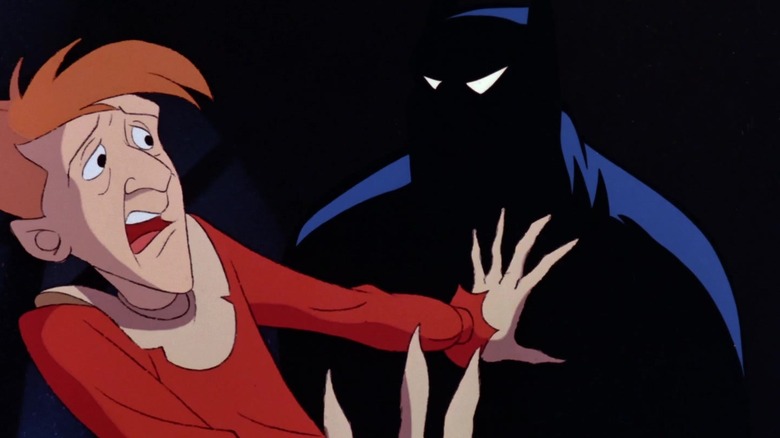
Still, when "Nothing to Fear" begins with a sweeping establishing shot of Gotham (drawn on black paper as was standard on "Batman"), it instantly has more atmosphere than "The Fear" did. It also makes Batman's Scarecrow-induced hallucinations more frightening. When Batman is surrounded by fire, his father's face literally forms from the flames. After Scarecrow is dosed with his own poison, he imagines Batman as a monster.
Speaking of, the Scarecrow isn't spreading panic for its own sake like in "The Fear." In "Nothing to Fear," he's driven by revenge. Once a psychology professor named Jonathan Crane, he used his students as test subjects for his fear drugs. Now, he wants to burn down the university that fired him. Brief flashbacks to Crane's childhood and academic career explain he's always delighted in scaring people. Later "Batman: The Animated Series" episodes would continue digging much deeper, and more sympathetically, into their villains' pathologies.
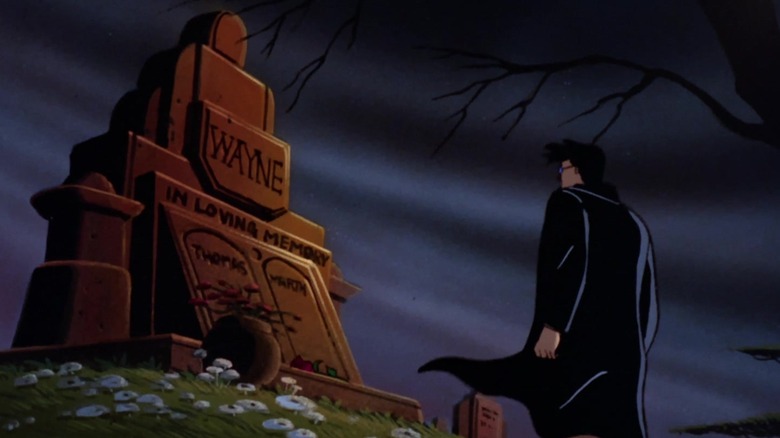
Instead of the Super Friends flying off into the sunrise with a captured Scarecrow, "Nothing to Fear" has a melancholic ending. Bruce stands at his parents' grave, leaves a flower, and as he walks away his shadow morphs into Batman's. The tragedy of his childhood will continue to follow Batman as long as he lives.