

Keanu Reeves And Denzel Washington's Forgotten '90s Shakespeare Movie Is Worth Revisiting
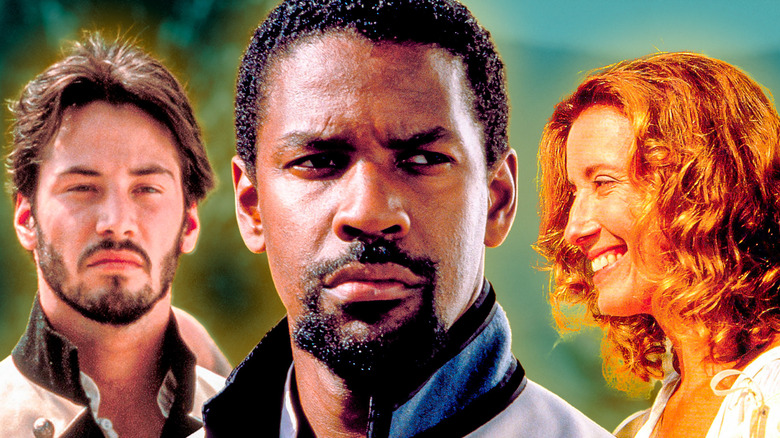
Kenneth Branagh's 1993 film adaptation of William Shakespeare's "Much Ado About Nothing" is, without hyperbole, one of the best films of its decade. And what a cast! Denzel Washington plays Don Pedro, a soldier returning home from the war, bringing with him the handsome young Claudio, played by Robert Sean Leonard, and Don Pedro's grumpy, villainous half-brother Don John, played by Keanu Reeves.
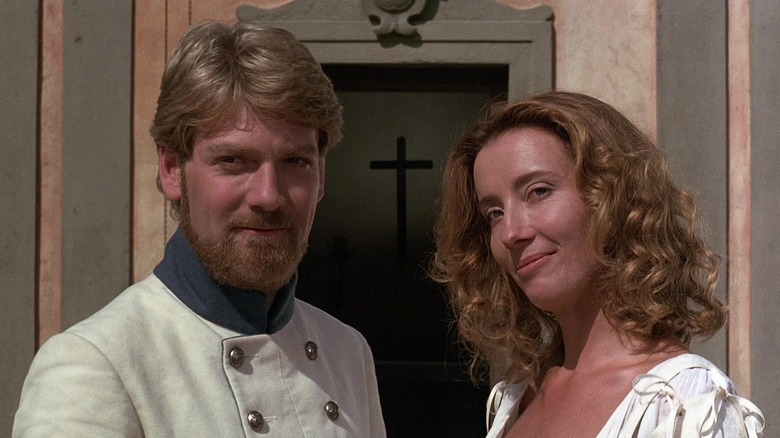
Additionally, Branagh plays the sharp-witted Benedick, and stands romantically opposite Emma Thompson, playing the even sharper-witted Beatrice. The actors were married at the time, and their scenes together play like gangbusters. Claudio falls in love with the pretty young Hero, played by Kate Beckinsale. Michael Keaton turns in one of his funniest performances as Dogberry, a slovenly cop. Also keep an eye out for Imelda Staunton, Richard Briers, and the amazing Brian Blessed.
Branagh understood that Shakespeare's text was so aggressively light and frothy that he needed to make a film that matched its tone and spirit. As such, "Much Ado" is bright, brisk, pastoral, and gorgeous. Despite a plot involving staged infidelity, faked deaths, and bitter reactions, the movie is overall an injection of liquid sunshine. The bulk of the film is laughter, romantic shenanigans, playfully flirtatious barbs, and relaxing summer night parties in the Sicilian countryside. And, naturally, as a comedy, everything works out in the end. I want to live in this movie.
There have been other recent, passable film renditions of "Much Ado" in recent years, including Joss Whedon's 2013 version, which bore the filmmaker's unique voice, and the 2023 romantic blockbuster "Anyone But You" with Sydney Sweeney and Glen Powell, but neither can match the glories of Branagh's version. It remains the high-water mark for filmed versions of this play.
What happens in Much Ado About Nothing again?
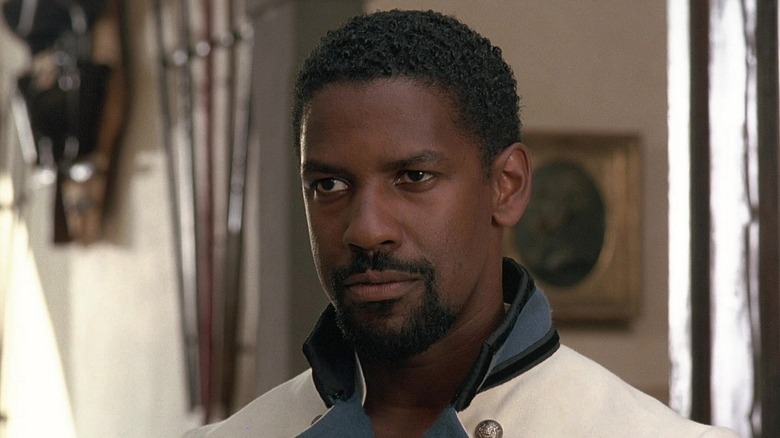
"Much Ado About Nothing" takes place in Messina, and opens with a glorious homecoming from Don Pedro and his men. This is a joyous occasion, and everyone in Messina is happy to begin a period of merry-making. It also marks the reunion of bitter exes Beatrice and Benedick, who seemingly hate each other, but who verbally spar so well, it's quite clear they're romantically perfect for each other. Each of their friends schemes to force Beatrice and Benedick back into each other's arms, largely by being "overheard" in choice situations.
Upon homecoming, Claudio instantly falls for the pretty young Hero, but he hasn't the wherewithal to charm her. Luckily, at a masked ball, Don Pedro stands in for Claudio, successfully charming Hero in his stead. A marriage is immediately arranged because this is Shakespeare, and comedies have to end with marriages. Meanwhile, side characters are hooking up left and right. "Much Ado" is a marvelously horny movie, and every actor looks the best they have ever looked.
Of course Don John is lurking in the shadows to foul everything up. He sees all the happiness at play and wishes to squelch it for reasons of generic villainy. He arranges for Claudio to witness a couple undressing in a window, convincing Claudio that he is witnessing Hero cheating on him already. Claudio, being a bit of a golden retriever, believes him and becomes bitter, rejecting Hero at the least opportune moment. And while there are some hard feelings of anguish, Branagh has already communicated through his film's bright white coloration, brisk music (by Patrick Doyle), and warm photography (by Roger Lanser), that everything is going to be fine.
What critics thought of Much Ado About Nothing
The only real issue one might take with Branagh's "Much Ado About Nothing" is — and I hate to say it — Keanu Reeves' performance. Reeves is a capable actor in the right kind of taciturn roles, and he is one of the best human beings we have on planet Earth, but he clearly struggles with Shakespeare's language. After "Much Ado" was released, a notable parody of Reeves' performance was featured on the TV series "The Critic," wherein Reeves was mockingly placed in a film version of "The Merchant of Venice," intoning, "Hath not a dude eyes?"
But Reeves' performance aside, "Much Ado" is pretty damn perfect. The film currently has a 90% approval rating on Rotten Tomatoes, based on 48 reviews. Roger Ebert gave the film three stars out of four, writing:
"Sunshine and laughter, and merrymakers on a hillside sprinkled with flowers. In the opening scene of 'Much Ado About Nothing,' Kenneth Branagh insists on the tone the movie will take: These are healthy, joyful young people whose high spirits will survive anything, even the dark double-crosses of Shakespeare's plot."
For a while there, Kenneth Branagh was on a hot streak. His 1989 debut feature "Henry V," also based on Shakespeare, was a critical darling, and his 1991 past-lives noir "Dead Again" is way better than it has any right to be. The '90s were very good for Branagh overall, as he also made "Peter's Friends" (1992), "Mary Shelley's Frankenstein" in 1994 (which is better than you remember and accurate to Shelley's novel), "In the Bleak Midwinter" (1995), and one of the very best movie versions of "Hamlet" in 1996. "Much Ado" was just a bright, soft, white feather in his feather-festooned cap.