

A Twilight Zone Episode Based On A Real-Life Experience Inspired Jordan Peele's Us
We may receive a commission on purchases made from links.
In 2019, Jordan Peele helped bring Rod Serling's iconic vision to our troubled times with his "Twilight Zone" reboot series. The director had been a fan of the original show since he watched reruns as a child, so stepping into Serling's role as host of the updated "Twilight Zone" was clearly a significant moment for him. But this wasn't the only time Peele revisited his love for the greatest anthology TV series of all time. In fact, that same year, he delivered "Us," his second feature length helming effort after 2017's "Get Out." And while Peele's originality is part of what made his horror directing career take off in the way that it did, it seems "Us" was heavily indebted to the 1960 "Twilight Zone" episode "Mirror Image."
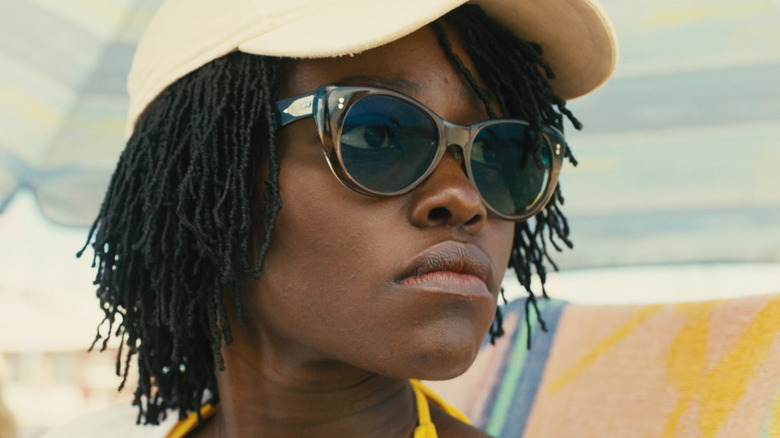
"Us" begins with a young Adelaide Wilson (Madison Curry) wandering away from her parents at the Santa Cruz Beach Boardwalk and entering an extremely creepy funhouse where she encounters her doppelgänger. We then jump ahead to the present-day, where Adelaide (now played by Lupita Nyong'o) is vacationing with her husband, Gabe (Winston Duke), and two children. But the family is very quickly menaced by their respective doppelgängers, who descend upon their vacation home in an attempt to kill off their counterparts and replace them. Of course, Serling never wrote a "Twilight Episode" quite like that. But he did write "Mirror Image," an episode about doppelgängers that was actually based on his own experience of having seen somebody who looked remarkably like himself. Little did he know at the time, his strange experience would ultimately inspire Peele and indirectly help bring "Us" to the big screen.
Rod Serling delivered a classic Twilight Zone doppelgänger story with Mirror Image
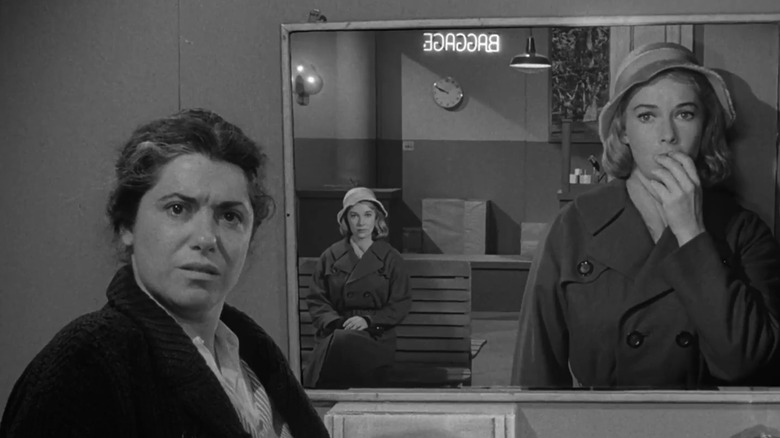
"Mirror Image" is the 21st episode of "The Twilight Zone" Season 1. It features "Psycho" star Vera Miles as Millicent Barnes, a woman who, while waiting at a bus station, is distressed to be told by both the ticket agent and the bathroom attendant that she has already spoken to them despite having no memory of having done so. Soon, she realizes that a sinister "twin" has somehow arrived to try to replace her. Nobody at the bus station believes her, however, and like so many others who unwittingly entered the Twilight Zone before and after her, Millicent begins to question her own sanity.
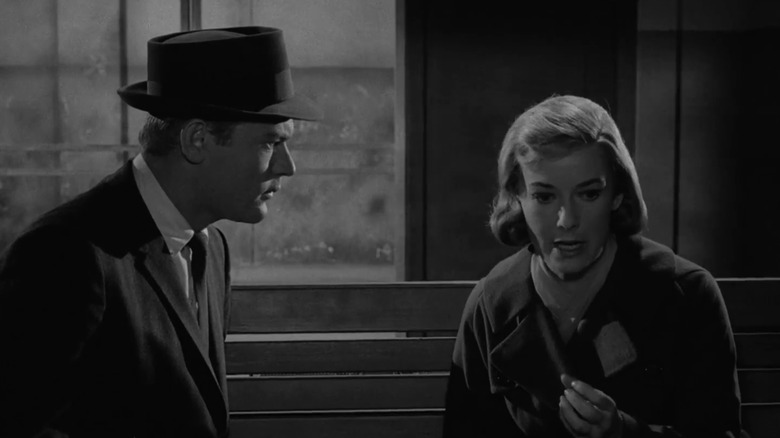
As does Martin Milner's Paul Grinstead, a kindly man who initially seems drawn to Millicent but becomes concerned when she starts talking about how her doppelgänger has somehow crossed the divide between parallel worlds and is out to get her. "In order to survive, it has to take over," she tells Paul. "Replace Us. Move us out so that it can live." After Paul has Millicent taken away by police, he very quickly learns that she may have been of sound mind after all, as his own "twin" is now lurking in the same bus station.
Though it isn't one of the essential "Twilight Zone" episodes, "Mirror Image" is a great Season 1 entry that's genuinely creepy. (Miles' almost imperceptible smirk as the doppelgänger sitting on the bus is particularly unsettling.) Thankfully, the real life experience Rod Serling used as inspiration when writing "Mirror Image" wasn't quite as upsetting.
Rod Serling's The Twilight Zone episode Mirror Image is the genesis of Us
In a promotional video for "The Twilight Zone" (referenced in "The Twilight Zone Companion"), Rod Serling recalled his experience of waiting in a London airport, top coat and briefcase in-hand. "I looked up and across the room and there stood a man," he explained. "5-foot 6, my identical height, wearing the identical top coat, with a briefcase of identical cowhide. And I kept staring and staring with this funny ice cold feeling that if he turns around and it's me, what'll I do?" That brief moment gave him the idea for "Mirror Image," with Serling adding, "[...] This did leave its imprint sufficiently to write a story about it." Little did he know that "Mirror Image" would leave a similar imprint on Jordan Peele.
"Us" was the box office hit that gave Peele true power in Hollywood. But the actor and filmmaker owes much of that success to Serling and "The Twilight Zone," which proved hugely influential on "Us." In a Rolling Stone interview, Peele confirmed that he was inspired by "Mirror Image" when he went to make his second horror film. "It's terrifying, beautiful, really elegant storytelling," Peele explained. "And it opens up a world. It opens up your imagination." In his case, that imagination led to the story of "Us," which, aside from using a doppelgänger premise, further recalls "Mirror Image' by using the idea of doppelgängers trying to replace their originals. Adelaide even tells Gabe about meeting her doppelgänger as a child in Peele's film. "My whole life, I feel like she's still coming for me," she says, an echo of Millicent's "Move us out so that it can live" line.