

Mapping The Galaxy: The Four Galactic Quadrants In Star Trek Explained

We may receive a commission on purchases made from links.
Welcome to Trekspertise, a series where we break down the technology, history, details, and decisions that make the Star Trek universe so complex — and so fun.
There are four quadrants in the "Star Trek" universe, named after the first four letters of the Greek alphabet: Alpha, Beta, Gamma, and Delta. When stellar cartographers on "Star Trek" decided to map the Milky Way, they sliced it into four pieces, just to keep things clear.
"Star Trek" stays bound almost entirely to the Milky Way galaxy. The distances between stars are so unbelievably vast, even the fictional starship engines concocted for the franchise aren't powerful enough to traverse those distances in any practical amount of time. Indeed, the vast bulk of the action on "Star Trek" takes place in the Alpha Quadrant, the portion of the galaxy where Earth happens to be situated. According to "The Star Trek Encyclopedia," Earth is also close to the Beta Quadrant border.
Humans, Vulcans, Andorians, and most members of the Federation all hail from the Alpha or Beta Quadrants. Ditto the Klingons and Romulans, who have empires situated mostly in the Beta Quadrant.
Thanks to a stable wormhole discovered in the pilot episode of "Star Trek: Deep Space Nine," denizens of the Alpha Quadrant suddenly gained near-instant access to the distant Gamma Quadrant. And, of course, the bulk of "Star Trek: Voyager" takes place in the even more distant Delta Quadrant, about 70 years' travel from Earth, where they couldn't replenish supplies. (Yet somehow, they never ran out of anything.)
All the other "Star Trek" shows take place mostly in the Alpha or Beta Quadrants, our little corner of the galaxy.
It's somewhat rare to see a map in Star Trek
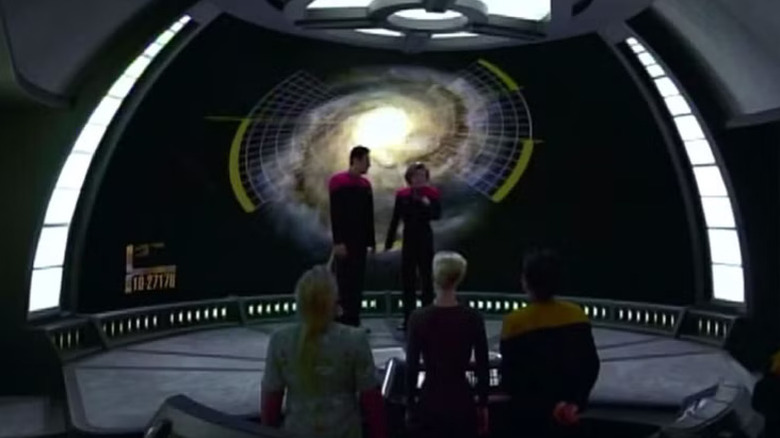
Maps of the "Star Trek" galaxy may be readily available from expanded-universe lore and various ancillary sourcebooks, but on-screen, canonical cartography of the actual galaxy is rare.
"Voyager" did have a few on-screen maps, usually seen on the show's novel astrometrics lab. There was also a map of the galaxy used on a PADD (Personal Access Display Device) prop from the 1998 feature film "Star Trek: Insurrection."
Those maps semi-canonically confirmed that the Milky Way is divided into four equal portions, crossed by one vertical and one horizontal meridian. There is no Z-axis consideration when mapping out the four quadrants, because stellar maps are looked at from the "top."
Mapping out four quadrants is easy to wrap our heads around. Since "Star Trek" is produced on the planet Earth, the series tends to be geocentric, meaning that our solar system gets to be part of the the "primary" quadrant — Alpha — with all the extant worlds and spatial territories in the Federation being nearby.
But according to those maps, the quadrants are not laid out in a logical fashion. If looking from the top down, the Alpha Quadrant is located on the lower left, the Beta Quadrant is on the lower right, then the Gamma Quadrant is on the upper left, and the Delta on the upper right. One might think the quadrants would be mapped out in a clockwise fashion, but instead, it's read counter-clockwise by letter, starting at the lower left, when the galaxy is viewed from underneath. Go figure.
The Gamma and Delta Quadrants are very far away
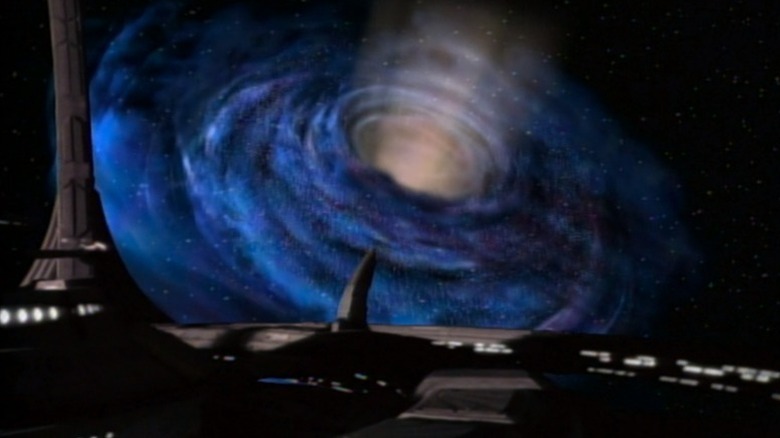
Larry Nemecek, author of the "Star Trek: The Next Generation Companion," went on the Mission Control podcast to discuss the third-season "NextGen" episode "The Price," which was the first time the Alpha and Beta quadrants were mentioned as a cartographic means of slicing up the whole galaxy. Nemecek said the word "quadrant" was thrown around without much consideration on the 1966 "Star Trek" series, and then he shared a "Star Trek" map of the Milky Way that was eventually included in a writer's technical manual, only seen by the show's makers. After the early '90s, the quadrants, their measurements, and "Star Trek" distances became much more consistent.
Prior to that, "Star Trek" could play a little fast-and-loose with distances. If you know anything about astronomy, for instance, you might know that Earth is located on one of the outer spiral arms of the Milky Way called the Orion Arm, about 26,000 light-years from the galaxy's center. Several "Star Trek" stories have taken place at the center of the galaxy — notably the 1973 "Star Trek: The Animated Series" episode "The Magicks of Megas-Tu" and the 1989 feature film "Star Trek V: The Final Frontier" — but those stories stray quite a bit from actual astronomical knowledge about the massive black hole called Sagittarius A* at the center of the Milky Way.
This is a scientific inaccuracy about "Star Trek" that Trekkies just have to begrudgingly accept, as is the fact that a starship has made it to the center of the galaxy in the matter of a day or two when, by the usual "Star Trek" rules of speed and distance, it would take over 17 years while traveling at "Next Generation"-era warp 9.