

You Can See Everything Has A Secret Actor That Will Break Your Brain
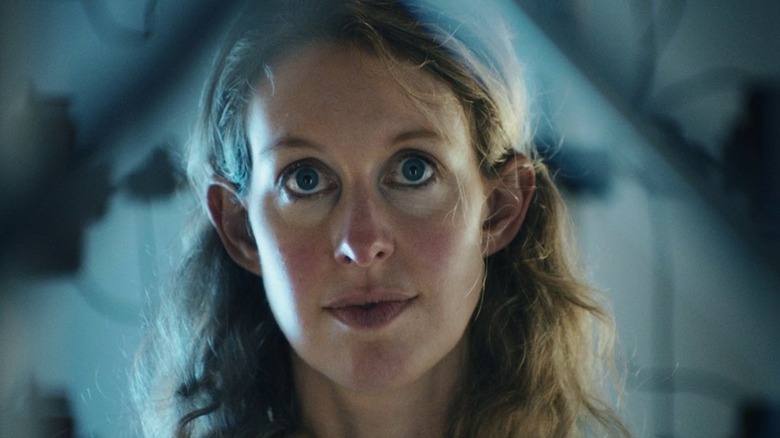
Absolutely stop reading right now if you have not seen "You Can See Everything." Full spoilers ahead!
About an hour ago, I walked out of an afternoon screening of Nathan Fielder and Lance Oppenheim's reality-breaking documentary "You Can See Everything." I live very close to the theater, but I needed to walk in circles to digest what I just witnessed, so I arrived home a bit later than I anticipated. Only part of my shock and awe is related to the movie's humongous surprise celebrity cameo, but believe me: it will break your brain, right before your brain gets broken a thousand more times.
I included a spoiler warning at the top, but seriously: Go away and come back later if you haven't seen "You Can See Everything" in its entirety. Halfway through the documentary, the action draws to an apparent close as Elizabeth Holmes, the fraudulent and disgraced woman behind Theranos — a company that falsely claimed it could diagnose multiple diseases from a simple blood test — goes to prison. (Holmes' prison sentence was repeatedly delayed after she was sentenced to 11 years behind bars for defrauding Theranos' investors, and she eventually surrendered on May 30, 2023.) That's when Amanda Seyfried shows up.
Seyfried, who won a well-deserved Emmy for portraying Holmes in Liz Meriwether's Hulu series "The Dropout," first appears to review footage with Fielder — an active participant in the documentary, while Oppenheim largely remains behind the camera — but before long, she's reenacting key moments that Fielder experienced with Holmes and her partner, Billy Evans, that Fielder can't show outright for various legal reasons. It's astonishing, weird, and makes the second half of "You Can See Everything" unbelievably riveting ... and proves, beyond any shadow of a doubt, that Seyfried is one of our greatest living actors.
You Can See Everything interrogates Amanda Seyfried's performance in The Dropout
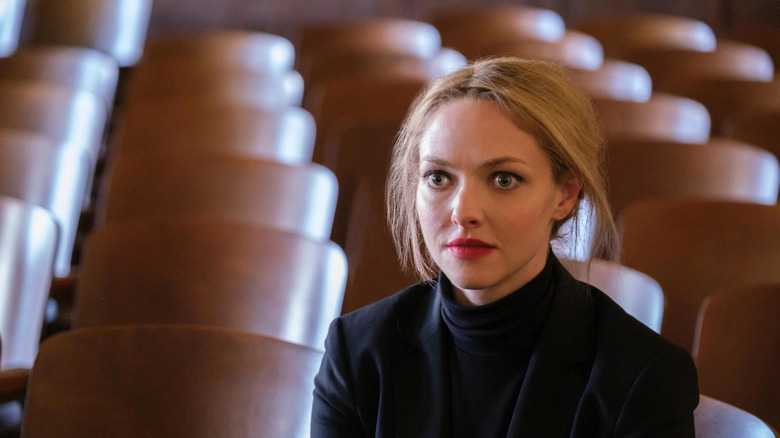
After the real Elizabeth Holmes goes to a federal prison in Texas, Amanda Seyfried — in a move that seems to be largely her idea — steps back into her role as Holmes to re-enact scenes that happened before any waivers were signed for the documentary, as well as a key scene that serves as the movie's climax, which I'll revisit in a minute. As for Billy Evans, Holmes' deeply toxic and frankly disturbing romantic partner, he's portrayed in these reenactments by Christopher Abbott, Seyfried's co-star in "The Testament of Ann Lee" (which I have to assume isn't an accident; based on the timeline, they may have recently wrapped filming when they came to work with Fielder).
In one key re-enactment, Abbott's Evans more or less extorts Fielder, director Lance Oppenheim, and A24 executives by demanding compensation from the film's box office, something that, as Fielder points out, crosses several ethical lines regarding the documentary and its integrity. Whether or not Holmes knew about Evans' demand is ... truly a mystery, even at the film's conclusion.
The strangest thing about Seyfried's involvement, though, is that it forces her and Fielder to reexamine her own work playing Holmes in "The Dropout." Both the real Holmes and Evans clearly resent her, claiming that the series did irreparable damage to the former's reputation. (One could argue Holmes did that all by herself, but she also claims she's never lied once in her life to Fielder, who breaks his façade for a second and exclaims, "Liz, what?!") Seyfried does admittedly seem bothered by whatever damage she's caused to Holmes, and at various points, both she and Fielder are forced to grapple with what this understandably sensationalized portrayal did to Holmes' story.
By the end of You Can See Everything, neither Amanda Seyfried nor Nathan Fielder knows what to believe
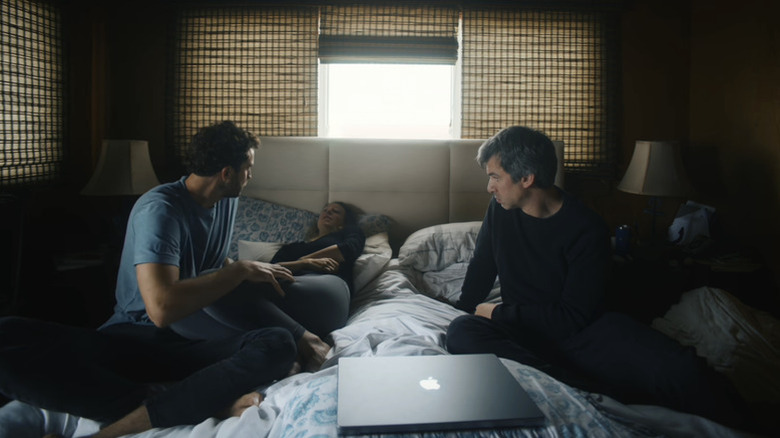
The most disturbing and fascinating aspect of "You Can See Everything" is that as the film draws to a close, neither Amanda Seyfried nor Nathan Fielder fully understands Elizabeth Holmes. In one pivotal discussion, Fielder says that, essentially, Holmes is either delusional (she keeps insisting that her Theranos device actually did work, which is just not true) or the most effective manipulator the world has ever seen.
At times, she seems to fall more into the former camp; in a scene where Holmes, Billy Evans, and Fielder attempt to watch some of "The Dropout," her discomfort at a scene involving Seyfried's Holmes and her longtime lover and Theranos collaborator Sunny Balwani (played by Naveen Andrews on the series), Holmes becomes so uncomfortable that she dissolves into tears. On the other hand, when Fielder arranges the film's final and most disturbing reenactment — one of the apparently only times he visited Holmes in prison — Seyfried notices he's changed a word to, essentially, make Holmes seem more gullible and innocent.
In that prison reenactment, it all hinges on whether or not Holmes knew about Evans' attempt to earn money from "You Can See Everything" before even agreeing to film it, or whether he did that without her knowledge. (Evans is extraordinarily controlling, so the latter option certainly isn't impossible.) Frankly, the craziest thing is that, as Seyfried and Fielder unpack the meet-up and we watch the re-enactment, they can't come to any sort of conclusion about what Holmes knew and when. It's a befuddling yet satisfying ending to a masterful documentary, and Seyfried's involvement takes an already great experiment to a new level.
"You Can See Everything" is in theaters now.