

Why Conquest Of The Planet Of The Apes Changed Its Original, Much Darker Ending
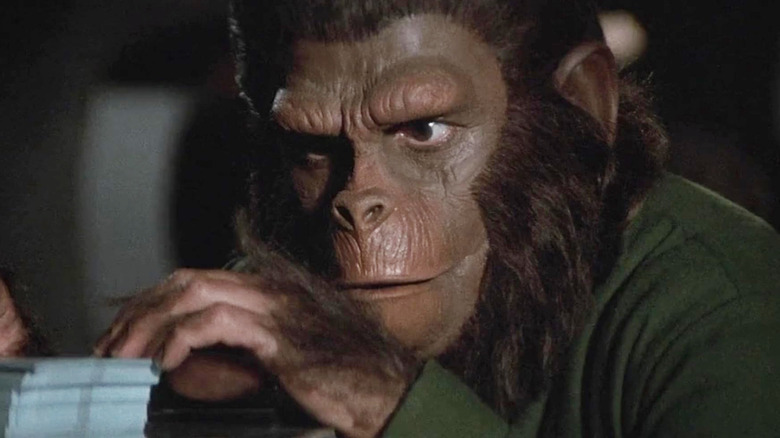
For a while, "Planet of the Apes" was the movie series that could not die. The world blew up at the end of "Beneath the Planet of the Apes," and yet, somehow, the franchise continued shortly after with a third film.
Said movie, "Escape from the Planet of the Apes," saw the chimpanzees Cornelius (Roddy McDowell) and Zira (Kim Hunter) time travel back to the 1970s. It was a clever reversal of 1968's "Planet of the Apes," with talking apes to fit in on the planet of humans. "Escape" ends with Cornelius and Zira dead, but their baby — Caesar — safely hidden away in a circus. That set up movie no. 4, "Conquest of the Planet of the Apes," where a grown-up Caesar (McDowell) leads an uprising of enslaved apes several decades later.
Those who've seen "Conquest of the Planet of the Apes" often hold it up as one of the best sci-fi sequels ever. But it's specifically one version of the movie that deserves that accolade. In the originally intended ending, Caesar embraces violent revolution and disregards the pleas of his human ally MacDonald (Hari Rhodes). Caesar then calls for his apes to execute the tyrannical Governor Breck (Don Murray), and the movie ends with a zoom in on Caesar's face looking out at the riot.
The theatrical cut adds some new beats. One of the female apes, Lisa (Natalie Trundy), whispers a soft "no" at the violence. So, Caesar does an about face, saying the apes have won the day and can afford to be merciful. Breck is implicitly spared, and then the ending proceeds the same. Murray, in a 2022 interview with Den of Geek, speculated that 20th Century Fox wanted a more open ending to ensure a fifth movie. But was that all it was?
Conquest of the Planet of the Apes gutted Caesar's revolution
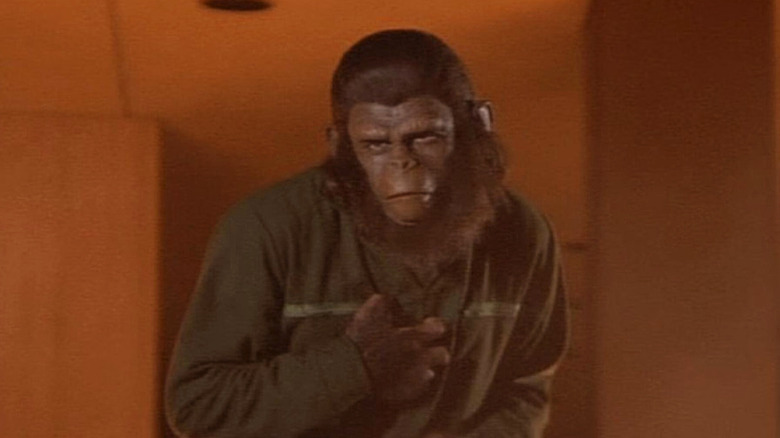
Watch both the original and theatrical endings for "Conquest of the Planet of the Apes," and I don't think anyone will argue the original ending isn't better than the theatrical. Caesar's proclamation that the age of humans is over and the time of ape has come should be harrowing, but after a film of seeing apes abused and enslaved, you can't disagree with his conviction. Roddy McDowell's delivery is so stirring that the speech makes you forget that you're cheering on the downfall of the human race as you watch Caesar deliver it.
The theatrical version butchers all of that, and it's also extremely poorly edited. The dubbed-over dialogue doesn't match McDowell's facial expressions, and Caesar's mouth is simply kept out of view in most shots. The rioting apes lowering their weapons is literally rewound footage of them raising them. After the stitched-in monologue, the ending continues as the original did with a push-in on Caesar's face watching the riot with the same ominous music score. It's the equivalent of taping a piece of cardboard over a broken window, only in this case, there was nothing that needed fixing at all.
Other behind-the-scenes reporting suggests 20th Century Fox's concern wasn't ensuring another "Apes" movie. Frankly, the unedited ending still leaves that door open, for it promises a full-scale war between Caesar's apes and humankind. But Fox was concerned the film's ending was too violent and too politically-charged for what it intended as a family-friendly blockbuster. ("Conquest of the Planet of the Apes" was even edited to avoid a harsher rating.)
In the documentary "Behind the Planet of the Apes," McDowell recalled that the ending was re-edited due to negative reactions from test audiences at the bleakness.
Conquest of the Planet of the Apes' allegory got too real
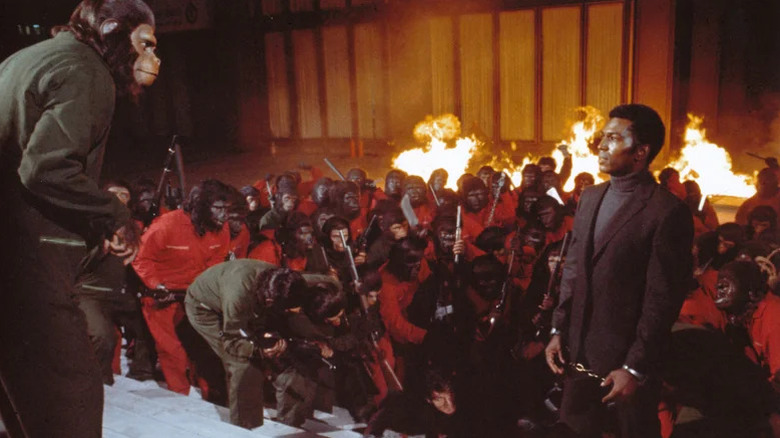
"In the first preview screening at Phoenix, mothers took their children running down the aisle to get out of the theater because of the bloodiness of the riots," said "Conquest of the Planet of the Apes" director J. Lee Thompson in that same documentary. "Fox wanted to try and retain the family audience, and they made us cut a great deal. It was a violent film and politically very disturbing."
Conversely, according to Thompson, "[a] largely Black audience" at a screening in Inglewood, Los Angeles "cheered." The documentary admits that the apes' revolution in "Conquest" was modeled on the 1965 riots in Watts, California, where Black people rose up in armed protest against racist policing. As film historian Eric Greene noted in "Behind the Planet of the Apes" — "In 1972, there was no way a major studio film was going to release a film where the hero was the leader of the Watts riots, but you could release a film where the leader of an ape slave revolution is your hero."
The ending puts the allegory into focus. Caesar cites the right of an enslaved individual to murder their oppressor, while MacDonald (a Black man descended from enslaved people) tells him to hold back. "Planet of the Apes" was always a political satire in the skin of a sci-fi blockbuster, but this one's scenes of revolutionary violence and allusions to real race relations pushed the line too much. Even with the edits, it's the only one of the five original "Apes" films to be rated PG instead of G.
Nowadays "Conquest" is overshadowed and surpassed by its spiritual remakes, the "Rise of the Planet of the Apes" trilogy. Even so, the film — especially its unaltered ending — retains its power.