

Tom Hanks' Thriller Franchise That Dominated The Box Office Is The Perfect Netflix Watch

Though it's 20 years old, director Ron Howard's Robert Langdon movie series is right where it was always meant to be: Netflix. It's not because the films are cheap-looking or lacking in big star power, though. Quite the contrary, Howard and his production team spared no expense as they jotted across countries like France and Italy to shoot their movies in and around some of the most striking churches, art museums, and historical pieces of architecture in all of Europe. Then you've got Tom Hanks (typically sporting a, hmm, questionable mullet) playing Mr. Langdon himself opposite the crème de la crème of European actors as either glorified peanut galleries for his character's puzzle-solving antics or diabolical baddies hell-bent on committing mass murder.
Starting with 2006's "The Da Vinci Code," Howard's thrillers follow Professor Langdon — the Indiana Jones of bookish experts on religious symbols — as he uses his academic know-how to unravel conspiracies centered on legendary artifacts or modern super-weapons. Hanks has openly poked fun at "The Da Vinci Code" and its sequels as the very, very silly enterprises that they are over time, but that doesn't mean he regrets working on them, much less that they're devoid of entertainment value. Rest assured, there's a good reason Howard's trilogy nearly brought in a combined $1.5 billion (!) at the box office over the course of its 10-year run: It's technically polished yet devoid of any pretense of being deeper than it appears on the surface, and it's got America's Dad rattling off completely absurd (but in a fun way) claims about the history of art, religion, and architecture with the seriousness of a heart attack.
In other words, these films really are perfect for watching on Netflix ... assuming you know what you're getting yourself into.
Tom Hanks' Robert Langdon movies were practically made for Netflix
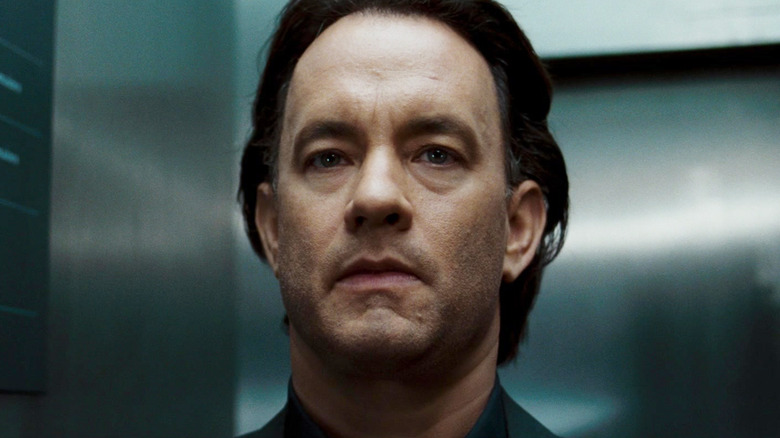
Dan Brown was the Colleen Hoover of the 2000s. His 2003 Robert Langdon novel "The Da Vinci Code," in particular, was a cultural phenomenon, enthralling readers with an amusingly ludicrous plot about a disturbing murder, killer monks, religious cabals, and a centuries-old coverup involving the Holy Grail. But while it may seem too preposterous to get upset about, the "Da Vinci Code" movie adaptation was banned in multiple countries in its day.
Not that this damaged its box office. In fact, the film did well enough for Tom Hanks and Ron Howard to reunite for 2009's "Angels & Demons," which acts as a sequel despite being based on a book that Brown published before "The Da Vinci Code" in 2000. Yet again, its story is pure nonsense (this time, it concerns Illuminati terrorists and anti-matter bombs), but pairing one of Brown's labyrinth narratives with Hanks, European A-listers, and first-rate production values once more proved to be a winning commercial formula. And while that was less true of 2016's "Inferno" (which adapts Brown's 2013 book about an amnesiac Langdon racing to stop a bioweapon from being activated), Dan Brown fever had dissipated so much by then that it's kind of amazing that it was even greenlit.
Nowadays, however, Howard's trilogy feels like it was made for Netflix. It's targeted at adults, each entry works as a standalone film, and Langdon spends so much time explaining what's even happening that, for better or worse, these suckers make for better "second screen" viewing than most Netflix originals designed for that specific purpose. That the actors in these movies actually look like they're investigating mysteries in majestic real-world locations and not merely faffing about on sound stages, that's the icing on these ridiculous cakes.