

Carrie Showrunner Mike Flanagan Explains Moving The Stephen King Story To 2026 [Exclusive]
This article contains spoilers for "Carrie."
Mike Flanagan's "Carrie" premieres on Prime Video 52 years after Stephen King's original novel first arrived on bookstore shelves. In the half-century since, King's name has become synonymous with horror bestsellers, but that legacy all goes back to his novel about a lonely girl and a cruel prom prank gone horribly wrong. "Carrie" remains one of the best Stephen King books, too.
Though published in 1974, "Carrie" is set in 1979. Large chunks of "Carrie" are in-universe reporting and interviews about "The Black Prom," as well as academic writing providing scientific rationale for Carrie's telekinetic powers. Setting the novel slightly in the future made for a better pretense. "Carrie" was a glimpse into tomorrow, but the setting is still unmistakably the 1970s. Flanagan brings "Carrie" into the present (with King's approval), but 52 years is a long time. Does the story still fit today?
For Flanagan, showing "Carrie" in a changed world is the entire point, as he said in a conversation with /Film's /Film's Chris Evangelista. One thing that hasn't changed since 1976 is that bullying definitely still exists today. More than that, it's evolved. Flanagan explained:
"Stephen King, half a century ago, could never have ever imagined the impact of the new tools of cruelty that we deploy on each other and how normalized they've become with social media, with the internet, with how our discourse has accepted this degree of bullying and cruelty as unavoidable."
"Carrie" Episode 1, aptly titled "First Period," ends with the famous shower room scene where Carrie (not knowing what menstruation is) gets her first period, freaks out that she's dying, and girls led by Chris Hargensen (Alison Thornton) pelt her with tampons. Only this time, Chris and others whip out their phones to record the incident.
Mike Flanagan's Carrie shows that, today, kids have only gotten meaner
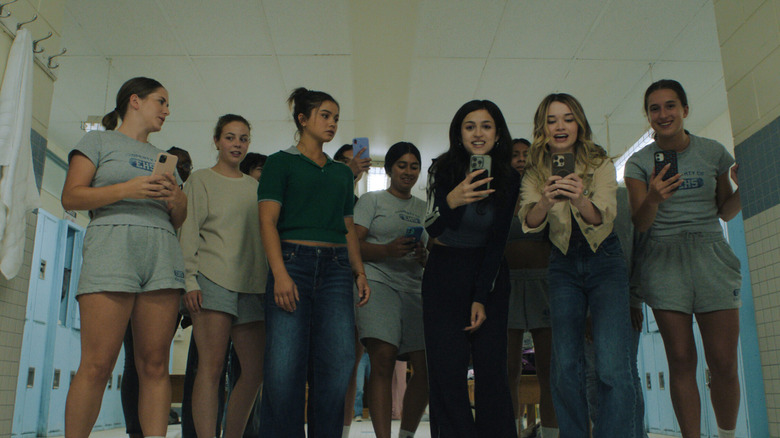
The video of Carrie in the shower spreads around Ewen High. Chris, riding that high and angry about some struggles in her personal life, makes an anonymous "Carrie Red" Instagram account to crowd-source and share similar videos and spread rumors about the school's students and faculty. While no-one ever suspects Carrie of running the account, it still turns her into the face of the nastiness.
This is why social media has made bullying more pervasive (if not worse). Nothing that happens to you escapes notice, gossip spreads faster than ever, and you can't escape it just by avoiding specific people. Chris being revealed as the one behind the account, her refusal to delete it, and her subsequent suspension then expulsion ultimately ignites a riot, which feels like an update of "Mean Girls" and the pen-and-paper "burn book" as much as one of "Carrie."
Chris' social media bullying finds an opponent in Carrie's mother, Margaret White (Samantha Sloyan). In the book and past films, Margaret has been depicted as a fire and brimstone evangelical Christian, which is admittedly a pretty '70s-'80s archetype. Flanagan's "Carrie" downplays (but doesn't remove) her Christian leanings and makes her into a paranoid conspiracy nut and parents' rights activist. This Margaret even becomes a streamer to spread her views.
Rewriting Carrie's backstory so she's been homeschooled her whole life is an extension of this. In the real world, that's one way parents like Margaret control their kids' education. Margaret also tries to claim pamphlets that Miss Desjardin (Amber Midthunder) gives to Carrie are obscene, the way some real parents call for certain books to be banned from schools.
Stephen King's Carrie predicted one thing correctly
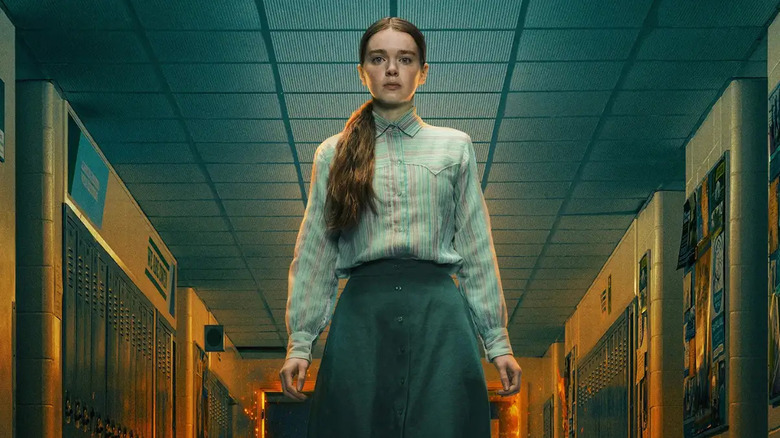
In Flanagan's "Carrie," Ewen High's students have to walk through metal detectors everyday. During Carrie's first day there's also an active shooter drill, leaving her utterly confused and terrified. The show uses that for some pointed satire; Carrie is baffled that people just accept school shootings happen, showing how absurd the current system of "prevention" is to people who haven't been living in a world of hypernormalization.
In his conversation with /Film, Mike Flanagan continued:
"[Stephen King] never could have imagined kids walking through a metal detector and facing the specter of school shooters on the daily as a normal part of life, not an aberration. He never could have pictured that, I think, and so that — really kind of bringing it into 2026 and today's teenage experience — I think is one thing that's quite different [about our version]."
Flanagan highlights what King couldn't have predicted back in 1974, but I'd argue King was also prescient. "Carrie" is essentially a school shooter story with a supernatural twist; an alienated child takes their pain out on their classmates with brutal violence, just with telekinesis instead of an assault rifle. (The shooter drill on Carrie's first day is some dark foreshadowing of what she ultimately does at the prom.)
"Carrie" was published 25 years before the 1999 massacre at Columbine High School, the event that arguably created the "school shooter" as an archetype. And maybe that's why, as /Film's "Carrie" review notes, the show stumbles a bit in updating the story. A child murdering their classmates isn't a shocking story in 2026 like it was in 1974, which is honestly a sentence as scary as anything that happens in "Carrie."
"Carrie" is streaming on Prime Video.