

25 Years Ago Today: One Of The Best Sci-Fi Movies Of The 2000s Flopped At The Box Office
It's possible that Richard Kelly's 2001 sci-fi freakout "Donnie Darko," which came out 25 years ago today, was a victim of bad timing. The film's action is kicked off by a rogue plane engine, detached from an overhead flight, crashing down into the bedroom of the film's title character (Jake Gyllenhaal). The film had the bad luck of hitting theaters on October 26, 2001, only a month and a half after 9/11, so perhaps plane crashes weren't all that entertaining.
It's also possible that audiences didn't flock to "Donnie Darko" because it's so arch and unusual. Technically, it's a time-travel film, and the teenage Donnie is obsessed with the mechanics and philosophy of time travel. Indeed, he reads a book called "The Philosophy of Time Travel," handed to him by a caring teacher (Noah Wyle).
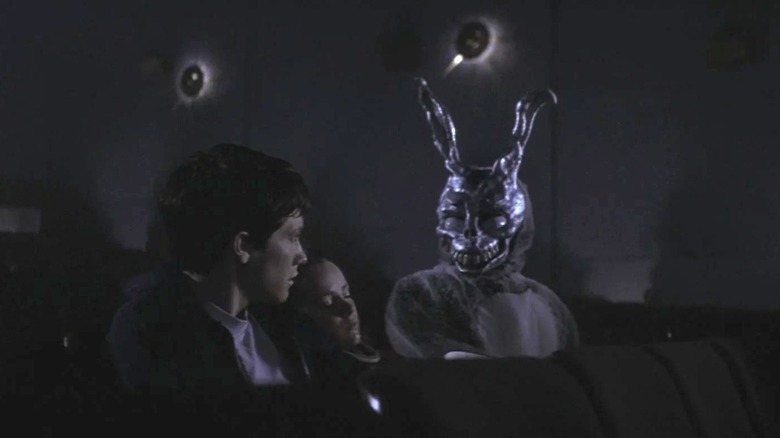
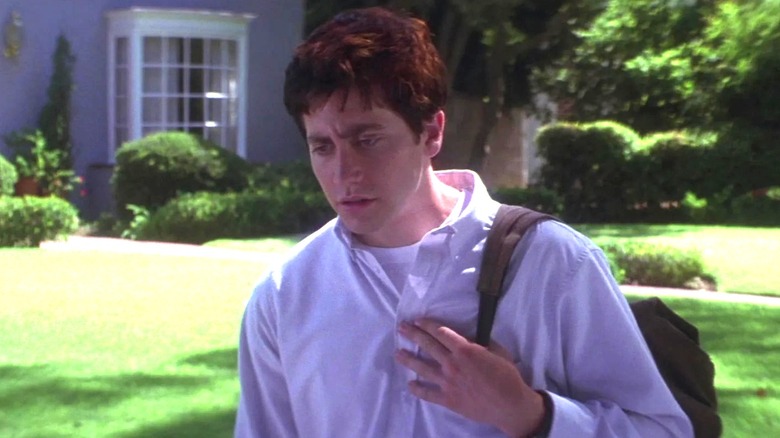
But moreso, "Donnie Darko" is a psychological study of a character who is suffering from paranoid schizophrenia. Donnie has recently begun having hallucinations of a man in a terrifying bunny costume calling himself Frank (James Duval). Frank is clearly a sinister presence in Donnie's life, but he speaks in cryptic riddles about events that are to come. Donnie has written a specific timecode on his forearm in a hallucinatory haze, and it's only a matter of time before those numbers become significant. Jake Gyllenhaal's performance is pitch perfect as a young man who aches for understanding and longs for human connection, but who is bound in by his own perception of the universe's eerie mechanics. It shouldn't surprise anyone to learn that there are very real time travel twists near the film's end.
"Donnie Darko" earned only $7.5 million at the box office on a $4.5 million budget. It wouldn't become a hit until it was released on home video, and started making rounds on the midnight movie circuit.
Donnie Darko initially bombed at the box office
The appealing, human elements of "Donnie Darko" are likely what drew people in. "Donnie Darko" is set in 1988, right when Reagan's America was about to topple over. The adult world of "Donnie Darko" isn't equipped to deal with a surly, mentally ill teen like Donnie, insisting on gentle get-along-everyone language that has become so cliché it's not even human anymore. Patrick Swayze plays a video-selling pop psychologist named Jim Cunningham whose videos are so popular in the local Virginia town where the film is set, that the local schools have begun adopting his language.
Some of the film's younger kids are involved in a dance troupe called Sparkle Motion, and, in one comedic scene, a snippy mom accuses another of not being devoted enough to it. For the adults, these flashy, shallow things are enough to sustain them.
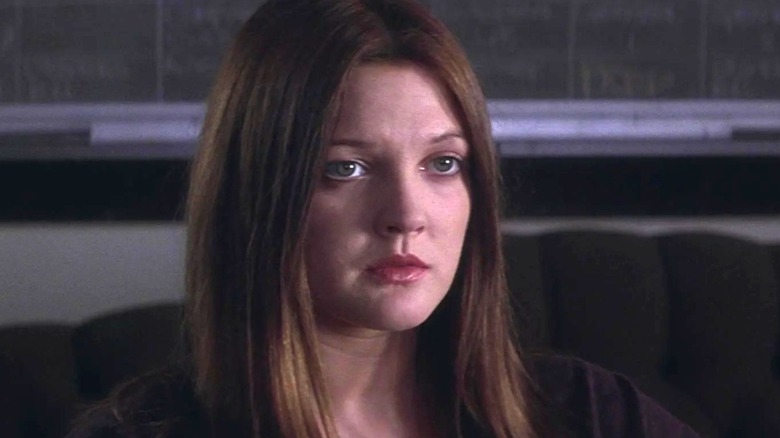
To the adults, Cunningham's touchy-feely bromides feel like a great stand-in for being genuine. Donnie, however, finds more solace in his teachers. Noah Wyle's character has a discussion with Donnie about the nature of the universe, and he has to cut it short before they start to get into God and religion. Drew Barrymore plays another teacher who is concerned with intelligence and beauty. Donnie is frustrated because the late '80s haven't provided him with anything genuine, something that several other outsider teens have also picked up on.
Donnie finds comfort in the arms of Gretchen (Jena Malone), a local "cool girl." Donnie doesn't want to unlock the secrets of time travel the way an obsessed mad scientist would. He merely wants to cut through all the pretense in life, including his own hallucinations. There's a tender beauty in "Donnie Darko," lurking in all the dim photography. It's ultimately about the power of selflessness.
Richard Kelly seemingly drank his own Kool-Aid
Although it initially bombed at the box office, "Donnie Darko" was found by the right people. Goth kids and seekers of unusual cinema gravitated toward it, and it eventually gained a sizable following. Here at /Film, we eventually called it one of the 15 best sci-fi movies of the 2000s. The film became such a hit that Richard Kelly tried to beef up its numbers by releasing a director's cut in 2004. The director's cut was reshuffled a bit, and 21 minutes were added. Only the film's biggest fans prefer the director's cut over the theatrical cut, but it did end up earning another $3.7 million for the flick. There was a sequel to "Donnie" called "S. Darko," released in 2009, but that film has been lambasted by just about everyone. Richard Kelly had nothing to do with its production.
In the wake of "Donnie Darko," Kelly became something of a cult hero, although that didn't translate directly to big-time Hollywood success. In 2005, he penned the screenplay for Tony Scott's baffling actioner "Domino," but that didn't really move the needle on his reputation. In 2007, he returned to movies in a big way with "Southland Tales," an ultra-ambitious, star-studded near-apocalypse sci-fi/philosophy text about the consequences of the George W. Bush administration. Some people love "Southland Tales," and just as many hate it, largely because it's an example of Kelly drinking his own Kool-Aid and giving himself over to brazen onanism. It's a bonkers, ambitious film, anyway. It also bombed.
Kelly's most recent film as a director was 2009's "The Box," based on the Richard Matheson story "Button Button," in which the filmmaker also gives over to bonkers, indulgent sci-fi nonsense. It's a feature-length "Twilight Zone" episode that flopped. "Donnie Darko" remains his high water mark.