

Before The Big Valley, Barbara Stanwyck Starred In A Genre-Defining Crime Thriller
We may receive a commission on purchases made from links.
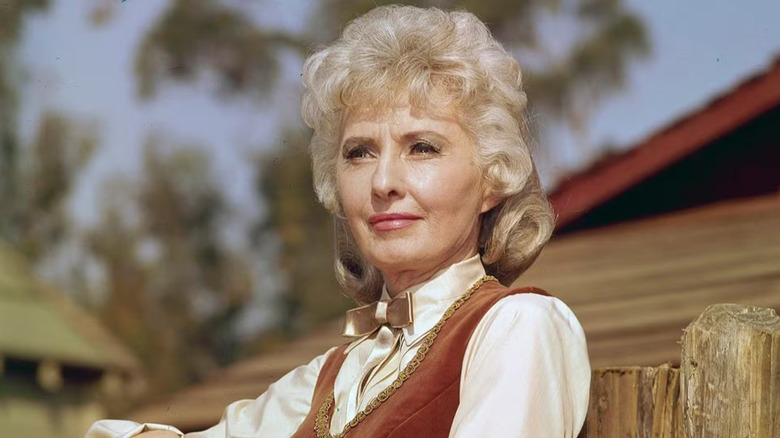
Western fans likely know all about "The Big Valley," the hit series that ran on ABC from 1965 through 1969. It racked up 112 episodes in those four seasons, and was a boon in the careers of stars Lee Majors, Linda Evans, and Richard Long. For those unfamiliar, "The Big Valley" is set in the late 19th century in Stockton, California, and follows the travails of the wealthy Barkley family, headed by the tough-as-nails Victoria Barkley (Barbara Stanwyck). She's taken over the family business after her husband died six years before the events of the series, and now looks after both the books and her adult children. Long plays the eldest son, Jarrod, a respected attorney. Peter Breck plays Nick, the angry ranch manager. Lina Evans plays Audrey, as strong-willed as her mother. Lee Majors plays Heath, the half-brother who's charming but rough-hewn.
The hour-long series is more of a dramatic soap than a straight-up adventure series, and it was noted for attracting many, many, many impressive guest stars. Everyone from Karen Black to Adam West, from William Shatner to Lou Rawls, and from Diane Ladd to Mako appeared on "The Big Valley." And that's just a small sampling. I could list way more.
It's possible "The Big Valley" was able to attract so many guest stars because of Stanwyck. Four-time Academy Award nominee, one-time Honorary Oscar winner, and three-time Emmy winner Barbara Stanwyck began appearing on Broadway in 1924, and began in movies in 1927. Her famous roles are innumerable, and her place in the Hollywood firmament is firmly established. If you know Stanwyck from anything, you probably know her from Billy Wilder's 1944 film "Double Indemnity," one of the best film noirs ever made.
You've seen Double Indemnity, right?
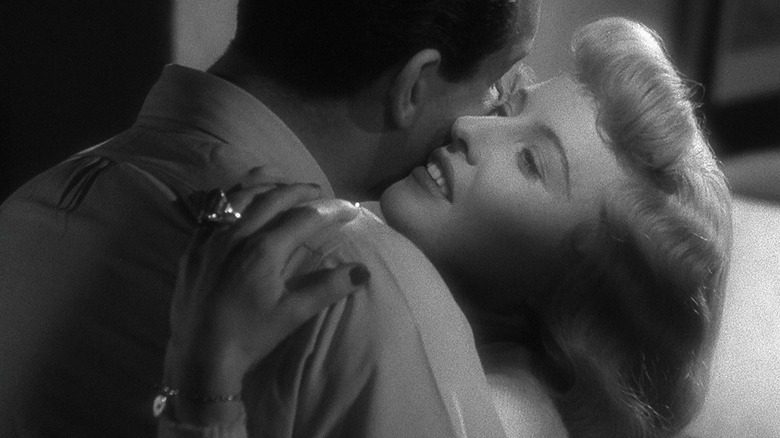
Billy Wilder's "Double Indemnity" contains many of the tropes and trappings of the film noir genre, codifying them for multiple generations. It was based on the 1943 novel by James M. Cain, and it's surprisingly seedy for a film of its vintage. In the film, Stanwyck plays a femme fatale named Phyllis Dietrichson who targets and exploits a horny insurance salesman named Walter Neff, played by Fred MacMurray. The two meet when Phyllis calls him to her house about the possibility of insuring her husband's life ... without the husband's knowledge. Walter groks right away that she has murder on her mind, and he initially balks.
Until he doesn't. Phyllis is so alluring, and Stanwyck's performance so deliciously seductive, that you can understand why Walter would go along with her murderous schemes. Because Walter is an insurance agent, he figures a few clever ways they might be able to outsmart the system, get away with murder, and split the massive insurance payout. He finds a strange double indemnity clause in the insurance offices that would pay out twice as much if Mr. Dietrichson (Tom Powers) were to die on a train. He slips it into the policy, and he and Phyllis begin their scheme to get Dietrichson on a train to murder him.
Like in all film noirs, though, nothing will work out for the best. There will be lies uncovered, double-crosses, and unexpected complications. The film is the tale of Walter's moral fall, prodded to evil by an alluring Lady Macbeth. Of course, when you're dealing with a powerhouse like Stanwyck, it's easy to see why he couldn't resist.
Edward G. Robinson plays Walter's suspicious boss. Billy Wilder hated Stanwyck's wig.
Double Indemnity was a big Oscar darling
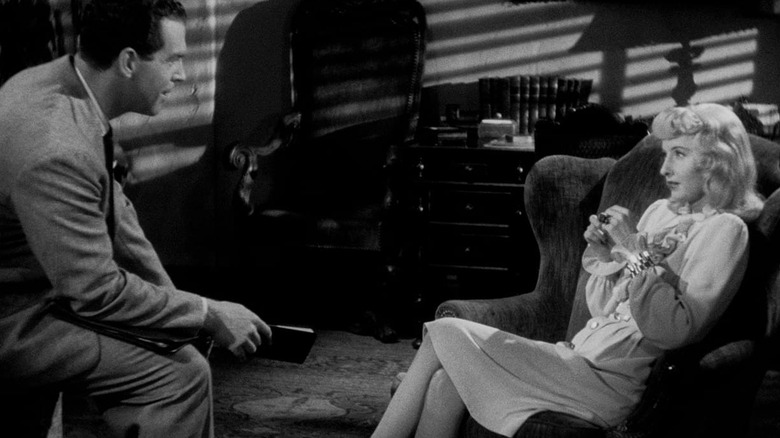
"Double Indemnity" was made during the heyday of the Hays Production Code, which meant that there couldn't be any on-screen sex. You would be forgiven for misremembering that there was, however, given the allure of Barbara Stanwyck's character. Phyllis was a change of pace for Stanwyck, who typically played good-hearted, stalwart, or generally human characters. She didn't play many outright villains. In moving out of her comfort zone, however, Stanwyck turned in one of her best-known performances. She thought it would ruin her career.
"Double Indemnity" was a huge Oscar contender at the time, nominated for seven Academy Awards, including Best Picture, Best Director, and, yes, Best Actress for Stanwyck. It was actually her third nomination, having previously been recognized for her performances in "Stella Dallas" in 1938 and "Ball of Fire" in 1942. Her fourth acting Oscar nom would come for the 1949 film "Sorry, Wrong Number." "Double Indemnity," meanwhile, was up against heavy-hitters in the Best Picture category like George Cukor's "Gaslight" and Leo McCarey's "Going My Way." It lost to the latter. Indeed, "Double Indemnity" lost in all seven of its nominated categories.
Of course, its awards losses aren't as important as its reputation. "Double Indemnity" regularly tops lists of the best films noir ever made, defining the genre and proving to be a template that other films noir would incessantly imitate. One will often see it on AFI list countdowns of the best of all American movies. Stephen King said that he loved it. It came along so early in the genre that the filmmakers didn't even consider it a "film noir." One might compare it to "Halloween" in the way it codified (even if it didn't invent) a genre.
It's rentable on Prime Video. Watch it today.