

Leonard Nimoy Lent His Voice To A Cult Classic 80s Sci-Fi Movie
Celebrity voice actors are a calling card of western animation, one that 1986's "The Transformers: The Movie" used. Judd Nelson of "The Breakfast Club" played Hot Rod, the film's lead and a young Transformer who winds up succeeding the fallen Optimus Prime (Peter Cullen) as the Autobots' leader. Most famously, Orson Welles played the movie's villain: the planet-sized Transformer god Unicron. Welles wasn't the only heel in the film with a famous voice, either.
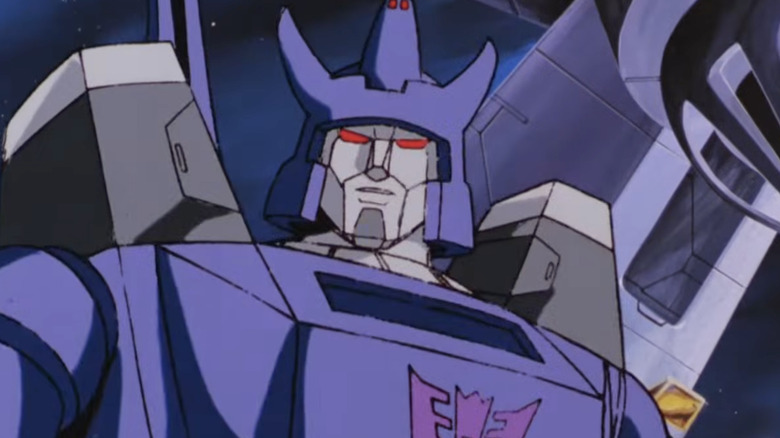
Dying Decepticon leader Megatron (Frank Welker), cast into the void by his treacherous right hand Starscream (Christopher Collins), is remade into Unicron's herald: Galvatron, who lives up to that name as Megatron, but galvanized. Where Megatron transforms into a handgun, Galvatron transforms into a huge cannon — similar weapons, but one is much grander. Megatron's gunmetal grey armor is replaced by a regal blue-purple, and Galvatron's new triple horned helmet resembles a crown.
He's also got a new voice: Leonard Nimoy. Most people remember Nimoy as Spock from "Star Trek," but there's little of Spock's voice in Nimoy's Galvatron. The reborn Decepticon's vocals are booming and cavernous, as if the timbre of his voice was scorched and blackened by Unicron's infernal fire. Megatron's old arrogance can still be heard, but the campiness is gone.
Galvatron was reportedly conceived as Megatron with "less bluster, more ruthless action." Case in point, what does Galvatron do first with his second lease on life? He kills Starscream, vaporizing him in front of the Decepticons (something Megatron should've done eons ago). After he does, he turns to his troops and asks, "Will anyone else attempt to fill his shoes?" But in that rhetorical question lies cruel irony. Galvatron's Faustian bargain with Unicron has put him in Starscream's place. He's now subordinate to a greater, crueler boss he can only dream of overthrowing.
Galvatron is Megatron, transformed
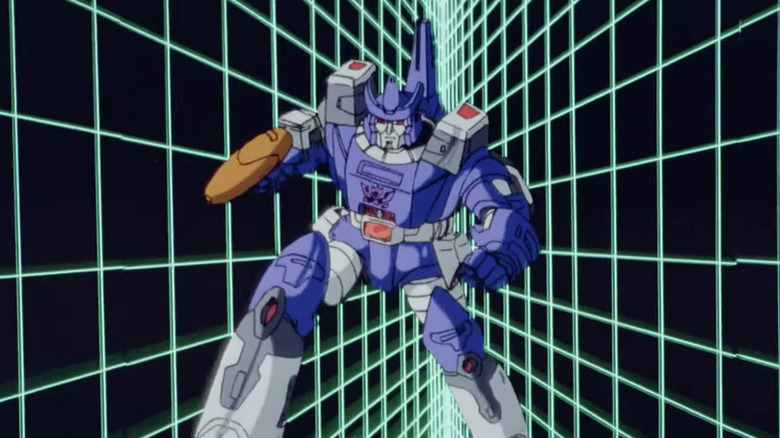
"The Transformers: The Movie" is rather infamous for its violent character deaths. It's also surprising for a children's film that the main hero dies while his villainous rival outlives him. Before their last battle, Optimus Prime tells Megatron that "one shall stand, one shall fall." In the final accounting, Megatron stood, and Prime fell.
Prime, accepting his time has come, dies surrounded by his loyal Autobots, who mourn and revere him. The Decepticons dump their dead and dying into space like discarded junk before scuffling over who gets to take Megatron's place as leader. When Megatron receives Unicron's offer of life paid via servitude, he at first furiously rejects it: "I belong to nobody!" But faced with death, it turns out Megatron's fear outweighs his pride. Optimus clocked his adversary's number during their fight, asking: "You, who are without mercy, now plead for it? I thought you were made of sterner stuff."
Ron Friedman, the credited writer of "The Transformers: The Movie," discussed (during an appearance at TFCon Toronto 2019) why he didn't just, say, kill Megatron and replace him with a new villain. The answer is strikingly philosophical: Birth and death are both transformations, and so, "I wanted to take a transforming character, Megatron, and transform him through death," Friedman explained. But that transformation came with a cost, as Friedman noted — not just Megatron's identity, but his sanity.
When "The Transformers" returned for Season 3 after the movie, it was unfeasible to bring Leonard Nimoy back. So, Frank Welker returned to his part while imbuing Galvatron with a new, higher-pitched voice, even screechier than Megatron. But it fit because Galvatron, having taken a nasty dip into a pool of lava, had mentally deteriorated. In the "Transformers" episode "Webworld," the Decepticons even have their leader institutionalized!
One of Leonard Nimoy's last roles was a return to Transformers
"The Transformers: The Movie" was hardly a critical darling, but it's become a cult classic, not to mention the foundational text for later "Transformers" series. The 2010s animated show "Transformers: Prime," in its epilogue movie "Predacons Rising," basically remade Galvatron's arc from the 1986 movie: a dead Megatron (Frank Welker once more) is resurrected by Unicron (John Noble) and painfully humbled under his new overseer's will.
The movie also isn't the end of Leonard Nimoy's ties to "Transformers." He'd actually influenced the franchise even before he was cast as Galvatron, as the coldly logical Decepticon Shockwave was modeled in part on Spock. Nimoy then returned to "Transformers" for the 2011 film "Dark of the Moon," which incidentally was Shockwave's live-action debut. Did Nimoy voice the villain and bring the influence full circle? Not quite.
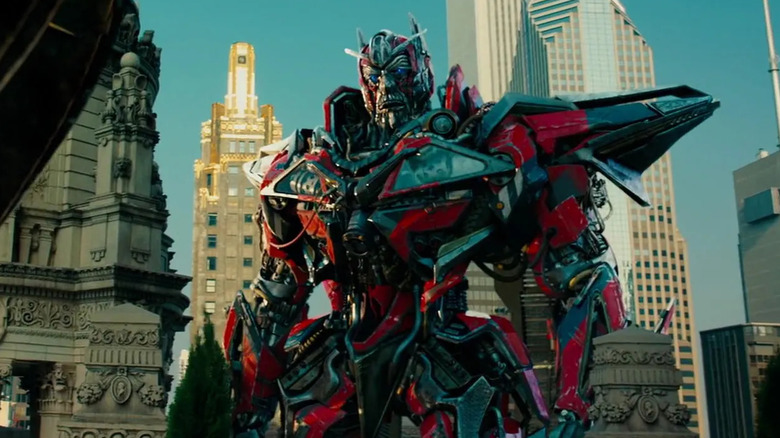
In "Dark of the Moon," Nimoy voices Sentinel Prime, Optimus Prime's predecessor as the Autobots' leader. Tragically, it turns out Sentinel is a traitor, having conspired with the Decepticons to conquer and strip mine Earth to rebuild the Transformers' wartorn home planet, Cybertron.
Nimoy voicing Galvatron back in the day was him playing against type, whereas his casting as Sentinel banked on Nimoy fitting as a wise mentor character. The film needed an actor whose voice could command the same gravity as Peter Cullen (if not more). Almost all of Sentinel's scenes are shared with Optimus, from a rare quiet moment, where the Primes watch a sunset together, to the heat of combat as they yell at each other in mutual betrayal.
Voicing Sentinel Prime was one of Nimoy's last roles before his death in 2015. Trekkies know him as Spock, but Galvatron and Sentinel show he could play a great bad guy, too.