

Resident Evil's Twisted Ending Pays Homage To A Key Part Of The Games
This article contains spoilers for "Resident Evil" (2026).
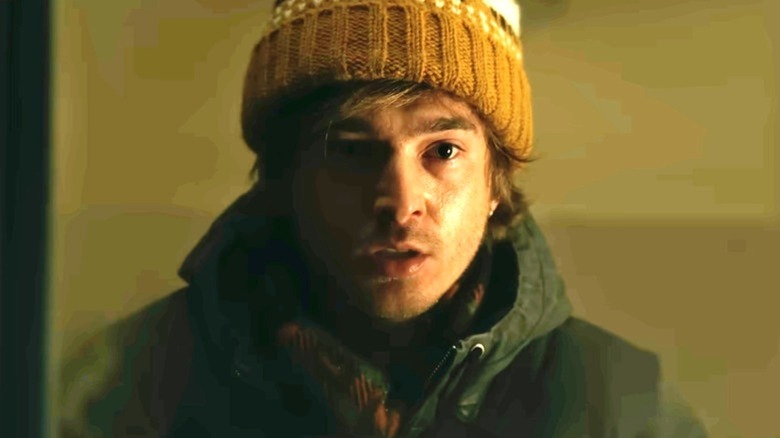
Zach Cregger's "Resident Evil" film has gotten very positive reviews (including from /Film), but also some (undeserved) flack from the fandom for not directly adapting the games. Rather, it tells an original story that occurs within the games' universe (despite a timeline that doesn't quite add up). Medical courier Bryan (Austin Abrams) takes a job delivering what he thinks is a transplant organ to a hospital in Raccoon City — just as the city has begun falling to the Umbrella Corporation's zombie horde.
Speaking on the red carpet to Variety, Cregger disputed the idea that "Resident Evil" is just a zombie movie with the franchise branding sewed on. "If I called this anything else, I think anybody that played the games would be like, 'Can he do that? That's 'Resident Evil.' It has to be 'Resident Evil,' it was written to be 'Resident Evil.'"
There's a campy black comedy that underpins the gross-out horror across the movie, just like in the "Resident Evil" games. One might remember Abrams from Cregger's "Weapons," where he played hapless drug addict James who keeps shooting himself in the foot. "Resident Evil" strikes a similar feeling, unfolding like a 90-minute one-man show of misfortune, right up until its bleak ending.
Around halfway through the movie, Bryan is bitten on the arm by a zombie girl. When he finally delivers his package (actually a key component to synthesizing a cure), the infection takes hold of him. He massacres the scientists, the cure falls out of his reach, and the movie ends with some National Guard helicopters staring down a now heavily-infected Bryan. Retroactively, the movie feels like an origin story for the type of zombie that would be a "Resident Evil" boss fight.
In Resident Evil, every zombie has a story
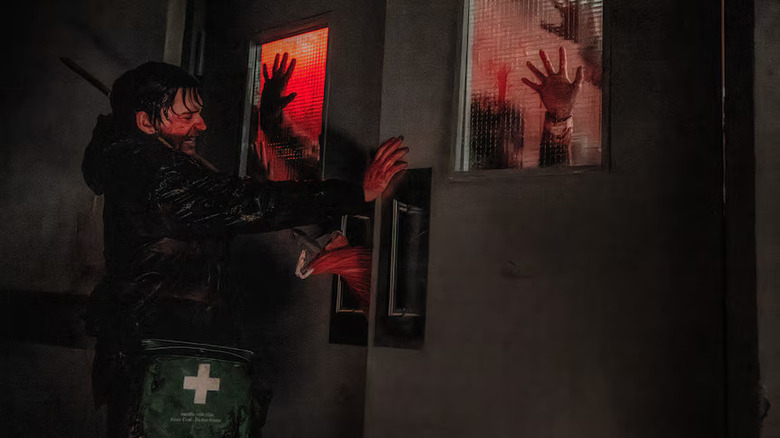
In zombie apocalypse stories, the macro disaster inevitably obscures the personal, that being that each and every zombie was once a normal person. They're dead and don't even get the dignity of a quiet rest, because their body is a shambling, cannibalistic husk the heroes have to kill twice over. That's often been true of "Resident Evil" zombies, bosses and generic enemies alike. Even as you fight them, you never forget they're victims of the Umbrella Corporation. Think of the first zombie Bryan encounters in the movie, an unnamed woman he hits with his car on some icy backroads. We never learn what her story was, and Bryan doesn't have the chance to see her as more than a threat.
One of the main bosses of the 2002 remake of the original "Resident Evil" game is Lisa Trevor, the patient zero of Umbrella's zombie virus. She's a horrifying sight, a tumorous, tentacled mass covered with the severed faces of her victims. But she also has a pitiable backstory, having spent her life as an Umbrella test subject. In "Resident Evil 2," the final boss is the mutated creator of the virus, Dr. William Birkin, who in a karmic twist of fate is undone by his own creation.
Bryan's fate as another undead monster fits into this pattern. It's like the whole of Zach Cregger's "Resident Evil" was told from the perspective of a "Resident Evil" boss, giving them the humanity the game would have no room for. If you think it's too cruel to watch Bryan struggle for 90 minutes and end up as a zombie, I get it, but that mean-spiritedness is just as true to the "Resident Evil" games.
"Resident Evil" is playing in theaters.