

5 Best Sci-Fi Movies Set Almost Entirely In One Location

Cecil B. DeMille was once quoted as saying that he could make a movie using nothing but two pages of the Bible. There is also a famous quote usually attributed to Jean-Luc Godard that all you need to make a movie is a girl and a gun (although that quote has been widely misattributed). It makes one wonder why studios bother spending hundreds of millions of dollars on single movies, when, on a practical level, so little is required to make one.
Sure, a filmmaker couldn't slap together something like "Avengers: Endgame" with just a girl, a gun, and any number of pages from the Bible. One requires hundreds of actors and craftspeople working lengthy hours to visually realize a bunch of superbeings wailing one another. And, of course, all those people need to be paid. Additionally, big-ass movies like that tend to lean into massively expensive advertising campaigns, which make the final budget bloat a tad.
But when it comes to telling a simple story of human isolation, one doesn't require a lot of sets, a huge cast, or really much of anything. Indeed, if one invents a fantastical sci-fi setting, it becomes even easier to tell a small-scale story, as a filmmaker can imprison a character or characters in a weird, high-tech box (sometimes literally, as we'll see below) and write a script wherein they slowly lose their sanity and composure. Indeed, sci-fi is a dandy genre to explore isolationism, as many sci-fi stories take place in space or on distant worlds, where humans are geographically separated from their peers by many lightyears.
The following five movies are great examples of sci-fi isolation. Each one will leave you feeling alone, so alone.
The Platform (2019)
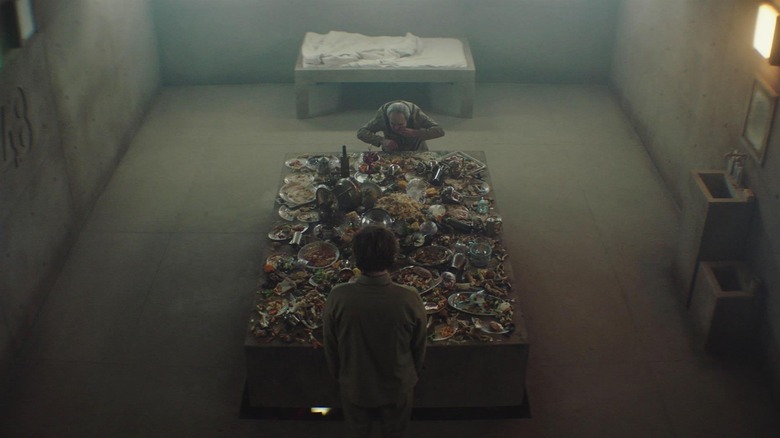
Galder Gaztelu-Urrutia's 2019 dystopian movie "The Platform" takes place in an unspecified year wherein prisons have been transformed into some kind of odd social experiment. The action is set in a silo-like concrete prison that has an unspecified number of tiers that reach deep, deep into the Earth. Each floor contains a single cell, and there is a large square hole in the floor and the ceiling. Each cell contains two prisoners, and they are welcome to look up or down into their neighboring cells. There don't appear to be any guards.
Once a day, a large floating concrete slab descends through the prison, stopping at each floor for a few minutes. It's laid out with a lavish array of foods, some of which were requested specially by the prisoners. The prisoners are permitted to each as much as they want. The catch is that the slab is not restocked as it descends. The people on the upper floors have free access to all the food they can eat, but those on the lower floors have to content themselves with scraps, provided there's any food left at all.
The commentary on social strata is evident right away. We have enough food to feed everyone in the world, but those "up top" (read: the bourgeoisie) take way more than they need, and those on the bottom (the proletariat) starve. Of course, one requires discipline to make the limited daily resources go around, but desperate prisoners in an unfair system have little to motivate them toward equality. Even as people are shuffled around the prison's floors randomly (another aspect of this bonkers sci-fi prison), they don't learn to share. And they certainly don't learn to fight the system that keeps them desperate for food.
Moon (2009)
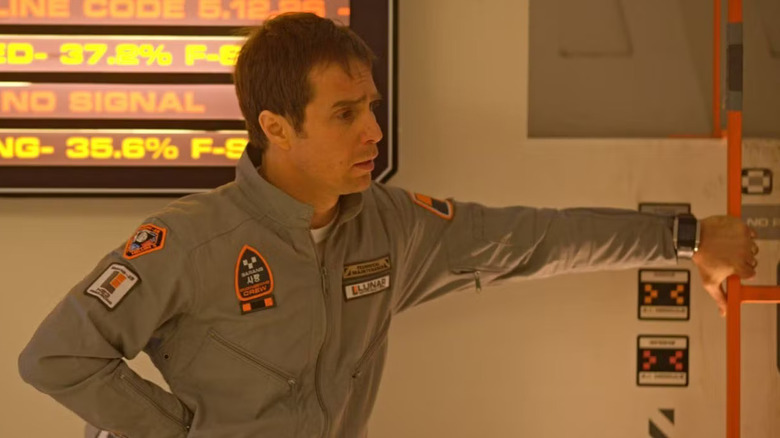
In the near future, after Earth's oil supply has run dry, astronauts have colonized the moon in order to mine a rare element called helium-3 that can work as a substitute. Well, humans haven't really "colonized" the moon, so much as they have built a mining facility that one needs one human to operate. The one human in Duncan Jones' "Moon" is Sam Bell (Sam Rockwell), a man who clocks in and out every day with an increasing sense of sisyphean ennui. He has been working there for three straight years with no face-to-face human contact, kept company only by the station's A.I. assistant GERTY (Kevin Spacey). He can't wait to get home in two weeks to see his wife and finally meet his three-year-old daughter.
Naturally, something foul is afoot. Sam begins seeing other people lurking around the station, hallucinations brought on by his isolation. When he suffers a moon rover accident, Sam awakens back at the base with no memory of how he got there. Some investigation reveals that Sam has a mysterious doppelganger out by the accident site. The two Sams don't know what to make of this, and they kind of hate each other. One of the Sams seems to think that his three-year stint on the moon is just beginning. What is going on?
Just from that plot description, you might be able to tell what the big twist in "Moon" is, but it's still a terse, pressurized drama about the horrors of loneliness. It's very telling that Sam, when he finally meets himself, isn't relieved for the company, but hateful of the interloper. Even though it's himself. Sam Rockwell, as he always does, gives a great performance as a stressed out mining wonk. Well, two of them, really.
Cube (1997)
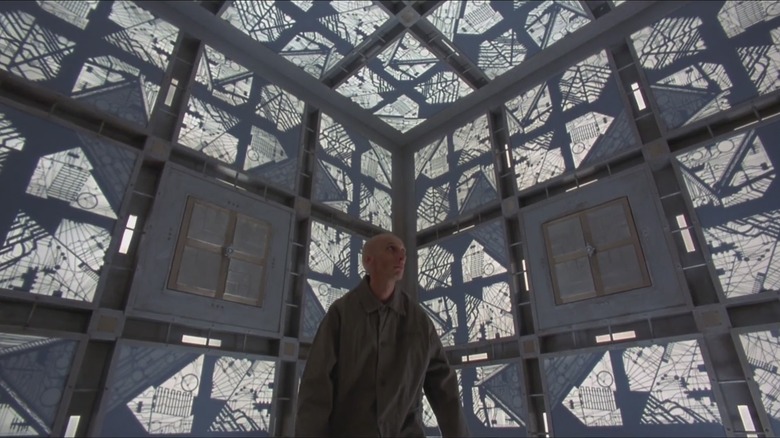
Vincenzo Natali's "Cube" caused a stir among sci-fi fans when it was released in 1997. Made on a shoestring of $350,000 Canadian dollars, "Cube" is set in a vast, ineffably large cubic prison containing an unknown number of cubic cells. There are no windows to the outside world. The prisoners in the cube arrive via kidnapping and have no idea why they have been locked up.
The cells in the cube are all identical apart from colored lights in the walls. There are hatches in all four walls of each cell, as well as in the floor and ceiling. Prisoners can move freely between cells, but the rooms appear to be randomly booby-trapped with lethal high-tech weapons. One room squirts acid. Another slices up humans with a mesh screen. That kind of thing. Oh yes, and the cubes shift around inside the prison, so it's possible to move in a straight line and pass through the same room twice.
There are six main characters in "Cube" played by Nicole de Boer, Andrew Miller, Maurice Dean Wint, David Hewlett, Nicky Guadagni, and Wayne Robson. They find each other clawing their way through the moving maze, and begin to posit why they're there, who built the cube, and how the traps work. There are numerical codes in each cell, so they can perhaps suss out some clues from them. Overall, though, the six figures just become desperate, wrathful, and ultimately murderous over the imprisonment.
"Cube" was clearly shot on the cheap, with the filmmakers reusing the same cell set over and over, only changing the colored lights in the walls. It's a brilliant, efficient movie that remains scary and unknowable throughout. Over the years, it has developed a cult, and even spawned a few sequels and a Japanese remake.
Iron Lung (2026)

Released in January of 2026, Mark "Markiplier" Fischbach's psychedelic horror film "Iron Lung" was a strong piece of evidence that Hollywood was more or less done for. A new generation of YouTubers was coming to the fore, and they would continue to infiltrate the mainstream with movies like "Obsession" and "Backrooms" later in the year. Other films like "Skinamarink" and "The Amazing Digital Circus" were further proof of the shift away from 2010s I.P.-milking, all while big movies like "The Mandalorian and Grogu" and "Supergirl" began reliably tanking at the box office. "Spider-Man: Brand New Day" is more an exception than a return to form.
"Iron Lung" is a gross, bloody, brain-melting movie about a prisoner named Simon (Fischbach) who has been sealed into a small submarine, and is being lowered to the bottom of the ocean on a distant alien world. It's never explained why, but the oceans on this world are filled with blood (!). When Simon's craft lands on the ocean floor, it shifts about, as the blood is clotting underneath him (!!). He can only see out into the ocean using an x-ray still camera, which can only flash for a moment. He's desperate, unskilled, and can't really concentrate on the job at hand. Naturally, there are vast, unknowable Lovecraftian horrors lurking in the blood ocean around him.
"Iron Lung" may run a little too long at 125 minutes, but Fischbach has managed to capture a nightmarish sense of desperation. He can barely survive in the depth of the sea, his mind unraveling faster than the leaking walls of his craft. There is a plot to "Iron Lung," of course, but you'll walk away only remembering the terror, the empty, bloody terror.
Dark Star (1974)
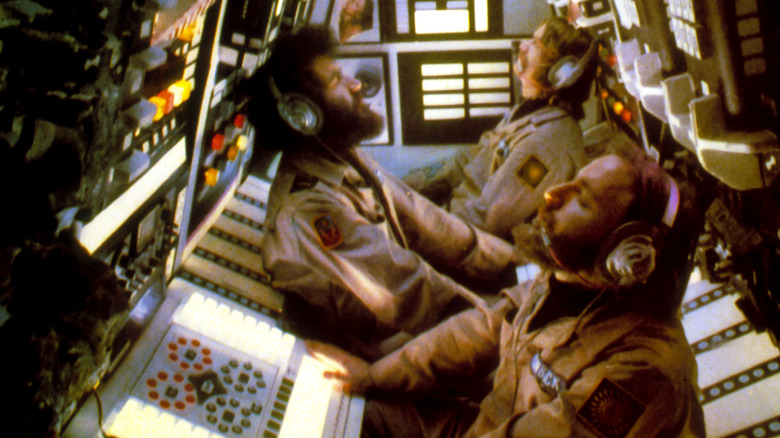
John Carpenter's first feature is also one of his most thoughtful. Like "Moon," "Dark Star" is also about working schlubs who have been trapped away from Earth for three years, although, thanks to relativistic time, about 20 years have elapsed back home. There's no real returning for them. As such, the three main characters (played by Dan O'Bannon, Brian Narelle, and Cal Kuniholm) have become distant and indifferent to their fate. They have encountered an alien being, but the discovery of alien life doesn't impress them. It doesn't help that the alien looks like a beach ball with feet.
It's the three astronauts' job to find "unstable" worlds, and lazily use their arsenal of nuclear weapons to blow them up. They are gods of destruction, but they don't really care. The bombs are overseen by an artificial intelligence, which seems like a bad idea. Of course, when one of the armed bombs becomes clamped to the ship, unable to deploy, one of the astronauts has to trek out to the exterior of the starship, face the bomb in person, and try to talk it out of exploding. "Dark Star" climaxes with an existential discussion about duty, and the purpose of existence. The bomb argues that it will no longer fulfill its function as a sentient being if it doesn't explode. The astronaut argues that we have free will.
"Dark Star" is nihilistic in the funniest way. It's about how despair and futility are actually kinda kooky when you think about it. Sure, we may all blow up someday, but that might be more exciting than the loneliness and the excruciating, excruciating boredom. The $60,000 flick led to an amazing career for Carpenter, who explored similar themes, albeit less comedically, in his 1982 film "The Thing."