

5 Forgotten '80s Action Thrillers That Still Hold Up Today
The 1980s were a golden age for high-octane action thrillers. It was the inevitable result of a genre evolution that began in the '60s and '70s with full-throttle New Hollywood works like "Bullitt," "The French Connection," and "Vanishing Point." Then came car chase opuses like "Gone in 60 Seconds," "Dirty Mary, Crazy Larry," and "Smokey and the Bandit," which gloried in the recklessness of stunt-heavy sequences that either defied gravity or challenged logic. And then everything changed.
By 1980, action thrillers were major box office attractions. Sylvester Stallone, Chuck Norris, Charles Bronson, and Arnold Schwarzenegger had become the kings of the box office. The movies were often gratuitously violent celebrations of vigilante justice or due-process-flouting police work. Bronson's movies (e.g. "Death Wish 3," "10 to Midnight," and "The Evil That Men Do") were particularly nasty, but moviegoers' Reagan-era bloodlust had to be sated. Sometimes the thriller elements of these movies, particularly when they involved serial killers, turned them into quasi-horror films. They could go very hard, which was a massive turn-off for most critics.
The best action thrillers of the decade came at the genre sideways. They had unique hooks, or crazily subverted conventional premises. And there were so many of them that some of the best managed to get lost in the shuffle over the subsequent decades. Here are five '80s action thrillers that have lost none of their invigorating power.
The Stunt Man (1980)
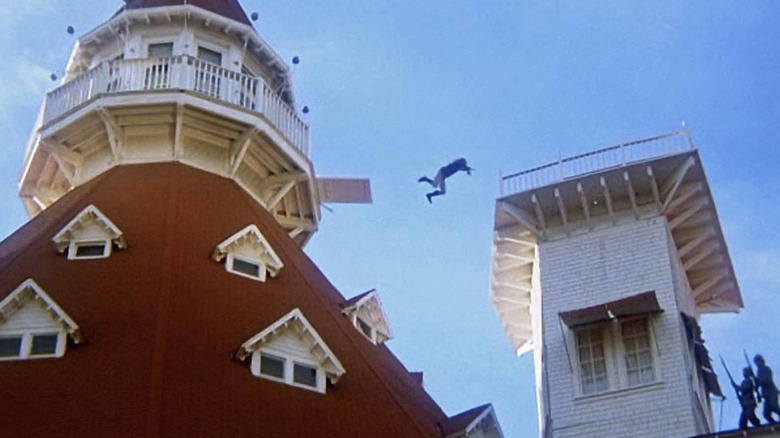
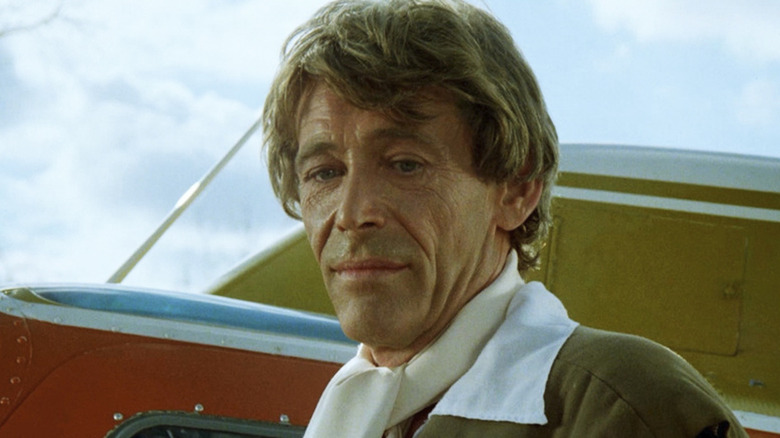
For cinephiles of a certain age, Richard Rush's "The Stunt Man" is far from a forgotten movie, but the 1980 darkly funny action thriller about a filmmaker who may be trying to kill the stunt double for the star in his epic war movie has failed to catch on with millennials and subsequent generations. It seems to stream fairly regularly, and is stuffed with spectacular set pieces. It was also nominated for three Academy Awards: Best Director (Richard Rush), Best Adapted Screenplay (Rush and Lawrence B. Marcus), and Best Actor (Peter O'Toole). Most importantly, it's enormously entertaining from start to finish. So why haven't the youngsters discovered it?
I've twice watched Rush's movie in a packed repertory house, and it plays like gangbusters every time. O'Toole is a study in slyness as director Eli Cross, who takes on Vietnam veteran Cameron (Steve Railsback) to replace a mysteriously missing stunt man. Cameron's a fugitive from the law for attempted murder, and while the gig gives him good cover, he can't shake the suspicion that Cross is placing him in grave danger on purpose. The viewer is kept off balance throughout the movie as Cameron performs wildly perilous feats that would never be allowable on a modern film set (a highlight being a vertiginous rooftop scamper across disconcertingly unsteady tiles). Cross seems almost omniscient, swooping down from the sky on his camera crane even when nothing's being shot, which makes the film feel as if it takes place in a heightened reality. Rush keeps the film barreling forward at a breakneck pace, never giving the audience time to question the internal logic. It's an exhilarating, masterfully directed ride that's a must-see for action junkies. (Jeremy Smith)
The Dead Pool (1988)
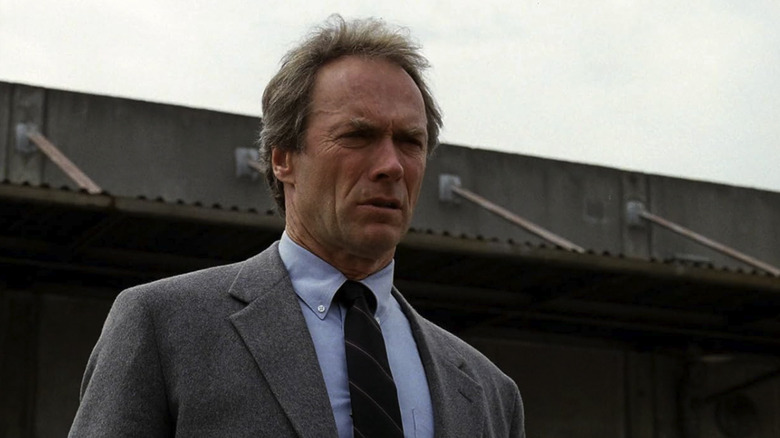
Dirty Harry is a truly iconic character in action cinema history. Brought to life brilliantly by the great Clint Eastwood, the character had a pretty impressive run from the early '70s through the late '80s. "Dirty Harry" inspired some controversy, but was popular nonetheless. However, Eastwood's final turn as the trigger-happy cop, "The Dead Pool," isn't nearly as often discussed as the other entries. All the same, it's an effective action flick that warrants discussion.
It focuses on San Francisco police inspector Harry Callahan, who's fresh off the conviction of a major mob boss. The action then switches to horror film director Peter Swan (Liam Neeson) who develops a "dead pool" that involves betting on celebrity deaths. Swan is shocked when a serial killer begins targeting those named, including TV reporter Samantha Walker (Patricia Clarkson) and Callahan himself.
Directed by Buddy Van Horn, "The Dead Pool" has a semi-meta "movie about making movies" premise, which provides a change-up to the formula for the series. It's not generally ranked high in the "Dirty Harry" franchise, but it's worth a second look. For one, it's a slightly older Eastwood transitioning into the man he'd become in the 1990s and beyond. Also, not for nothing, it features a truly wild performance from a young Jim Carrey that's worth the price of admission alone.
Time has been strangely kind to this movie. A swan song for a series that had a tremendous impact on the culture, it's better than its reputation suggests, anchored by a fantastic cast. Less grimy than its predecessors but retaining the cop mystery elements that made the series work, it's still a good time. (Ryan Scott)
Shakedown (1988)
James Glickenhaus had the strangest filmmaking career. Before retiring in the mid–1990s to become a car manufacturer, he co-ran the schlock factory called Shapiro-Glickenhaus Entertainment, which, if nothing else, supported cult-horror maestros Frank Hennenlotter (the "Basket Case" sequels and "Frankenhooker") and William Lustig ("Maniac Cop" and "Maniac Cop 2"). When Glickenhaus affixed his name to a movie, you were guaranteed a gooey dollop of sleaze.
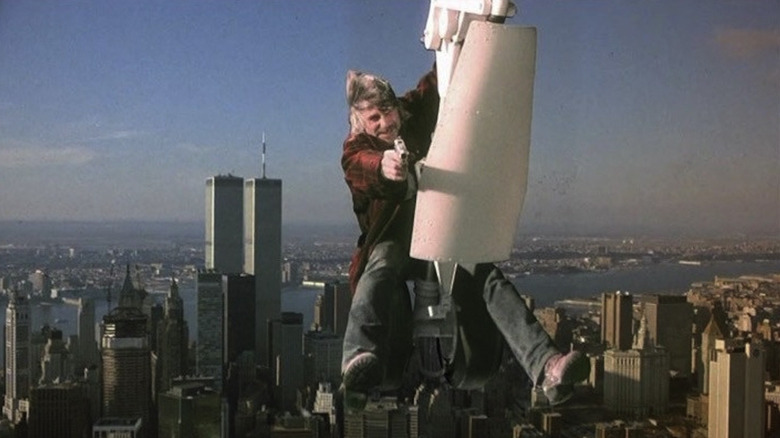
"Shakedown" was a shocking exception. The 1988 film stars Peter Weller (one year removed from "Robocop") as a weary New York City public defender who's about to marry into money. Alas, he catches one last case that requires him to represent a crack dealer (Richard Brooks) who shot a corrupt NYPD cop (Jude Ciccolella) in self-defense. To clear his client, he enlists the assistance of rough-and-tumble narcotics detective Richie Marks (Sam Elliott), who routinely finds himself caught up in improbable set pieces involving conveyances such as rollercoasters and jumbo jets. The latter sequence is ludicrous beyond belief, but because Glickenhaus has spent the entire movie establishing that physically impossible feats are possible in this world so long as Sam Elliott is involved (which is the way it should be), you cheerfully buy it. Weller and Elliott are fun together, and you get hammy character turns from Antonio Fargas and John C. McGinley. The budget's low, but Glickenhaus's skill level is, for the first and last time in his career, high. "Shakedown" is a raucously mindless '80s action classic. (Jeremy Smith)
Hard Ticket to Hawaii (1987)
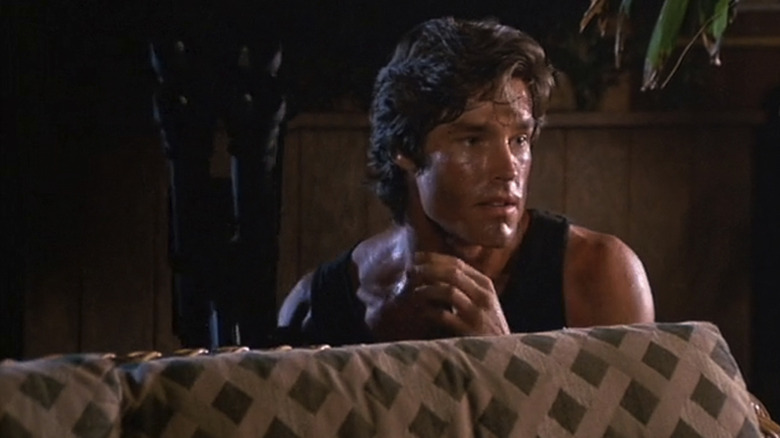
Every lover of action cinema deserves to experience the glory of "Hard Ticket to Hawaii" at least once. For certain types who appreciate what the realm of B-movie cinema has to offer, this is by no means a forgotten relic. For many others, though, it's an absurd diamond waiting to be discovered in the caves of vast '80s genre canon. It's not "great" in the traditional sense, but it's great in a way few movies can claim to be. It's the absolute best kind of "bad" movie in existence — the kind that can't be made on purpose, but instead is a glorious accident of good intentions gone haywire.
Directed by the legend that is Andy Sidaris, it focuses on two secret agents (Dona Spier and Hope Marie Carlton) who intercept a delivery of diamonds intended for a drug lord. This kingpin and his henchmen launch a full-scale assault on the duo, and to survive, they recruit agent Rowdy Abilene (Ronn Moss) and his partner/kickboxing expert Jade (Harold Diamond). Delightfully unhinged chaos ensues.
For the initiated, "Hard Ticket to Hawaii" is one of the best action movies ever made. For the uninitiated who can appreciate the grindhouse-y, schlocky, over-the-top action on offer, it's a treasure yet to be uncovered. If ever there were an exercise in a lack of restraint, this is it. If ever there were an example of "you don't need a lot of money to make magic," this is it.
The violence is over the top. The dialogue is delightfully cheesy. The humor is unintentional. It's absurd in the best of ways. It has stood the test of time in a way nobody could have been anticipated, but should absolutely be appreciated. (Ryan Scott)
Psycho 2 (1983)
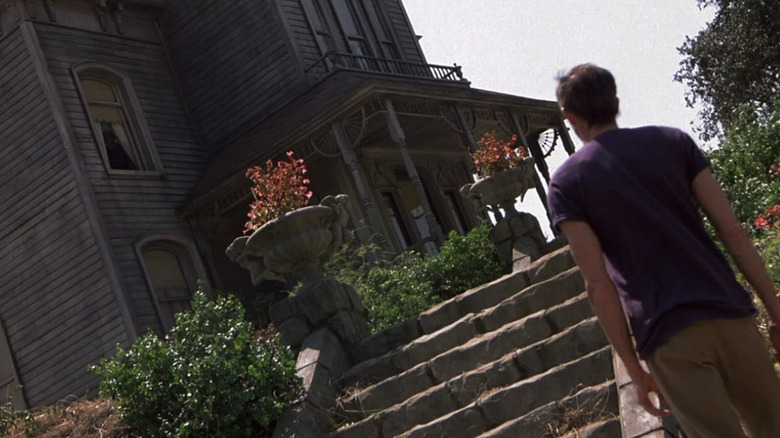
Alfred Hitchcock's "Psycho" is one of the best horror movies ever made. There's no disputing that. Making a sequel to that movie 20 years later feels like a fool's errand, destined to feel lesser-than. However, 1983's "Psycho II" is nothing shy of a minor miracle in that it's an incredibly effective thriller that doesn't sully the reputation of the classic it's following in the footsteps of. It's a genuinely good sequel. Surprisingly so.
Directed by Richard Franklin, it's set two decades after the original murders at the Bates Motel. Norman Bates (Anthony Perkins) completes his treatment at a mental institution and is released. He returns home to find his hotel run down under the management. Despite a new friendship with a waitress and a job busing tables, Norman begins to hear voices again. Mother is back, coaxing him to unleash his inner homicidal maniac.
There's a lot to love about this movie. For one, Perkins delivers another incredible performance as Norman Bates, offering more depth to the character, which goes a long way. It also looks rather good, a credit to Franklin having to follow in Hitchcock's footsteps. Without spoiling it for those who haven't seen it, there are also some wild twists and turns along the way, too. There's a reason why Quentin Tarantino likes this horror sequel more than the original classic.
It's not terribly heavy on action, but it's one heck of a thriller, and one that doesn't get talked about nearly often enough — especially in terms of sequels that have no right being as good as they are. (Ryan Scott)