

Spider-Man: Brand New Day's Most Impressive Visual Effect Is Almost Impossible To Spot
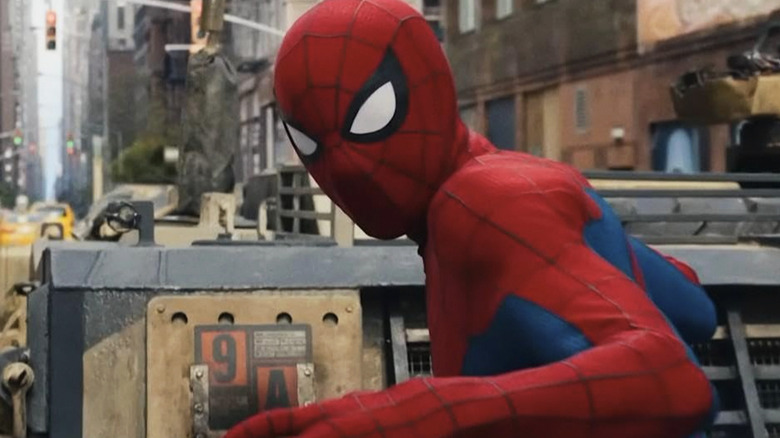
"Spider-Man: Brand New Day" wrote its way into the record books this year, passing "Star Wars: The Force Awakens" to become the highest grossing domestic release in history. Tom Holland's best outing yet puts Spider-Man through the wringer as the webslinger faces off against Jean Grey (Sadie Sink), a rampaging Hulk (Mark Ruffalo), the ninja group The Hand, and much more in a variety of visual effects-fueled set pieces. But the film's most impressive visual effect is one you almost certainly didn't notice at all.
A veritable army of people across multiple companies worked behind the scenes to bring "Spider-Man: Brand New Day" to life, and /Film's Rafael Motamayor recently spoke with Chris Waegner, one of the VFX supervisors, who revealed that he and his team at Sony Pictures Imageworks utilized "billions and billions of polygons" to create a digital version of New York City, complete with fake cars, pedestrians, simulated river water, and volumetric steam rising out of rooftops for around 500 shots in the final film. Compared to the work done on "Spider-Man: Homecoming" nearly a decade ago, this marked "a huge step forward" for the technology. Here's how Waegner and his team pulled off the seamless immersion in "Brand New Day."
Spider-Man: Brand New Day's VFX artists turned Scotland into NYC
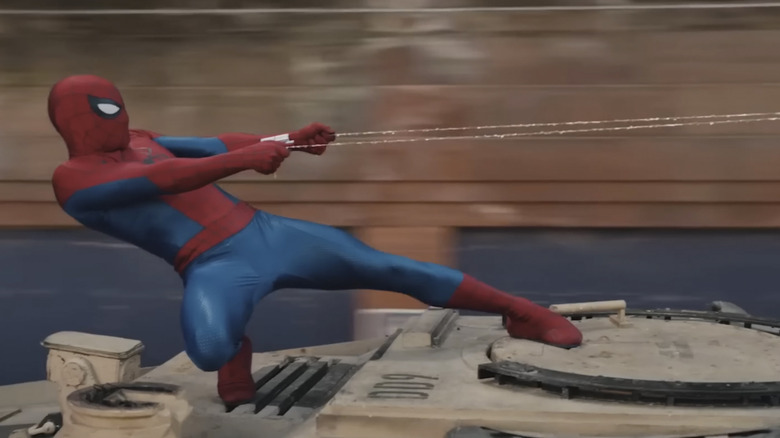
As Chris Waegner explained, the film's opening tank chase was shot in Glasgow, Scotland, and director Destin Daniel Cretton and the movie's producers wanted the action to seem like it was taking place in The Big Apple. But due to production limitations, "there's only so much they can really do to physically augment the streets of Glasgow to look like New York City." So, they leaned heavily on Waegner and his team to make it happen in post-production. Not that it was an easy ask, mind you:
"You have to take into consideration they shot for a considerable amount of time on the street. So, time of day is different, weather conditions are different, cloud cover is different. And what ends up happening is they go off their storyboards and they shoot this giant sequence — different streets, things like that — and then they reassemble it all in editorial. And then as digital filmmakers, you have to put it all together. So, one day it may have rained and is overcast, and then the next shot is bright and sunny. So, not only do we have to manipulate the environments, but we also have to manipulate the time of day, atmospheric conditions, if it was a little bit foggy on that day, if it was raining."
Matching the weather conditions after the fact seems difficult, but the job required far more than that:
"One of the things that's interesting about Glasgow is there's a lot of architecture in Glasgow that isn't really New York City-esque, if you will. So, there were a lot of building replacements. So, we would take one of our digital buildings that we have in our library from a New York City or a more typical U.S. city-type building, [and] drop that building into that environment. So, all the cameras had to be tracked, all the buildings had to be mapped out [...] We have to go in and basically almost rebuild every single building on the street."
Cultural specificity was important to making Brand New Day feel real
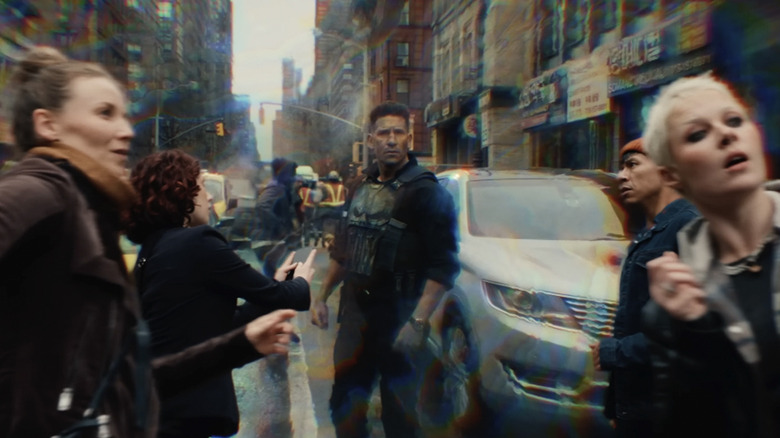
In addition to things making sure all of the cars are in the right places throughout a sequence, Chris Waegner pointed out that cultural specificity was crucial to maintaining the illusion for audiences:
"Things like street signs are different between the U.S. and Glasgow. Traffic lights are different. Pedestrian lights are different. Painting, crosswalks are different. Signage on the streets, signage inside windows like 'New York style pizza,' that's not very common in Glasgow. Mailboxes, garbage cans, dumpsters, construction areas. As you start putting the sequence together, and you start looking at it in context, you start seeing more and more things that you need to fix to keep people engaged with the story and not getting visually bumped out of the story because something isn't working.
I mean, one thing in particular was there was a big bus, and it was in a bunch of shots, and all of a sudden, because of how the story evolves, the bus all of a sudden disappears. Okay, well, we didn't anticipate building a digital bus, now we're building a digital bus, and [we've] got to put people in the bus. And even as you're building these streets and you're augmenting with different buildings, you say you're going to drop in a digital building here, but then that digital building, the window reflections have to match the plate buildings on the other side of the streets."
That level of attention to detail — making sure the reflections are accurate — is something that audiences don't consciously think about when they're watching a film, but they might notice if it wasn't accurate.
Inserting a digital asset caused a cascading series of consequences on Brand New Day
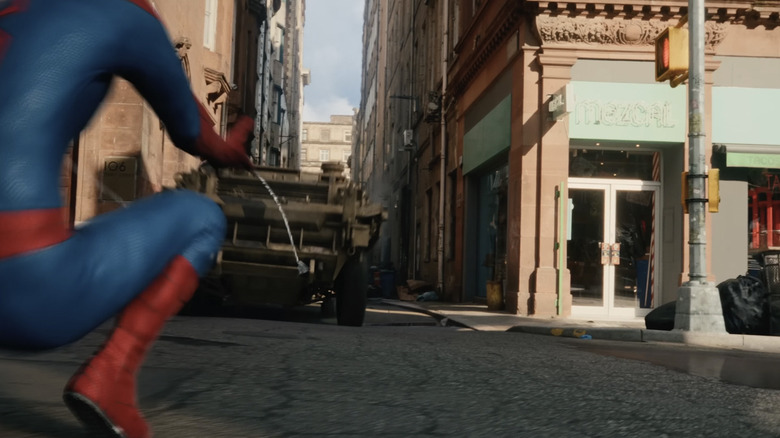
Another invisible effect Waegner told /Film about involves the street itself, which sometimes has to be fully digital as well. And it can't just be a uniform slab of concrete. It needs signs of life, like cracks, different colors, puddles, manholes, litter, and more. Plus, it has to convincingly be placed underneath things like parked cars, and all the shadows have to make sense.
That "everything matters" approach extends to locations above the street as well:
"You add fire escapes and you're like, 'Okay, these look like fire escapes. The building looks good.' And then you look at photo reference, and fire escapes are not just as simple as fire escapes. People usually use those as an extension to whatever room the fire escape's at. So, you start adding bicycles, and you start adding clothes, and you start adding plants, and the visual layering that needs to be done to make it believable. And the filmmakers — Destin and our visual effects supervisor, Jerome Chen — really wanted to make it feel gritty. So, on top of that, the buildings can't be freshly-painted buildings, because when you look at buildings and you look [at] photo research, you have to do staining on the buildings and you have to put some ivy and things like that.
Then you start looking at that, and you're like, 'Oh, we have to add some trees and foliage, and now the leaves need to move around.' So, it kind of becomes a house of cards, in a way, where you keep adding and adding and adding. And even though you get the first edit, and you think, 'This looks great,' by the time you look at the final end result, there's so much augmentation that's ended up happening throughout the course of the sequence that it's a tremendous amount of work, many artists working on it."
Next time you give "Spider-Man: Brand New Day" a spin, I hope you'll watch it with an extra appreciation for the unsung heroes of the movie: the teams of artists who toiled away on these tiny details to make sure we all were sucked into the action and never taken out of the story.