

This Landmark '70s Western Miniseries Everyone's Forgotten About Was Based On A Beloved Book
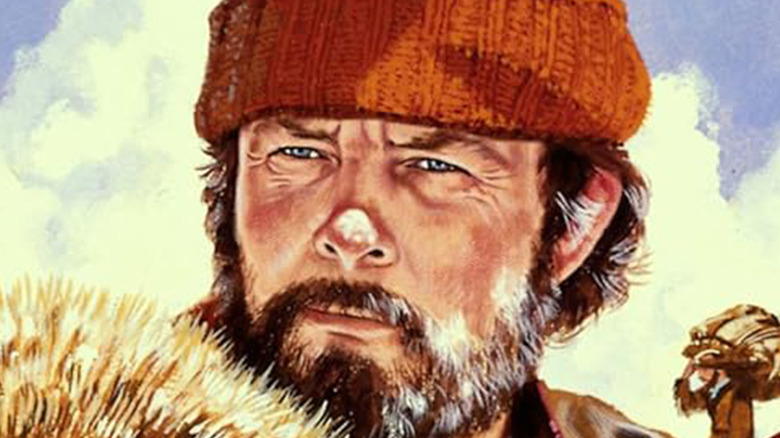
We've had some excellent Westerns in the 21st Century, but the 1970s was the last great decade for the genre. As the traditional Oater's popularity faded, a revisionist style flourished, led by figureheads such as Clint Eastwood who deconstructed the very genre that made him a star. It was during this tumultuous time that we also got the almost forgotten miniseries "Centennial," which given its massive budget and scale, should be much more well remembered than it is.
By 1978, Eastwood had taken a break from Westerns and was busy traveling the United States with his orangutan pal in the risky project that was "Every Which Way but Loose." In his place came an unlikely temporary replacement in Jack Nicholson, who that same year debuted one of his few Westerns, "Goin' South." Critics weren't too impressed. Thankfully, Terrence Malick also gave us "Days of Heaven," which was more period drama than Western, but was a hit with critics nonetheless. Over on the small screen, James Arness was leading the ABC series "How the West Was Won," and fellow TV Western luminary James Garner returned to one of his best known roles in "The New Maverick."
At the same time, NBC unleashed its grandiose Western miniseries "Centennial," which across 12 episodes told the story of the American frontier via a study of the titular Colorado town. It was a hugely expansive and expensive project featuring established stars and even country legends, overseen by four directors and shot in multiple locations around the United States. Today, it's all but forgotten.
Centennial was sprawling, but the book was even more epic
"Centennial" was based on James A. Michener's 1974 novel of the same name, which sat at number one on the New York Times bestseller list for 28 weeks between 1974 and 1975. The critically-acclaimed book was even more epic than the TV adaptation, beginning in prehistory and charting the evolution of the eponymous Colorado town right up to the 1970s.
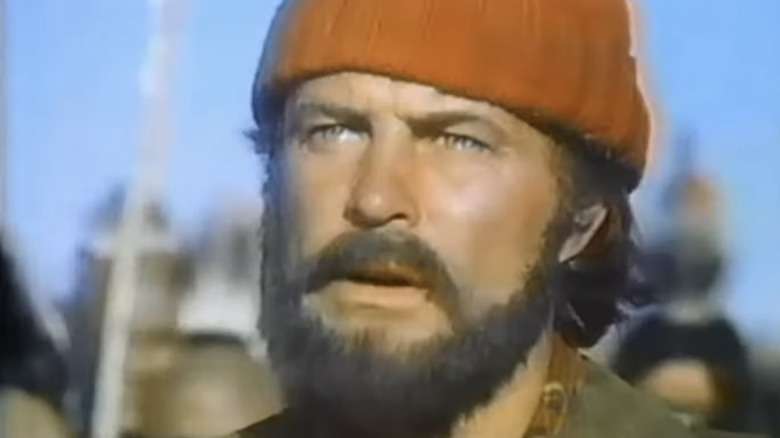
The TV series aired on NBC from October 1978 to February 1979 and, like the book, told a fictionalized history of the town of Centennial, Colorado. Rather than starting in prehistory, however, the show picks things up in 1795 and runs all the way through to the 1970s. Executive producer and writer John Wilder adapted the original novel for TV alongside fellow scribes Charles Larson and Jerry Ziegman. Their version of the story picks things up in 1756 by focusing on Native American tribes before shifting to 1795 and the arrival of fur trapper Pasquinel (Robert Conrad).
Alongside Scottish trader Alexander McKeag (Richard Chamberlain), Pasquinel settles in the area that later becomes known as Centennial. Soon, more settlers arrive, played by an all-star cast that includes Richard Crenna, Raymond Burr, Timothy Dalton, Donald Pleasence and even country music legend Merle Haggard just to name a few. Over the course of the next 200-odd years, we see how the area develops, often at the expense of its natural beauty and the pain and suffering of the native inhabitants. "Centennial" is not often mentioned among other classic TV Westerns, but it arguably should be.
Centennial was a hugely ambitious TV project that's hard to find today
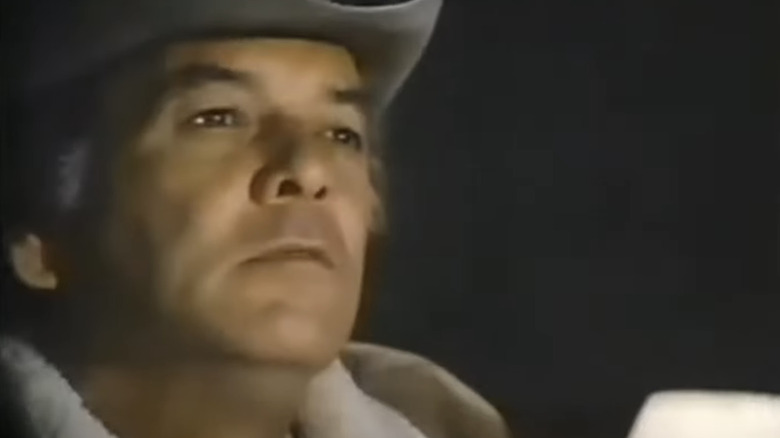
In its final episodes, "Centennial" focuses on the then-modern era of the 1970s, where rancher Paul Garrett (David Janssen), a direct descendent of the original settlers, wants to preserve the natural environment. However, he clashes with another prominent resident of the titular town, Morgan Wendell (Robert Vaughn), who wants to expand industry with little concern for the environmental impact. Throughout it all, there's even a murder mystery which takes two centuries to solve.
It all adds up to a series that's nothing short of epic and one of the best Western TV shows of the 1970s, which makes it even more puzzling that it's been mostly forgotten. According to the New York Times, "Centennial" was the "most expensive and most complicated" TV project made at the time. NBC reportedly spent $25 million on the show, which employed four directors (Harry Falk, Paul Krasny, Bernard McEveety, Virgil W. Vogel), five producers, five cinematographers, and featured almost 100 speaking parts and hundreds of extras.
Contemporaneous reviews are hard to come by, but in a 2020 retrospective for the San Francisco Chronicle, Zaki Hasan claimed to have fallen in love with it, writing, "the narrative and themes of 'Centennial' — about respecting the land so that it respects us — are still as timely as ever." The show was also nominated for two Emmys, editing and art direction, upon its initial release. Today, however, it's hard to track down on any legitimate streaming platform, though in the spirit of the show itself, less legitimate online sources have preserved this ambitious piece of TV history.