

This Classic Crime Thriller Was A Major Influence On Joker In Christopher Nolan's The Dark Knight
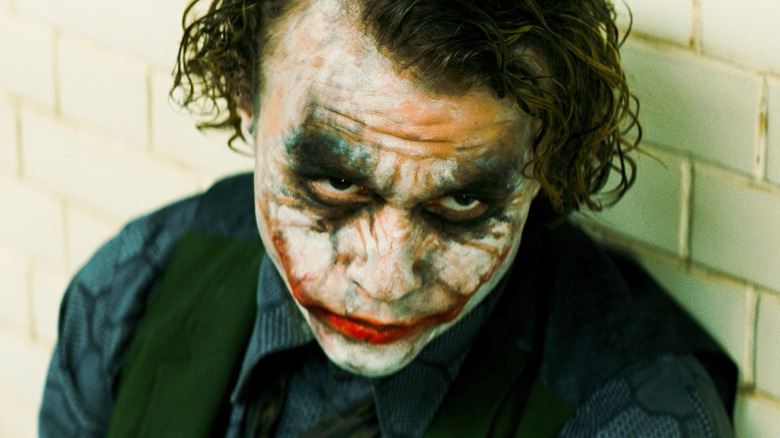
While visiting the Criterion closest in July 2026 as part of the press tour for "The Odyssey," Christopher Nolan selected movies like Godfrey Reggio's experimental documentary "Koyaanisqatsi." He also picked out Fritz Lang's 1933 film "The Testament of Dr. Mabuse," itself both a crime thriller and one of Germany's great horror movies. Calling the titular villain (played by Rudolf Klein-Rogge) "an amazing mastermind criminal," Nolan noted, "We looked at Dr. Mabuse a lot, my brother [Jonathan Nolan] and I when we were doing 'The Dark Knight' for the character of the Joker."
Several of Nolan's picks during his 2026 Criterion visit were ones he previously compiled into a list for Criterion in 2013, including "Dr. Mabuse." Nolan described the picture as "essential research for anyone attempting to write a supervillain."
The character of Dr. Mabuse is a criminal mastermind with hypnotic abilities that he's used to build a racketeering empire. Mabuse originates from a novel, 1921's "Dr. Mabuse, the Gambler" by Norbert Jacques, which Lang made into a silent film the following year. When Jacques wrote a sequel, "The Testament of Dr. Mabuse," 10 years later, Lang followed him and adapted the sequel (this time with sound).
Dr. Mabuse was defeated at the end of his first appearance, and "Testament" picks up with him still institutionalized in a mental asylum. He doesn't speak, but he does write down criminal plans that, somehow, a terroristic gang in the outside world is putting into effect.
As a notorious criminal with a talent for getting inside people's heads and who's still a threat behind bars, Dr. Mabuse can be read as a proto Hannibal Lecter. But more than that, Lang intended Mabuse's words, and the hypnotic effect they have in pushing people to violence, to reflect another prison-written manifesto afflicting Germany: "Mein Kampf."
Dr. Mabuse and the Joker both seek chaos
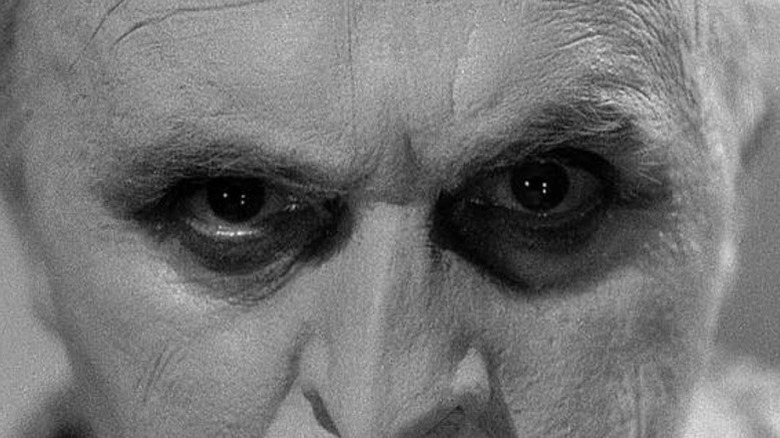
Rudolf Klein-Rogge doesn't get that much screentime as Mabuse in "Testament." The character actually dies halfway through the film, but his evil legacy endures. Mabuse has indoctrinated the asylum's head doctor, Baum (Oscar Beregi), and Baum is the one passing along the doctor's criminal designs.
A pivotal scene shows Baum reading some of Mabuse's writing before a ghostly Mabuse appears and possesses him. This could be symbolic of indoctrination, or perhaps Mabuse has literal mind transference powers. Either way, by the end of the film, Baum is convinced that he is Mabuse and is sitting in a cell just like the doctor was at the start.
Crime, chaos, and destruction are goals unto themselves in Mabuse's eyes. "The ultimate purpose of crime is to establish the endless reign of crime. A state of complete insecurity and anarchy, founded upon the tainted ideals of a world doomed to annihilation," his writing declares.
Those words certainly sound like ones that Heath Ledger's Joker might say. In "The Dark Knight," he self-aggrandizes as "an agent of chaos," burns a mountain of mob money because crime is about something deeper to him, etc. The Joker also orchestrates his own capture (and then escape) during the movie, echoing Dr. Mabuse in adapting his evil designs around being imprisoned.
It's while the Joker is locked up that he executes his most devastating blow against Batman (Christian Bale). Having had both Harvey Dent (Aaron Eckhart) and Rachel Dawes (Maggie Gyllenhaal) captured and strapped to ticking time bombs, the Joker leaves Batman just enough time to save only one of them. The Joker's subsequent corruption of the scarred Dent, turning an upstanding man into another agent of crime, mirrors Mabuse possessing Baum, too.
Could the Joker have ended up like Dr. Mabuse?
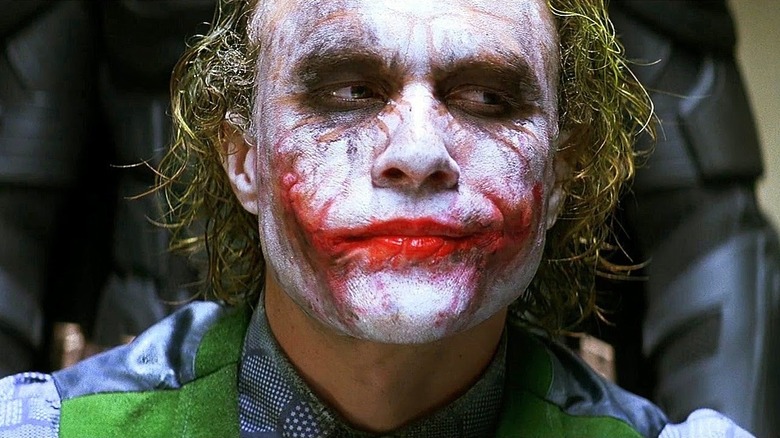
The Joker's final scene in "The Dark Knight," musing he and Batman are "destined to do this forever" as he's arrested, works as a thematic ending. The Joker is an unstoppable force that meets a bat-shaped immovable object, and they'll keep clashing without ever killing each other — Batman because he has a moral code, Joker because he's having too much fun. But that ending was also leaving the door wide open for a third film to use the Joker again. Sadly, "The Dark Knight Rises" had to shut that door.
"The Dark Knight Rises" exists as it does because of Heath Ledger's tragic passing. If he'd been still alive and available to return as the Joker, then the third "Dark Knight" film might've been unrecognizable from what we actually got. Bane (Tom Hardy) was introduced to fill the void of a worthy enemy of Batman. If the Joker was available, would Christopher Nolan even bother with Bane? "Dark Knight" trilogy co-writer David S. Goyer admitted this in a 2021 interview with The Hollywood Reporter, saying if Ledger hadn't died, "that would have completely changed the polarity of the third film."
This is purely speculative, because Nolan never actually made any plans for how to use the Joker in a third movie. Ledger died months before "The Dark Knight" premiered, and Goyer confirmed in that same THR interview that he and Nolan didn't start discussing a third movie until "The Dark Knight" was already out. But perhaps Nolan could've gone back to Dr. Mabuse, with the Joker spending the film locked up in Arkham Asylum yet still a major threat. That's the central contradiction of both Mabuse and the Joker: They're "agents of chaos" who organize criminal empires to enact their will.