

TV Veteran Leif Erickson Played A Small Part In One Of The Best Movies Ever Made
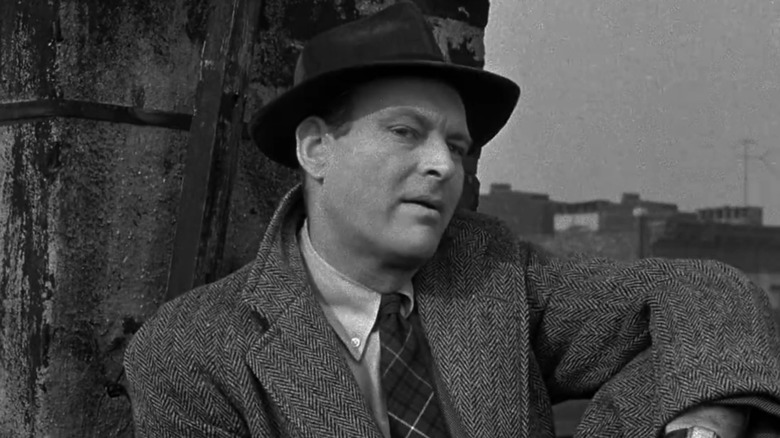
When some people hear the name "Leif Erikson," they'll think of the 10th-11th century Norse explorer believed to have been the first European to have sailed to North America. (Erikson's name for his discovery was "Vinland.") But for others, their minds will go to Leif Erickson, the 20th century actor known for various TV and film projects, among them the underrated 1960s Western show "The High Chaparral." Erickson's almost 50+ year career also includes a supporting role in one of the greatest films to ever come out of Old Hollywood: the 1954 Elia Kazan-directed crime drama "On the Waterfront," a star vehicle for Marlon Brando.
Brando plays Terry Malloy, a New Jersey longshoreman forced to take a courageous stand. Terry has long lived his life under the thumb of corrupt union boss "Johnny Friendly" (Lee J. Cobb). Once a prizefighter, he took a dive at the request of Friendly and his gangster brother, Charley Malloy (Rod Steiger), turning him from contender to schnook. When Terry accidentally lures the soon-to-testify dockworker Joey Doyle (Ben Wagner) to his death, he ultimately decides to take Joey's place and inform on Friendly's corrupt grip on the union and extortion of its members.
Erickson shows up twice in the film as Glover, an investigator for the Waterfront Commission of New York Harbor. He first appears about 13 minutes into the movie, sniffing out Terry on the docks and asking him if he knows anything about Joey Doyle. Glover plays a comparatively good cop to his fellow investigator, the pushy Gillette (an uncredited Martin Balsam). Glover returns an hour later, tracking Terry to the rooftop where he tends to a pigeon coop. Erickson is a pure supporting player in his scenes, but he does his job of helping bring out the best in Brando.
The controversies that overshadow On The Waterfront, explained
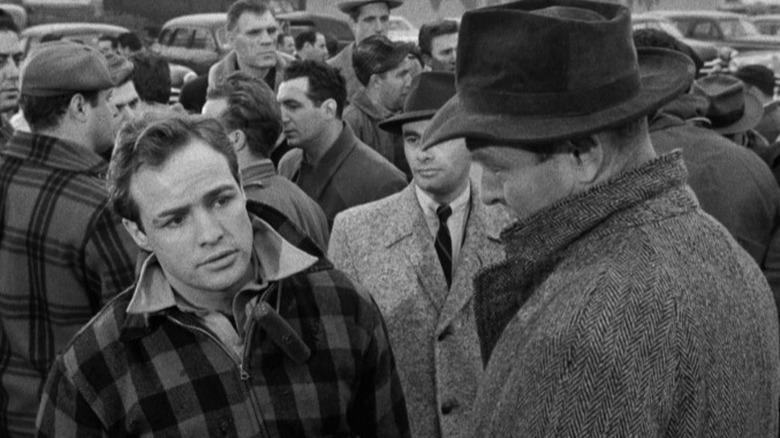
By the end of "On The Waterfront," Terry does inform on Johnny Friendly, survives a beating from Friendly's thugs, and inspires the other dockworkers to no longer fear Friendly. It's a triumphant ending for Terry and any viewer watching. However, knowing the movie's offscreen history adds shades of gray. "On The Waterfront" was based in broad strokes on a 1948 New York Sun article about real corruption on the New York metro area docks, but that's not all.
Acclaimed playwright Arthur Miller had also (in 1947) written another screenplay for Columbia Pictures about mob control over the New York-New Jersey longshoremen's unions, titled "The Hook," and Elia Kazan had even been in line to direct. But "The Hook" never happened, in part because Miller refused a studio note to make the villains into communists. Then, in 1952, Kazan infamously testified before the House Un-American Activities Committee (HUAC). He named names of eight suspected American Communist Party members working as actors and writers, including Miller. Unsurprisingly, Miller and Kazan's friendship didn't survive.
It's now widely accepted that "On The Waterfront" is Kazan's heroic portrait of himself and his actions as an informant. (The film's screenwriter, Budd Schulberg, also named names to HUAC after being named as a former communist himself.) Think about it: A corrupting influence has infiltrated a labor union and twisted it for their own purposes (here, a dockworkers' union instead of the Screenwriters Guild). Then, the hero of the picture is the person who tells on them. The scenes of Leif Erickson's Detective Glover sniffing out Terry as a witness play a little differently when you know that, huh?
On The Waterfront is both self defense and a cinematic masterwork
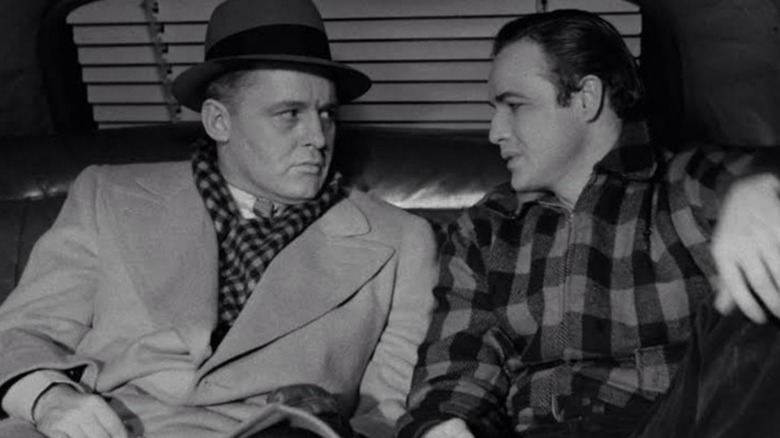
In a 1978 interview, Elia Kazan claimed his testimony was motivated only by "the truth" and framed himself as having found courage and conviction, much like Terry Malloy. Except Kazan, a former and disillusioned Communist Party member himself, didn't have the threat of death hanging over him like Terry did, merely a career hit. The latter is what happened to the people who named Kazan to the committee as part of Hollywood's blacklisting of suspected communists.
During that interview, Kazan added the unsurprising detail that his HUAC testimony made him both friends and enemies. It also followed him until the end of his life. When Kazan received an honorary Oscar at the 71st Academy Awards, several audience members (including actors Amy Madigan, Ed Harris, and Nick Nolte) pointedly refused to clap in one of the most awkward Oscars moments ever.
"On The Waterfront" reflecting Kazan's real life is a much bigger part of its legacy than Leif Erickson appearing, too. In 1982, Orson Welles excoriated Kazan for his HUAC testimony, calling him "a traitor" and "On The Waterfront" as "celebration of the informer." (See below.)
In that same speech, though, Welles conceded, "I have to add that he is a very good director," i.e. Kazan's moral failings don't cancel out his artistry (or vice versa). "On The Waterfront" has been rightly hailed as a new era for movies. Marlon Brando's Oscar-winning performance and the film's grittier atmosphere makes it feel like a forebear to the more cynical New Hollywood of the 1970s. Martin Scorsese has likewise talked about how the film electrified his young self with a truthful depiction of working class communities. It's legacy may not be simple, but it's still titanic.