

Why Apple TV's Silo Made A Major Change To The Stairs From The Books

Apple TV's "Silo" is one of the streamer's best TV shows: a sci-fi thriller full of mystery and intrigue, and a character drama with an ensemble you want to follow week after week, whose relationships and arcs become as gripping as the show's biggest mysteries. In a way, it feels like a show that truly understands what made "Lost" so special — the mystery was a narrative tool, not the end-all-be-all of the story.
Based on Hugh Howey's book series of the same name, "Silo" takes place in a world seemingly destroyed after some kind of cataclysm. Now, the remnants of humanity live inside an underground silo, filled with as many issues as the world before. How and why did the silos come to be, and why are there so many secrets and rules about knowing about the past and the world outside? These are questions at the center of the show, which makes several changes to Howey's books, including some the author considers better than his own choices.
One of the best elements of the Apple TV show, and where some of the most interesting changes to the show are, is the set design. The show has a fully realized, tactile, lived-in world, one that feels both empty and claustrophobic, with one giant concrete stairwell that goes along the silo, with mostly empty space surrounding it. This is actually a big change from the book, which imagines a metal stairwell.
When asked about this change in a Reddit AMA Q&A session, Howey said there are many good reasons for it. "For one, metal stairs would be an acoustic nightmare for production. But the biggest reason was simply to make the staircase much larger while still being possible to build."
The stairwell is an important part of Silo's worldbuilding
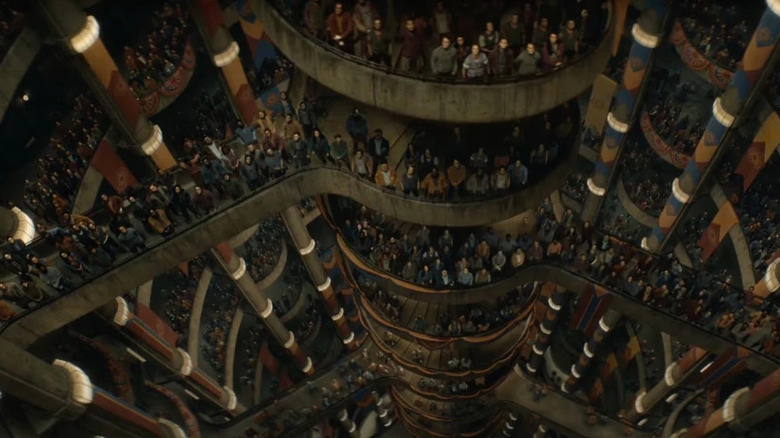
As Hugh Howey explained in the Reddit AMA, the stairwell is narrow in the books, so much so that it barely fits two people at a time. "That would make it almost impossible to shoot anything meaningful on them. And they would basically disappear on the screen," the author said. "Metal is better for the books. Concrete is better for the TV show."
In the books, the metal stairwell serves a specific purpose. Without television's visual aspect and the ability to show dozens of extras on and around the stairwell, the books use the sound of feet on the stairs to tell the reader about the silo's mood. If there is a commotion, there'd be a lot of noise coming from the stairs; when people are afraid, there's little noise.
In the show, we don't need that; we just see how people act.
As for the stairwell itself, we learn early on that the silo forbids any elevator technology, or anything that moves vertically. In theory, this is because elevators would need repairs, and it's hard to ensure there are tools and materials to repair one after a couple of centuries. In reality, as this third season has hinted, the lack of elevators is likely meant to keep the silo's inhabitants separate. We don't know for sure, but there is reason to believe the silos are a form of social experiment straight out of "Fallout," and the lack of elevators and a stairwell that separates people by levels and by social class is a great way of keeping the population controlled — regardless of whether the stairs are metal or concrete.