

This Underrated Ron Perlman Sci-Fi Movie Inspired Fallout's Power Armor Design
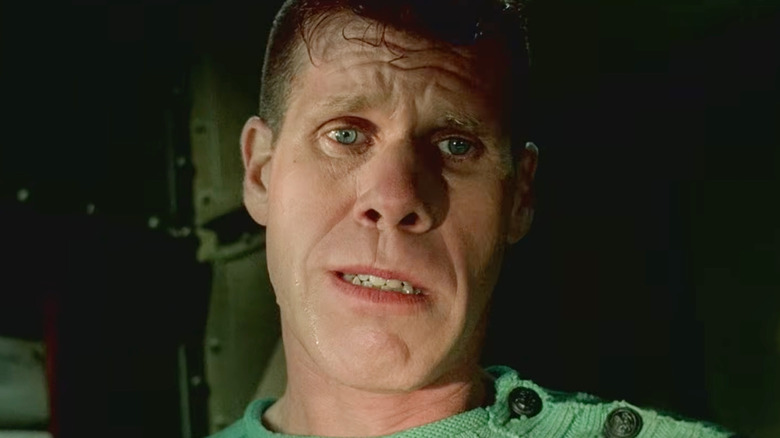
The very first "Fallout" video game was released in 1997 by Interplay Studios and was set in the post-apocalyptic future of 2161, decades after a nuclear war that nearly wiped out humanity. The player controls a vault-dwelling character who lives in an underground bunker, and the gameplay involves searching for a specialized computer component that can repair your water systems. "Fallout" is also striking for its retro-futurist designs, drawing many cues from 1950s Art Deco and steampunk aesthetics.
"Fallout," of course, has been followed by a massive video game franchise that includes four games (and an upcoming fifth) in the "main" series, and seven spinoff games. One might also be familiar with the acclaimed "Fallout" TV series, currently streaming on Prime Video and starring Ella Purnell, Aaron Moten, and Walton Goggins. The show is highly celebrated, just like the "Fallout" games.
The original "Fallout" was created by Tim Cain and Leonard Boyarsky, and one can see many of their very clear cinematic influences throughout. "Fallout" falls on the same matrix as other well-known post-apocalypse dramas like "The Road Warrior," "A Boy and His Dog," and the end-of-the-world episodes of "The Twilight Zone." That much is obvious. In a 2023 interview with the Tweak Town website, however, Cain went on record saying that Jean-Pierre Jeunet's and Marc Caro's now-relatively-obscure 1995 French sci-fi steampunk film "The City of Lost Children" provided some much-needed inspiration as well.
Notably, the game's Power Armor — a heavy, clanking gasmask-encrusted full-body super-suit — was inspired directly by the film. The French film stars Ron Perlman as a childlike strongman in a bizarro steampunk future who has to care for a lost girl named Miette (Judith Vittet).
Fallout's designs were partly inspired by The City of Lost Children
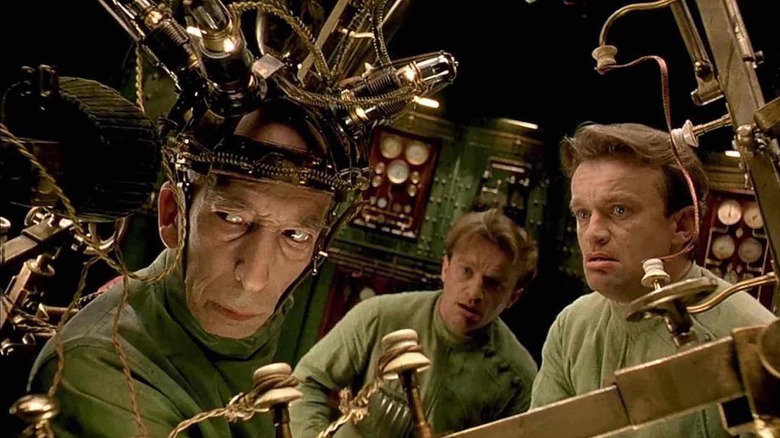
For those who haven't seen it, "The City of Lost Children" is a sci-fi steampunk fairy tale about a creepy old man named Krank (Daniel Emilfork) who cannot dream. His inability causes him to age rapidly, so he tasks a retinue of minions to kidnap children and affix elaborate devices onto their heads, allowing him to "steal" their dreams for himself. The minions are called Cyclops because they have lenses bolted to their eyes, and they live in a world that is Dickensian by way of Terry Gilliam.
As someone who was alive in 1995, I recall the minor tempest caused by "The City of Lost Children" among the kookier teenage cineastes of the day. The film proliferated on VHS in the mid-to-late '90s, passed around among Tim Burton fans and attendees of midnight movies.
One such kook was Tim Cain (born in 1965, incidentally), and another was Leonard Boyarsky. Cain was forthcoming about how Jeunet's film inspired the tech of "Fallout" in the early days. As he explained:
"What happened is that we needed a high-end armor, and Leonard had made one, but later on when he needed something more detailed to show in cinematics, that's when he made the power armor that's on the cover and in the cinematics, and subsequently in the game. I know parts of it came from 'City of Lost Children.' You know the helmet eyepiece, you can see that in the movie 'The City of Lost Children.' The tubing and vents were inspired by movies like that. The whole look of tech in 'City of Lost Children' was very inspirational to a lot of our artists."
If you've seen the film, you can see it on screen when you play "Fallout."
Jean-Pierre Jeunet and Marc Caro eventually split after The City of Lost Children
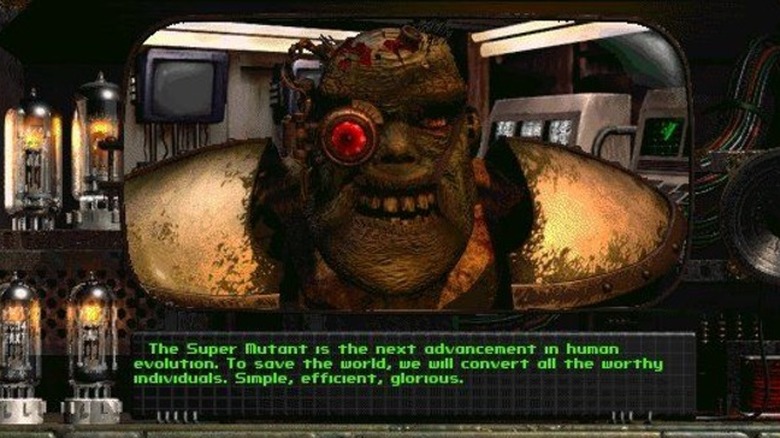
Indeed, the first "Fallout" game has characters with cybernetic, bolted-on eyepieces and features many vacuum tubes and exposed wiring. As Tim Cain noted, these are all aspects from "The City of Lost Children," and if you like one, you'll likely enjoy the other.
Jean-Pierre Jeunet and Marc Caro were, very briefly, a growing creative force in cinema. They exploded onto the indie scene in 1991 with the release of their bizarre, dirty, cannibalistic dark comedy "Delicatessen," which saw its popularity surge when "The City of Lost Children" came out a few years later. The latter was popular enough that Jeunet and Caro were invited by 20th Century Fox to direct "Alien Resurrection." Jeunet ended up with sole directorial credit on the film, with Caro contributing only some designs. It seems that Caro was uninterested in participating in a major franchise, and the two haven't worked together since.
Caro has directed only one movie since, and it was the very obscure 2008 sci-fi film "Dante 01." Jeunet, however, continued to work and even made notable, acclaimed films. In 2001, Jeunet directed the cult romance "Amélie," and in 2004, made the Oscar-nominated drama "A Very Long Engagement." He also made lesser-distributed films like "Micmacs" and Netflix's bizarre smart home nightmare "Bigbug." His next film, "Violette," is due in French cinemas at the end of 2026. There doesn't seem to be a reconciliation in the cards for Jeunet and Caro, so we'll have to comfort ourselves with the two rather excellent movies they made back in the 1990s. And, if we want to know what would happen if they tried to "go Hollywood," we can always rewatch "Alien Resurrection."