

This Short-Lived NBC Series Could Have Been One Of The Best Sci-Fi Shows Of The 2020s
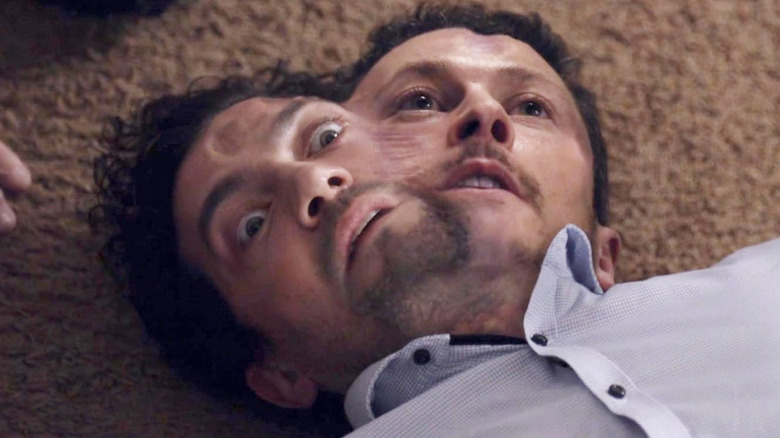
The 2021 NBC sci-fi series "Debris" was a classic post-"Lost" mystery-box-style show, but it had a more intriguing premise than most. Six months prior to the start of the series, a massive alien spacecraft exploded in Earth's orbit, and huge chunks of debris rained down on the planet. This alien spacecraft was made of materials heretofore unknown to humankind and seemingly possessed bizarre, magical, and psychic qualities that no one could quite understand. In the pilot episode, for instance, one of the show's leads accidentally psychically manifests the dead son of a local woman in Wichita. It's not until the dead son's mother faces her grief that the "ghost" vanishes. Why did the alien debris do that?
The main characters of "Debris" are members of an international clean-up task force who have been assigned to pick up all the alien chunks and return them to safe government storehouses. Jonathan Tucker plays Bryan, an agent from the CIA, while Riann Steele plays Finola, who hails from MI6. The wildcards of the series came in the form of Influx, an underground extremist group that is trying to collect debris chunks for their own nefarious purposes. The most visible member of Influx is a weirdo named Anson Ash, played by Scroobius Pip.
Although presented as a serialized mystery, "Debris" also benefitted from a semi-episodic "debris chunk of the week" structure that introduced a new mystery every episode. Bryan and Finola would find a new chunk, observe its eerie properties, and get a tiny piece of insight into the nature of the alien craft it came from. Sadly, "Debris" wasn't a ratings giant, so it was canceled after just one 13-episode season. The show was striking enough, however, to draw a cult following, and it could've gone on to become something truly special.
Debris was clever but short-lived

The tone of "Debris" was more "X-Files" than "Lost," and it featured some truly horrific stories. In one episode, a chunk of debris lands on a man and kills him, only to start creating clone-like duplicates of him, each amnesiac and programmed to kill the clone that came before. Other chunks create portals to alternate dimensions that open and close at random intervals or terraform an area of the Midwest into an enclosed space with a chlorine gas environment, causing local farmers to mutate so they can breathe chlorine. Yet another piece of debris even appears to reverse aging, prompting older people to flock to it.
During all of this, Influx collects debris to, perhaps, find a way to manipulate people's minds. Indeed, there's some talk of a piece of debris that the group calls a "game-changer." We even get to see this debris in the show's final episode, and it turns out it can erase memories and keep people in trances. Overall, though, the show doesn't offer much insight into the central mystery of the alien spacecraft all these chunks came from, and "Debris" ultimately ends on a cliffhanger that was clearly designed to set the stage for a second season.
Like all mystery box shows, there are more players and plot wrinkles than I am describing here. But these broad strokes should give you the general vibe of "Debris." It certainly has more of a narrative thrust and palpable story beats than something like "Lost," itself a TV show that thrived on keeping viewers in the dark. And while we'll never know the actual nature of the alien craft in "Debris," one gets the sense the series was headed in a definite direction.
Debris had the potential to become something more

"Debris" was created by J.H. Wyman, who had previously written numerous episodes of the "airtight" sci-fi TV show "Fringe" and created the very good robot cop TV series "Almost Human." (Incidentally, "Almost Human" was another good show that was canceled before its time.) In addition, the pilot was helmed by Brad Anderson, the director of films like "Session 9," "The Machinist," and "TransSiberian," and a frequent director on "Fringe" as well.
So far as its critical reception goes, "Debris" was generally warmly received. The only real common complaint was that Bryan and Finola were too serious to make for engaging characters and didn't have the same sort of mis-matched banter as, say, Scully (Gillian Anderson) and Mulder (David Duchovny) on "The X-Files." Brian Tallerico, writing for RogerEbert.com, also admitted that "Debris" was hurt by the fact that it arrived after years of lousy "Lost" imitators had run the mystery-box formula into the ground. As he put it:
"Two decades ago, 'Debris' would have felt new. A decade ago, it would have felt even more like a rip-off of 'Lost' or 'Fringe.' Now, it has to fight through all the overcrowding, finding a way to stand out with so many options every single week. Will I watch another one? Maybe. But I also might forget it even exists."
Despite this, Tallerico noted that most episodes of "Debris" make for "an undeniably fast-paced hour, which could be all anyone needs on a Monday night, and it's on the upper half of the 'intellectual sci-fi TV' scale in terms of plotting." It certainly had potential, in other words, so who knows what it might have become with more seasons under its belt to flesh out its characters and mythology. Alas, we can only wonder.