

Catherine Zeta-Jones Made Her Debut In A Fantasy Movie That's Impossible To Stream
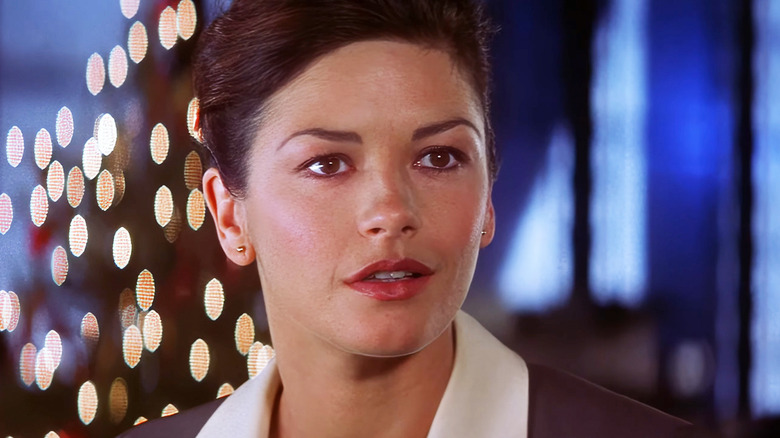
In 1990, a young Catherine Zeta-Jones landed her first film role in the fantasy "Les 1001 Nuits." Unfortunately, it wasn't exactly the grand debut she'd likely hoped for. A play on the Arabic folklore collection "One Thousand and One Nights," the movie didn't make it to many theaters outside its native France, and wasn't even a hit there. "Les 1001" Nuits also wasn't given the chance to become a cult classic in the years after its release, and has all but disappeared today.
Having established an enviable career in Hollywood, Zeta-Jones is busy playing Morticia in Netflix and Tim Burton's "Wednesday." But back in the late '80s, though she'd appeared in several stage productions, she was yet to be seen on-screen in any capacity. French director Philippe de Broca — known for 1964's "That Man from Rio" ("L'Homme de Rio") and 1997's "On Guard" ("Le Bossu") — changed all that when he cast the Welsh actor as Sheherazade in his film "Les 1001 Nuits."
The movie is a satirical take on the source material, focusing not on Sheherazade's fantastical stories but on her own struggle to escape from her murderous husband. Set in Arabia, "Les 1001 Nuits" sees Zeta-Jones' character marry a King (Thierry Lhermitte) with a proclivity for marrying young women, consummating the relationship, and having them killed. Scheherazade, however, is having none of it, and decides the best way to avoid a quick death is to regale her new husband with elaborate stories every night. When she runs out of ideas, however, she seeks help from one of her own creations, the Genie of the Lamp (Gérard Jugnot). It's all very strange, really.
Les 1001 Nuits is a strange movie that nobody saw
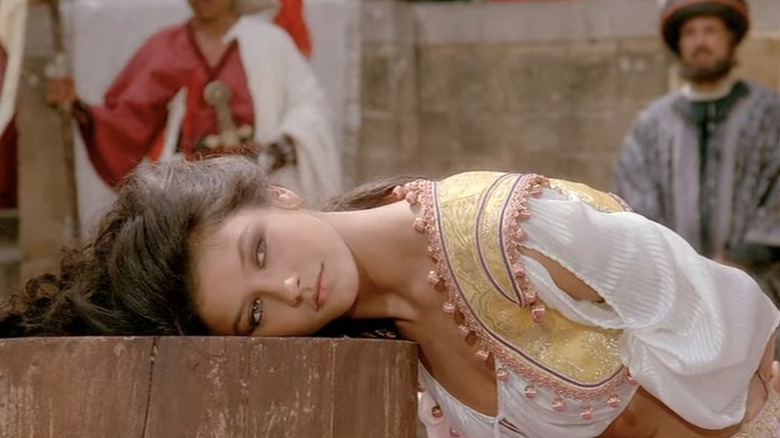
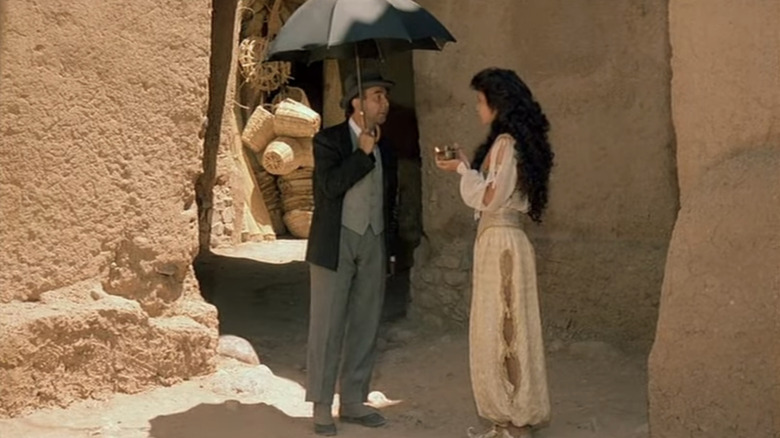
"Les 1001 Nuits" might just count as a terrible movie made by a great director. Phillipe de Broca directed one of the best action movies of all time with "That Man from Rio." "Les 1001 Nuits," however... Well, "terrible" might be a stretch, but the film is sort of weird. For one thing, the Genie of the Lamp is also a dapper English gent who emerges from said lamp via some of the most dodgy CGI you'll ever see. Even for 1990, these VFX are rubbish. Why is the Genie from Blighty? Who knows. Something about being cursed to live in 20th Century London.
It's also not entirely clear why he uses his TV as a portal to reach Catherine Zeta-Jones' imperiled princess. He is at least somewhat useful, providing Scheherazade with multiple methods of escape from her deranged husband, including a toy motorbike that becomes a real one when transported through the tube. Again, weird movie.
Otherwise, "Les 1001 Nuits" seems to function as an excuse to make Zeta-Jones get her kit off, which she does several times throughout. At one point she drops, fully nude, into the lap of an elderly Sinbad the Sailor. Again, it's not entirely clear why. As The Daily Telegraph put it in their Philippe de Broca obituary, "The film received little acclaim and is best remembered for its enjoyable nude scenes." Never before has the word "enjoyable" seemed so creepy. Imagine being a young actress from Wales who's hauled off to France to strip off for a bunch of leering crew members. It might have been worth it if the film had some artistic merit or made a ton of money and launched Zeta-Jones' career. Sadly, nobody saw it.
Les 1001 Nuits is close to becoming lost media
Despite its "enjoyable" nude scenes, nobody at the time seemed to enjoy "Les 1001 Nuits" very much at all. The film ranked 78th at the 1990 French box office and was promptly forgotten. Afterward, Catherine Zeta-Jones returned to Britain, where she found success on the small screen, starring alongside the great David Jason in ITV's period comedy "The Darling Buds of May." By the end of the decade, she was starring in major Hollywood productions including 1998's "The Mask of Zorro," the last old school blockbuster, and 1999's "Entrapment." At that point, "Les 1001 Nuits" had become a distant memory for her and everyone else.
That said, not everyone dismissed "Les 1001 Nuits" outright. Several Letterboxd users seemed to enjoy what they saw as a "campy" take on the source material, with one in particular describing it as "an unexpectedly deranged treat" and a "loopy bastardization of the Arabian classic." Unfortunately, if you fancy seeing it for yourself, "Les 1001 Nuits" isn't available on any streaming service. Those who do want to check it out will either have to hunt down a physical copy or perhaps a YouTube search might turn up — I don't know — the entire movie for free? Worth a go if you're so inclined.