

This 2000s Sci-Fi Movie Based On A Ray Bradbury Short Story Was A Major Box Office Flop
Ray Bradbury's 1952 short story "A Sound of Thunder" is perhaps one of the most influential time-travel tales to have been written since H.G. Wells' "The Time Machine" (a classic sci-fi book still awaiting a great movie adaptation). It deals with long-term causality in a way that sci-fi fans now recognize as the genre's baseline. Bradbury's original story is set in a version of 2055 where time travel is not only real but also commercially available to tourists. Its protagonist, Eckels, is a big game hunter who wants to travel back in time to the Mesozoic era and hunt a Tyrannosaurus rex.
Luckily, there are safeguards in place to make this sort of activity safe and viable. For one, those traveling to the Mesozoic have to stay on a special path and are only allowed to shoot animals that have been determined to die of natural causes soon. When Eckels sees the T-rex, however, he panics and runs, hastily stepping off the path and crushing a butterfly. Hence, when he returns to 2055, a dictator has inexplicably won the latest U.S. presidential election. The titular "sound of thunder" is a gunshot heard right at the end of the story, implying that Eckels — as he sobs in regret — has been shot by his tour guide.
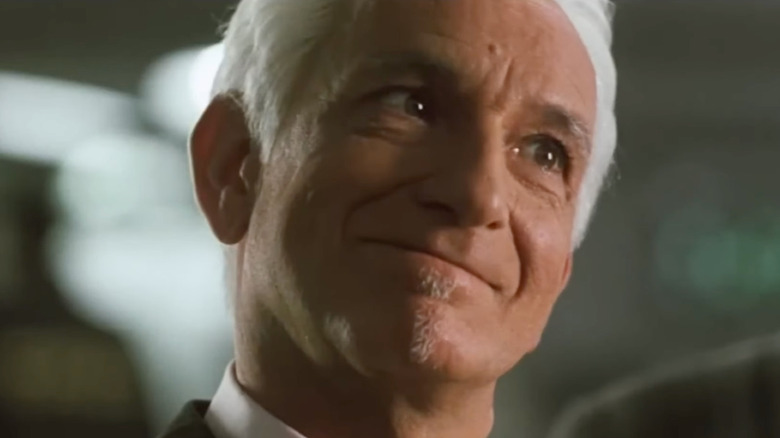
"A Sound of Thunder" has been adapted to different mediums over the years, including as a notable NPR radio show and an episode of the TV series "Ray Bradbury Theater" in the 1980s. Eventually, in 2005, it was adapted by director Peter Hyams into an $80 million film starring Ed Burns, Catherine McCormack, and Ben Kingsley. The movie was savaged by critics, though, and bombed heartily at the box office.
A Sound of Thunder was a notorious bomb
There was no reason to believe that "A Sound of Thunder" would bomb. Indeed, on paper it seemed to have nothing but promise. The film's director, Peter Hyams, had a long list of modest hits to his name, ranging from the '70s NASA conspiracy flick "Capricorn One" to the '90s Jean-Claude Van Damme sci-fi thriller "Timecop" and the Arnold Schwarzenegger action/horror flick "End of Days." Having him handle a well-regarded Ray Bradbury story seemed like a safe bet, and the story's causality concept would be understandable to anyone who'd seen "Back to the Future" (which took its core ideas from Bradbury).
Screenwriters Thomas Dean Donnelly and Joshua Oppenheimer, on the other hand, had only barely penned the 2005 action/comedy bomb "Sahara," so that should've been a red flag. Sure enough, "A Sound of Thunder" became notorious virtually overnight upon hitting theaters. Everyone hated this thing.
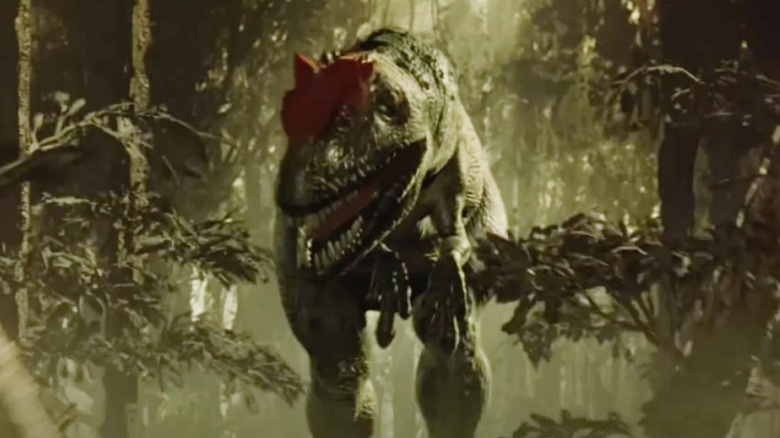
A version of the Eckels character from Bradbury's story, known as Ted Eckels, is played by William Armstrong in Hyams' "A Sound of Thunder" movie adaptation, but the film's leads are new figures named Travis Ryer (Ed Burns) and Sonia Rand (Catherine McCormack). Similarly, a crushed butterfly does, in fact, come into play, but the plot is way more complicated and involves people going on multiple trips to the Mesozoic. In the first expedition, there is an Allosaurus attack that goes awry, and a return to the present reveals, curiously, a rise in global temperatures and an increase in plant growth. The second trip to prehistoric times then reveals that these time trips have unleashed (sigh) "time waves" across history. Back in 2055, Chicago sees the sudden time-instigated appearances of swarms of beetles and giant trees.
A Sound of Thunder is nothing like the original story
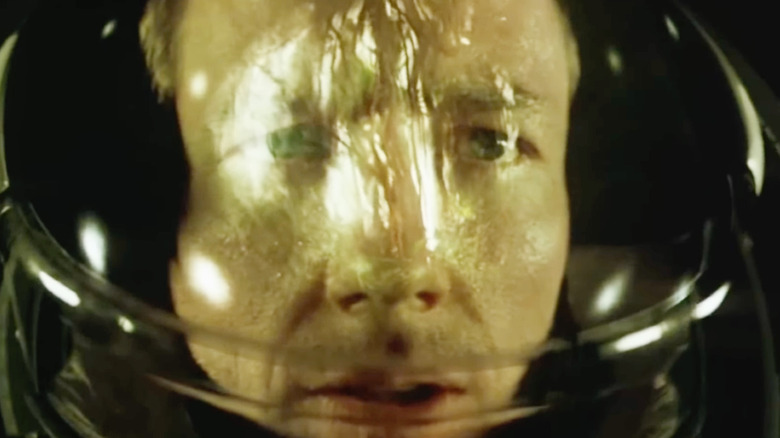
So, yeah, we're looking at a sillier, more sensationalized version of Ray Bradbury's story. The "time waves" conceit is pure hokum and is most certainly not how causality works. It seems that one can crush a butterfly in the ancient past but that history will continue apace until a "time wave" hits, presumably emanating from the time travel tech that the characters in the film use. It's all nonsense. At one point, the Catherine McCormack character even evolves into a catfish-like human. Luckily, with a time machine, there's always a chance to go back in time before all the chaos began and undo the horrors ... which is what happens.
Of course, if everything turns out okay, why use the "A Sound of Thunder" title? Where's the irony of Ray Bradbury's original tale? The unintended consequences? The movie version wrings all of Bradbury's intriguing ideas out of its plot.
As mentioned, critics hated the film, as evidenced by its dismal six percent critical score on Rotten Tomatoes. Scott Brown, writing for Entertainment Weekly, described the movie as "perfect in its awfulness." He later added that even co-star Ben Kingsley, "in full ham-and-cheese mode as a badly toupeed industrialist [...] must compete, for sheer silliness, with the film's treatment of evolution: For 'Sound,' natural selection begins and ends with giant monkey-lizards. Random chance created a movie this beautifully stupid? Ha! Don't try to make a monkey-lizard out of me."
Elsewhere, Roger Ebert gave the film two stars (out of four), feeling that it was bad but that one could chuckle at it under the right circumstances. Is it one of the best so-bad-it's-good movies of all time? If you're curious, you can currently stream it on Howdy and decide for yourself.