

Christopher Nolan Has A Book Recommendation That'll Completely Melt Your Mind

Christopher Nolan is often accused of being an overly intellectual director. His movies, while filmed in a bracing and often balletic fashion, tend to possess an emotionless steeliness that might keep some audience members from feeling fully engaged. His strengths and weaknesses as a filmmaker have been pored over and endlessly discussed since his debut feature "Following" premiered in 1998 and have persisted into the present with the release of his mega-hit "The Odyssey," one of the best films of the year. He loves to play with time and often constructs his narratives around non-chronological conceits. And his movies are generally hits; Nolan is a franchise unto himself, adored by filmbros the world over.
As one might imagine, Nolan is very well-read and has interesting taste in music. Back in 2018, he was interviewed by the BBC about his desert island discs — that is, the records he would want on hand, should he be stranded on a desert island — and he picked out a few minimalist movie scores, along with some notable British pop music. For instance, he selected Hans Zimmer's "Journey to the Line," a piece composed for Terrence Malick's venerated 1998 war movie "The Thin Red Line." He also chose Radiohead's "Paranoid Android" and David Bowie's "Loving the Alien, "so he's not a total square. Okay, he chose Franz Schubert's "Fantasia for Four Hands in F minor, D. 940 (Op. 103)" as well, so he's definitely a little square. What's more, he's a cinephile to the bone, as he selected the scores for "Koyaanisqatsi" (a known favorite of Nolan's) and, curiously, "On Her Majesty's Secret Service," too.
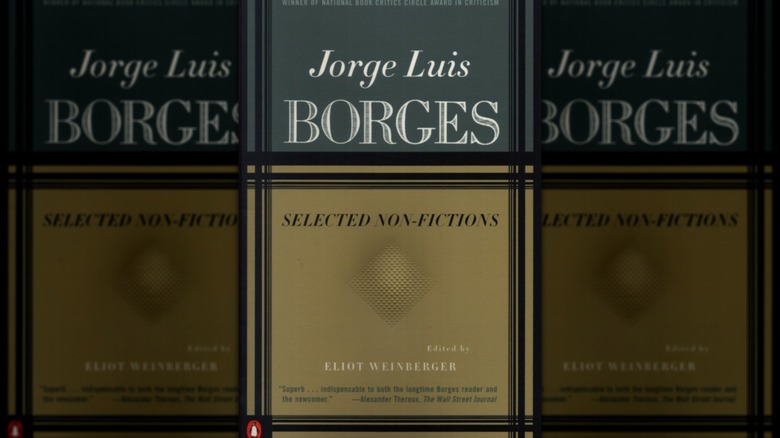
His book(s) choice, though, was a doozy. He picked "Collected Fictions" and "Selected Non-Fictions" by Jorge Luis Borges, the celebrated Argentinian author known for his influence on magical realism.
Christopher Nolan is a fan of Jorge Luis Borges
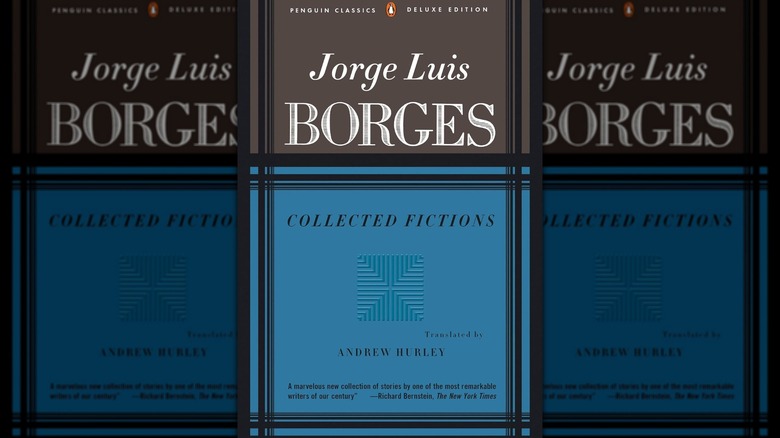
The desert island game is always fun, and the BBC had a few rules for Christopher Nolan to follow. On his desert island, he was allowed to bring three books. The Bible, the complete works of William Shakespeare (the two most common answers), and a third book of his choice. Nolan said that he wanted to cheat a little bit and throw in the double volumes of Jorge Luis Borges' "Collected Fictions" and "Selected Non-Fictions." He left out the third noted Borges collection, "Selected Poems," but maybe he just wasn't as keen on that one. Regarding the author, Nolan explained:
"He's a writer I admire tremendously. The collections of his writings, they're labyrinthine. In a way, all stories are contained within his stories. If I had to choose just one, I'd go with the fictions."
Those who have read Borges would know why Nolan would love to continuously reread him. Borges' fictions are staggeringly imaginative and will leave a mark. Many might be familiar with one of the short stories contained in "Collected Fictions," namely "The Library of Babel," first published in 1941. The story takes place in a parallel universe that is, essentially, one gigantic library that consists of interlocking hexagonal towers. The library contains infinite books that contain every single permutation of the letters of the alphabet. Although the bulk of the books are just random gibberish, the rules of the library dictate that every book that could ever be written rests within its walls somewhere. Even a correct index is around there somewhere.
Naturally, scouring through said books leads to endless "incorrect" versions of the texts, as well as lies and misleading information.
The short stories of Jorge Luis Borges will alter your thinking
And that's just one of the short stories in "Collected Fictions." Some readers might also be familiar with Jorge Luis Borges' short story "The Immortal," first published in 1947. "The Immortal" is about Rufus, a Roman soldier who hears about a magical faraway river that, when one drinks from it, grants immortality. Rufus goes in search of the river, but, after a life-threatening and arduous journey, only finds a polluted place surrounded by a confusing, labyrinthine city populated by grunting, non-thinking "troglodytes." Exploring the place, Rufus finds that the polluted river is actually the immortality river and that the troglodytes are immortals. One of them is Homer.
He learns that if one is immortal, there is no hurry or motivation to do anything. Why not spend 400 years lying still at the bottom of a hole? That's a new experience. Now immortal himself, Rufus spends centuries just sort of sitting around thinking. The second part of the story involved Rufus looking for a second river that can take his immortality away. Ancient tales of immortality — indeed, the very notion of immortality — is exploded by Borges.
Many of Borges' stories have been adapted into short movies over the years, although he hasn't inspired many notable English-language features. Alex Cox of "Repo Man" fame adapted "Death and the Compass" in 1996, but few have likely seen it.
An English translation of "Collected Fictions" by Andrew Hurley was released in 1998, and it swept through college campuses like a hurricane. Translations of "Selected Non-Fictions" and "Selected Poems" followed in 1999. Christopher Nolan was correct to select "Fictions" as his go-to desert island read, but all three are worthy of your attention.