

James Dean's Final Movie Was A '50s Western That We Don't Talk About Enough
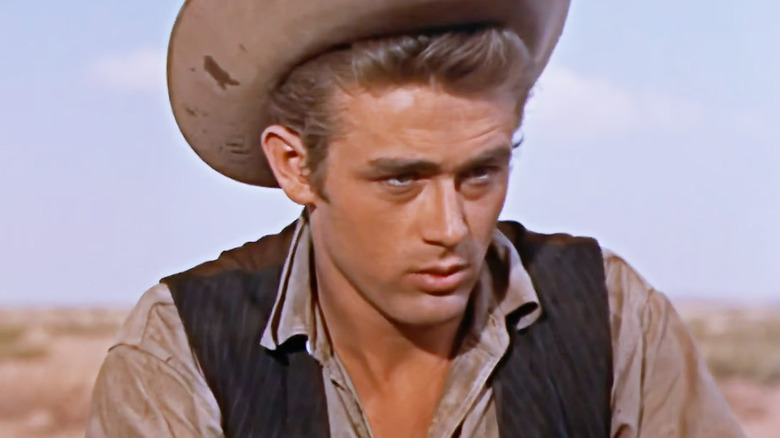
As any film historian will be eager to tell you, James Dean had only three credited roles in major motion pictures before his death in a car crash in 1955. The three films he was in, however, were all notable and intriguing, even outside of the fact that they starred a notoriously short-lived, devastatingly handsome, rising movie star like Dean. His first credited film was Elia Kazan's "East of Eden," released in March of 1955, and based on the novel by John Steinbeck. Tragically, on September 30, James Dean died on the road near Cholame, California, so his second and third films were released posthumously. Dean's second film, incidentally, was Nicholas Ray's "Rebel Without a Cause," one of the best-known films of the 1950s, released at the end of October.
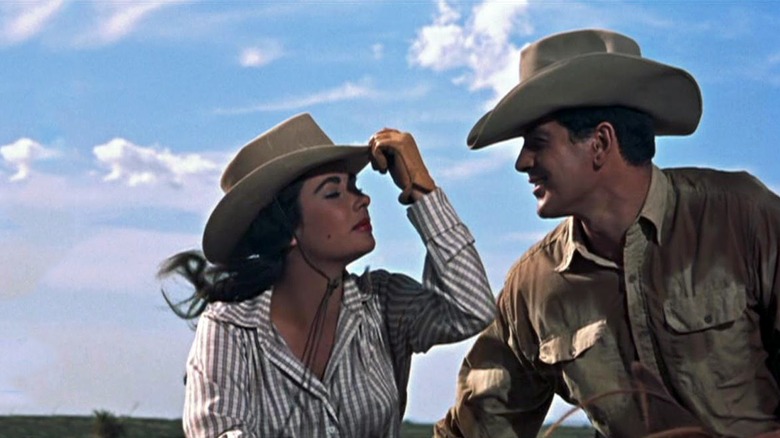
Dean's third and final credited film was George Stevens' epic "Giant," based on the novel by Edna Ferber, and released in October of 1956. "Giant," as the title implies, is a massive epic with a 201-minute runtime, and a multi-decade story about the growth of a Texan cattle ranch from the 1920s to the present. The film stars Rock Hudson as Bick Benedict, the head of a wealthy ranch in Reata, and begins when, in the '20s, he travels to Maryland to purchase a stallion. He returns with the stallion, but also with a new wife, Leslie, played by Elizabeth Taylor. Over the course of the movie, Leslie will learn how oppressive it is to live on a Texan cattle ranch, and will take note that women are treated poorly, and all the Mexican ranchhands are treated with virulent racism.
James Dean plays Jett Rink (yes, Jett Rink), a handsome, rough-hewn ranchhand who is in love with Leslie, and, thanks to some inheritance-related plot complications, becomes an oil millionaire.
Giant is, well, giant
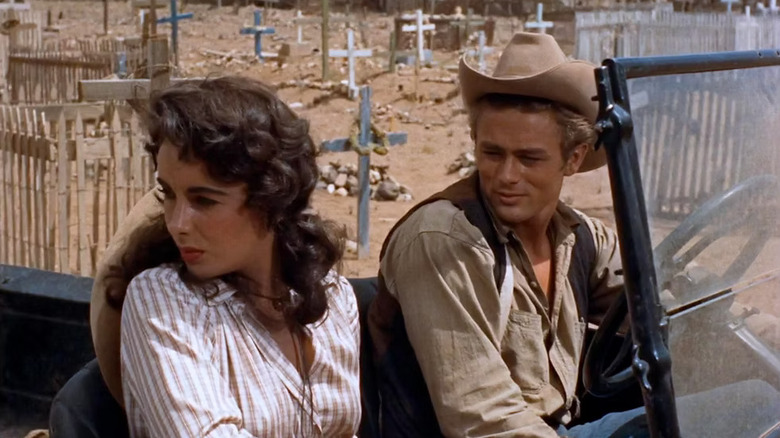
Mercedes McCambridge plays Luz, the sister of the Rock Hudson character, and it's her unfortunate death that sees Jett inheriting some land; Luz was fond of him, you see. No, this is not a "Wuthering Heights" romance where the handsome stable boy has an unconsummated fling with his wealthy adopted sister. Instead, this is a very modern story about the soul-sucking nature of modern industry. Jett inherits land, strikes oil, and becomes a millionaire. Meanwhile, though, Leslie and Bick have a very strained relationship, mostly because of his hate of his Mexican workers and resentment of Jett.
And the years pass. Leslie and Bick have children together. They grow up. Pearl Harbor is attacked. Cattle ranching becomes a less important industry in America, and Bick has to decide whether or not oil should be drilled on his property, etc. The two most notable scenes in the movie involve the two male leads and occur right near the end. Not to give too much away, but there is a scene wherein Jett, a rich man and very drunk, confesses to an empty ballroom that he always had a thing for Leslie. This, in earshot of Leslie's daughter. The other is a final confrontation involving Bick and a pack of bigots who refuse to serve Mexican customers. Bick, it seems, finally grows a spine and stands up for the Mexican people that he has lived with most of his life.
In "Giant," some people end up rich, some end up poorer than they started, but their souls will eventually be bared. "Giant" has all the trappings of an old historical novel. It's packed with outsize tragedy, large characters, and operatic emotions. In that 1950s way, it's gloriously blunt.
Giant was an Oscar darling in 1956
It may be because television was cutting into cinematic profits in the 1950s, but the Academy loved to recognize extra-long, extra-large epics during this time. "Giant," as such, was nominated for a whopping nine Academy Awards, including Best Picture. James Dean, Rock Hudson, and Mercedes McCambridge were all nominated, as were Ivan Moffat and Fred Guiol, who wrote the screenplay. Only George Stevens won, however, for his directing. It lost in all eight other categories.
That was the year "Around the World in 80 Days" won Best Picture, and while many will say it's worse than "Giant," they will at least agree that it, too, is an enormous production. Indeed, that year also saw "The Ten Commandments" and "The King and I" up for Best Picture, so it was a year for epics.
If the financial comings and goings of a wealthy Texan ranch — and all the soap-opera-like relationship complications therein — sound familiar, it's because you probably watched "Dallas" back in the day. "Dallas" isn't based on "Giant," but it definitely drew a lot of inspiration from it. And if you watch any of the shows created by Taylor Sheridan — "Yellowstone," "Mayor of Kingstown," "Landman," "The Madison," etc. — you have seen the children of "Dallas" thriving in the streaming era. "Giant" was the grandfather of all of them, introducing a rustic setting and the love lives of the millionaires who lord over them.
The difference is, in "Giant," the characters have a shot at redemption. They got a photo opportunity. They don't end up cartoons in a cartoon graveyard. The "Dallas" people are, well, largely awful.