

Andy Weir Thinks This '50s Sci-Fi Book Was Ahead Of Its Time (And He's Not Wrong)

Andy Weir would probably be a celebrity even if some of his novels hadn't already been adapted into hit movies. Weir's sci-fi books "The Martian" (2011), "Artemis" (2017), and "Project Hail Mary" (2021) were all popular sellers, and his short story "The Egg" has gotten attention worldwide (and was even adapted into several short films). Of course, the public at large likely knows about Weir because "The Martian" was adapted into a very popular 2015 feature film starring Matt Damon and directed by Ridley Scott. "Project Hail Mary," meanwhile, was adapted into one of the best movies of 2026, starring Ryan Gosling and directed by Phil Lord and Christopher Miller.
Now in the public eye, Andy Weir is interviewed a lot about sci-fi literature, and he has gone on record a lot to talk about his favorite books, both contemporary and classic. He loves "Paradox Bound" by Peter Clines and has a weakness for the classics. Weir said his favorite sci-fi authors were all legends like Isaac Asimov, Arthur C. Clarke, and Robert A. Heinlein.
To that last point, Weir has stressed that he liked Heinlein's 1955 Y.A. novel "Tunnel in the Sky" a great deal. Written as part of Heinlein's juvenile fiction line, "Tunnel in the Sky" concerns a near-future where overpopulation on Earth has become a major concern. Luckily, humanity has invented a teleportation technology that can shunt people to very distant inhabitable worlds in a matter of moments. The technology, however, only works in one direction, so once you're on another planet, you're stuck there. Weir talked about "Tunnel in the Sky" in a 2015 interview with Lightspeed Magazine.
Andy Weir loves Robert A. Heinlein's Tunnel in the Sky
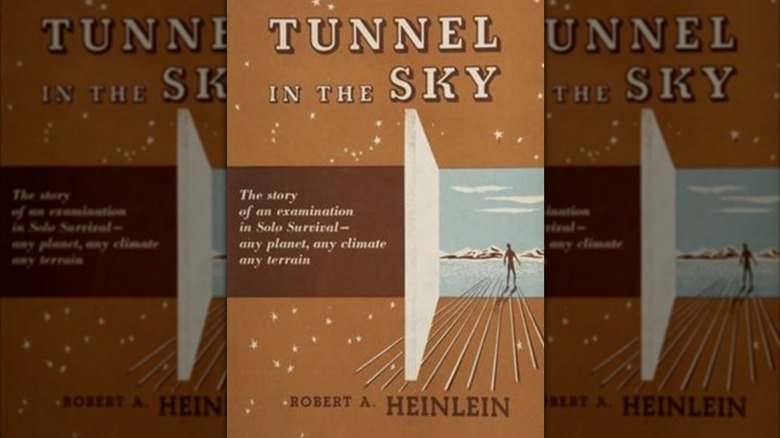
Because the teleportation technology in "Tunnel in the Sky" is one-way, any potential colonists can only take sustainable, simple technologies with them that allow them to till soil and travel by non-motorized means. Once they've settled, they live similarly to the Old West. The plot follows teenage protagonist Rod, who thinks he's merely taking a wilderness survival test but learns that he and several other kids have been left stranded on a distant planet with no return transport coming anytime soon. The teens have to form a society together.
The interviewer at Lightspeed Magazine asked Andy Weir about "Tunnel in the Sky," noticing a parallel between Robert A. Heinlein's work and Weir's own "The Martian," another story about someone surviving on a distant planet. Weir said that he liked the survival aspects, but also pointed out the story's subtly progressive politics. In his words:
"That's one of my favorite Heinlein novels. I love a good man-versus-nature story. [...] It's a fantastic novel. I don't know when it was written — in the early 1950s, maybe — and the main character of that story is Black. In that era, if he'd overtly stated it, then the book would've been classified ... 'Oh, we'll just sell it to Black people.' And he didn't want that, so he was just really subtle, but he dropped three or four clues in the book that you could back-calculate. He was pretty forward-thinking for his time, and managed to outmaneuver the publishers and marketers."
Because the story was written in 1955, a much more expressly racist time, Rod's race is never quite stated outright in "Tunnel in the Sky," but there are allusions to his race throughout. He is a Black character.
Robert A. Heinlein wrote a compelling survival story, and a progressive text at the same time
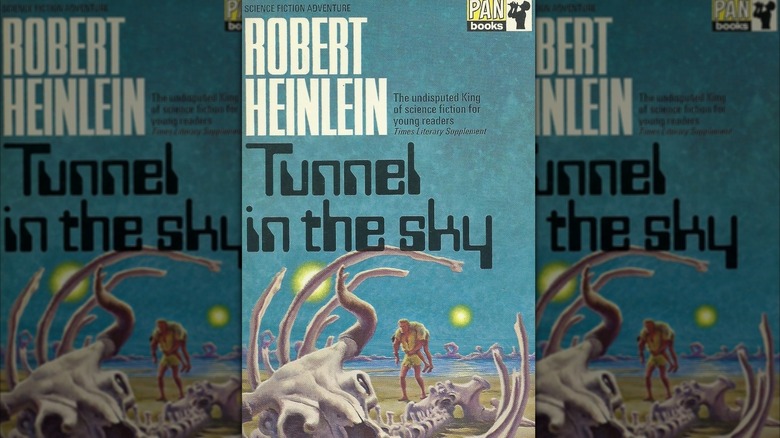
Because Rod's race isn't mentioned explicitly in Robert A. Heinlein's book, many book cover artists defaulted to portraying the character as white, sometimes even blonde. But Rod was indeed Black in the text, as has been confirmed in a few places. On the FAQ page for the Heinlein Foundation, someone asked to clear up any ambiguity about Rod's race, and the webmasters replied by saying that "he was Black. The clues are in the novel, but Heinlein didn't treat race in this novel as an 'issue' and so writes all characters, regardless of their sex or race, as characters on equal footing." Additionally, a Heinlein scholar named Robert A. James said that the evidence of Rod's race was "slim but definite."
One can also buy volumes of correspondence between Robert A. Heinlein and various people in his life, and it seems that, in a letter to one Sandra Jane Fulton, Heinlein said that Rod was indeed a Black character. He also said that he and one of his publishers had to stop working together over issues of racism.
Some have also pointed out that Rod has a romance in "Tunnel in the Sky" with a young woman named Caroline, who is explicitly said to be Black. This, in the 1950s, counted as a clear sign that both characters were the same race. Keep in mind that anti-miscegenation laws were on the books in the United States until as late as 1968 (remember the film "Loving?"), so Heinlein was, by pairing his protagonist with a Black woman, saying pretty clearly to a 1950s audience that Rod, too, was Black.
Andy Weir loves it.