

Why Hollywood Doesn't Shoot More Movies With IMAX Cameras
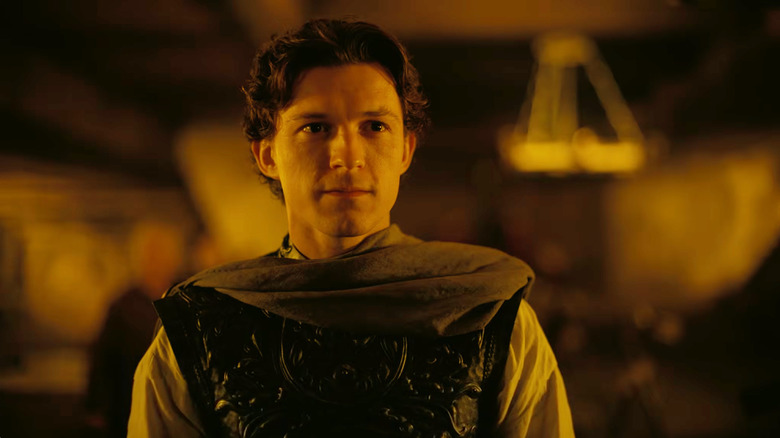
To the surprise of no one (or the petty chagrin of Emily Wilson), Christopher Nolan's "The Odyssey" is cleaning up at the worldwide box office. As the 173-minute movie adaptation of Homer's epic poem nears its third week of release, it's coming up on $700 million at the global box office. And with an "A" Cinemascore, it's likely to be another one of Nolan's ultra-leggy blockbusters.
Nolan is inarguably the most powerful director on the planet. Aside from the Covid-compromised "Tenet," each of his films is a guaranteed commercial smash and a surefire awards contender. Having built up a massive fan base via his prestige trilogy of Batman movies, he can afford to take big swings every time at bat. There's always a rush to call a director like this "The New Spielberg," but Nolan's his own man. If anything, he's cut from the same literate cloth of David Lean, who proved himself with intimate dramas before wowing audiences with full-blown spectacles like "The Bridge on the River Kwai" and "Lawrence of Arabia."
Like Lean, Nolan loves dizzyingly big formats. Lean shot "Lawrence of Arabia" on Super Panavision 70mm, and if you see it projected correctly in a big house, it will still knock you flat on your tuchus. Nolan loves film, too, but his celluloid drug of choice is IMAX 70mm. These cameras offer immersion, clarity, and unmatchable texture. In 2026, you should accept no substitute. Nolan shot the entirety of "The Odyssey" with these cameras, and you've never seen anything like it because, well, it's never been done.
Can it be done again? There are many challenges: skill, money, and most intriguingly, noise. These obstacles are driving many talented filmmakers to toe-dip with IMAX 70mm cameras rather than dive all the way in.
IMAX 70mm cameras offer a spectacular visual payoff, but they're noisy beasts
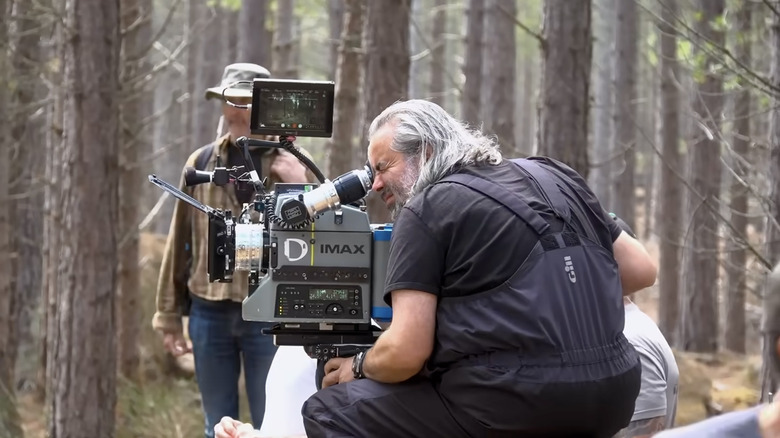
In a recent Variety article, an IMAX source acknowledged the sheer cost of shooting a whole movie on their 70mm cameras. "The Odyssey" carries a budget of $250 million, and the onerousness of using noisy IMAX cameras (which Christopher Nolan has likened to the sound of a lawnmower) presents a filmmaker with certain creative compromises. Nolan and IMAX have found a way to blimp that noise to a degree, but it's still a performance-challenging cacophony that Matt Damon has compared to having "a Cuisinart in your face" (via Us Weekly).
Thus far, no one aside from Nolan has stepped up to deal with the obstacles of shooting exclusively in IMAX 70mm. This is understandable. You have to account for the noise and the unwieldiness of the cameras. Ryan Coogler and Denis Villeneuve have shot portions of their films (respectively, "Sinners" and the "Dune" movies) on IMAX 70mm, but the latter really loves digital IMAX cameras for desert shooting (and most people will be seeing the upcoming "Dune: Part Three" on digital IMAX anyway). Other filmmakers shoot movies to be upscaled to IMAX. But employing those cameras for an entire production? Nolan stands alone.
And maybe that's the way it should be. David Lean was unbeatable once he entered his epic phase. Most filmmakers nowadays don't have the chutzpah, much less the skills to play on this rarefied field. The old guard (Steven Spielberg, Martin Scorsese, Francis Ford Coppola) may not have the energy to match this visual dynamism. The new masters have arrived. And they're all chasing Nolan.