

Christopher Nolan Waited 20 Years To Direct One Specific Scene In The Odyssey
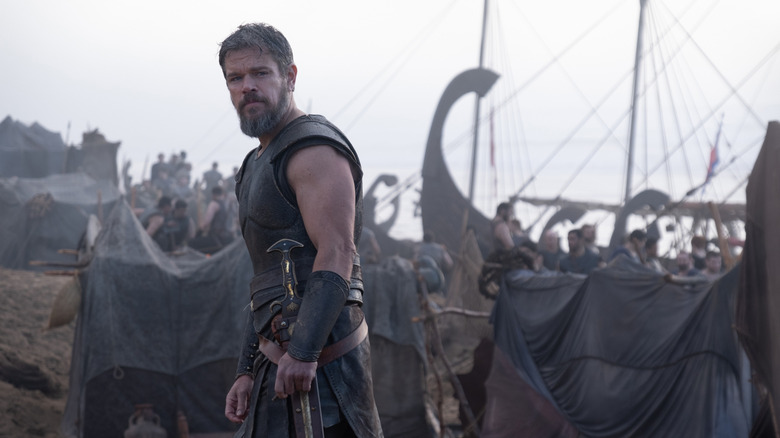
Christopher Nolan is famous for his rather grounded approach to storytelling and his preference for practical effects — like creating a nuclear detonation with no CGI for "Oppenheimer." So the idea of Nolan tackling "The Odyssey" seemed strange at first. How would the filmmaker behind those practical stunts in his Batman trilogy handle a story with literal gods and monsters?
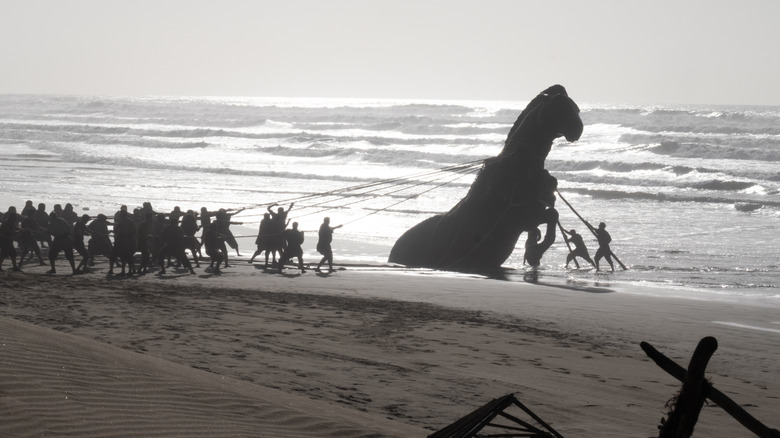
Well, turns out he still did it his way. "The Odyssey" is phenomenal, and a triumphant piece of cinematic spectacle. He managed to make the cyclops Polyphemus a giant puppet, and used jet skis to produce a whirlpool that was then enhanced digitally to create the monster Charybdis. The entire movie is familiar, but still filtered through Nolan's unique vision. This extends to the Trojan Horse itself, which has been at the center of the film's marketing from the beginning. It's a different take on the horse, not on wheels, not standing, but a horse rearing. It makes it substantially harder to make the horse just stand, let alone move it.
It's an undeniably striking image, one that Nolan has apparently been imagining for 20 years. Speaking with Independent, Nolan spoke of how he first came up with the image of the horse sinking into the sand in the early 2000s, when he was working on "Troy."
Yes, "Troy," the movie that was ultimately directed by Ridley Scott. As Nolan tells it, "I did a lot of thinking about the Trojan Horse and how I would portray that and make it credible." Ultimately, he came up with the idea of the horse in the sand.
Nolan needed to wait before he could make The Odyssey
According to writer David S. Goyer, "Batman Begins" was but a "consolation prize" for Christopher Nolan for not getting the directing gig for "Troy."
Had Nolan taken the "Troy" gig, it's hard to imagine his career being at all similar to what it is now. For one, it was through the long process of working on his Batman trilogy that Nolan grew as a filmmaker from a rather clinical and calculating one to a filmmaker with a true eye for visuals. It was "The Dark Knight" where Nolan began working with IMAX cameras, the format that completely reshaped his career. Without it, it's hard to imagine Nolan would dare make "Oppenheimer," a movie that isn't just a fantastic drama, but also a testament to the power of the IMAX format.
And yet, the idea of a "Troy" Nolan movie made without IMAX, at a time when Hollywood was still experimenting with CG but not fully relying on it, and using huge sets with thousands of extras, is intriguing. Most importantly, at that time, Christopher Nolan was still regularly collaborating with his brother Jonathan on his scripts. It's not controversial to say Jonathan Nolan is the better writer of the two, having co-written "Memento," "The Dark Knight," and "Interstellar" with his brother.
Ultimately, Nolan's "Troy" didn't come to happen, but he did come up with an image for his version of the Trojan Horse that feels like a great encapsulation of his entire career. The horse, with its posture that makes it hard to move and even harder to manufacture, a horse that has every actor hidden inside it, is stupidly uncomfortable, but which ends up in a very cool cinematic image, feels apt for Nolan's hard-to-make but highly successful cinematic output.