

The Odyssey Scholars Say Christopher Nolan's Adaptation Ruined One Character
We may receive a commission on purchases made from links.
Christopher Nolan's new film version of "The Odyssey" takes a lot of liberties with the original Homeric poem from about three millennia ago, something that may upset the poem's longtime fans. The biggest difference being the ending of the movie, which is a bold departure from Homer's epic poem. As most high school students know, "The Odyssey" ends with a homecoming of violent proportions, with the former king of Ithaca, Odysseus, finally returning home after decades abroad and heroically slaughtering the many suitors that had moved into his home. The story ends on a moment of triumph, with order finally restored.
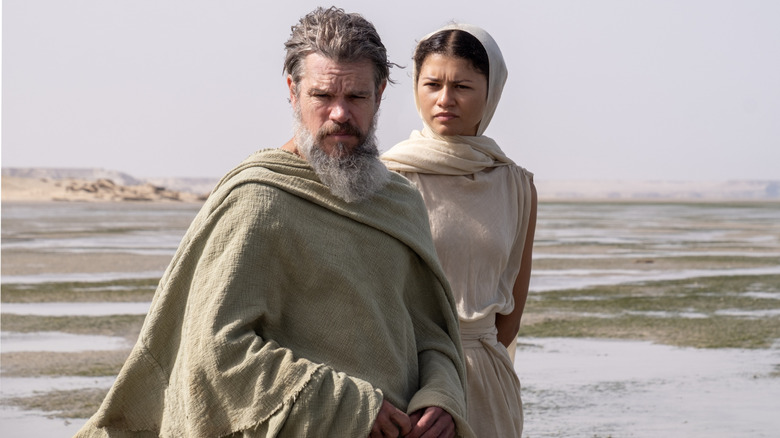
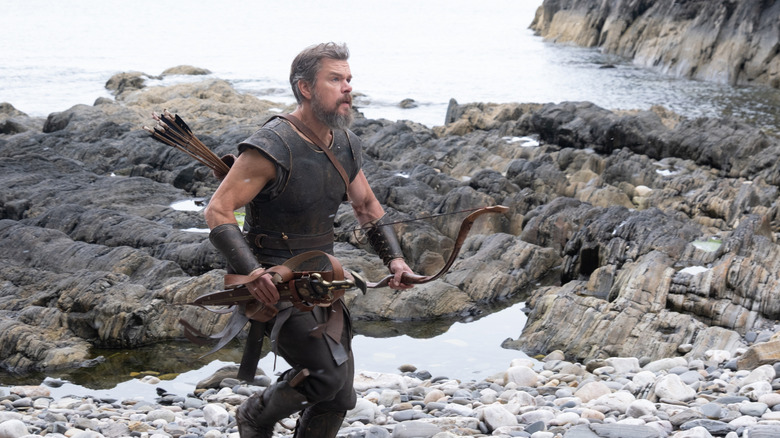
The movie, however, is a more tragic affair, with Odysseus (Matt Damon) spending the bulk of his time on screen mourning the death he caused during the Trojan War. The film ends with Odysseus returning home to Penelope (Anne Hathaway), but by then, Odysseus is so wounded and wracked with guilt that it hardly feels like a triumph. In his voyage home, the former general traveled into the land of the dead and talked to the soldiers who died in his charge. From their perspective, they were chaff in the war effort, dishonored and left on the battlefield, killed via Odysseus' tactics. In Nolan's vision, the Trojan Horse is no different from the atomic bomb that Oppenheimer invented in "Oppenheimer."
If the theme of "The Odyssey" is to be war guilt, as Nolan dictated, then it would be necessary to make a fundamental change in the titular hero. Odysseus, as he is depicted in Homer's epic, is a shrewd, clever, fast-thinking, trickster character. He disguises himself a lot, obfuscates, and distracts people with stories. According to a translator named Daniel Mendelsohn, as quoted in an AP interview, the Odysseus in Nolan's film was pretty much ruined in translation.
Translators disliked Christopher Nolan's treatment of Odysseus himself
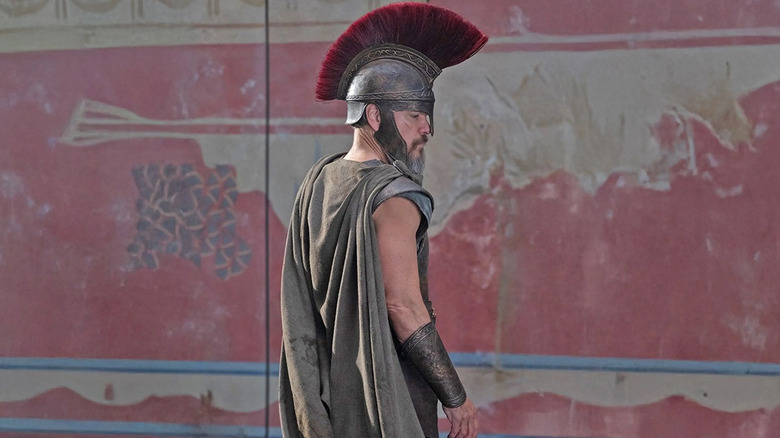
Daniel Mendelsohn's new translation of "The Odyssey" was published in 2025, and it has a lot of glowing pullquotes on the back cover praising its poetry. Mendelsohn noted that Nolan's adaptation of "The Odyssey" was an impressive cinematic production, but also that it was more in tune with Christopher Nolan's personal interests as a filmmaker rather than loyal to the characterization of Homer's original epic. In the poem, as stated, Odysseus is a dazzling, slippery character, able to twist out of a bind and remain stalwart. The way Matt Damon depicted the character, Mendelsohn said, displayed "no cleverness, no humor, no wily charm." He continued:
"This tormented, guilt-ridden Odysseus, stripped of humor and wit, seductiveness and cleverness, is a sibling of 'Memento's' anguished amnesiac, of Batman, of Oppenheimer, men tormented by pasts they wrestle with in different ways. [...] Nolan has merely remade Homer's hero in his own image."
And he's not wrong. Many of Christopher Nolan's male protagonists (he doesn't typically write women very well) are tortured in some way, wrestling with angst and emotional wounds. Odysseus was marked by the sins he committed during wartime, something he definitely did not do in the original epic poem.
The AP also talked to Emily Wilson, who published a highly celebrated translation of "The Odyssey" in 2017, and whose translation Matt Damon has namechecked as an inspiration for his performance. She was relieved that the public was reading "The Odyssey" again, "But at the same time," she said, "I had the sense that Christopher Nolan was trying to pack everything in while missing themes that were essential to the poem."
Emily Wilson also felt that Nolan left a lot out of his Odyssey
Emily Wilson, it should also be noted, is a professor of classical studies at the University of Pennsylvania, and she criticized (without any snobbery, mind you) that Christopher Nolan made a very unusual literary choice in omitting the Olympian gods from "The Odyssey." In Homer's epic, the gods are active participants in the action. In Nolan's film, only Athena (Zendaya) appears on screen, while the key characters of Zeus and Poseidon are absent (although they are mentioned in dialogue a lot). Wilson also hated the reduction of Penelope's role and pondered aloud how her marriage to Odysseus was supposed to work.
But Wilson wasn't so ticked off by the omissions that she didn't enjoy "The Odyssey" as a movie. "It was fun to be there with my kids," she said. "I didn't feel it was pulling teeth to engage with it. If you can see it on a big screen, you should absolutely go." A high recommendation indeed.
There have been screen-accurate versions of Odysseus in the past, of course. Many, many Italian cinema epics (usually of very low budgets) depict Odysseus as a clever, enthused character who aids his peers in war efforts. Of course, a lot of those old Italian peplum movies were constructed as lighthearted entertainments and not ponderous meditations on war-associated guilt. And the world, it seems, is more than ready for the latter; "The Odyssey" has, to date, been very successful at the box office. /Film also loved it, with our own Chris Evangelista giving the movie an 8 out of 10. It may not be accurate, but "The Odyssey" is striking a nerve.