

Why Christopher Nolan's The Odyssey Is Actually His Second Adaptation Of The Classic Story
This article contains spoilers for "The Odyssey."
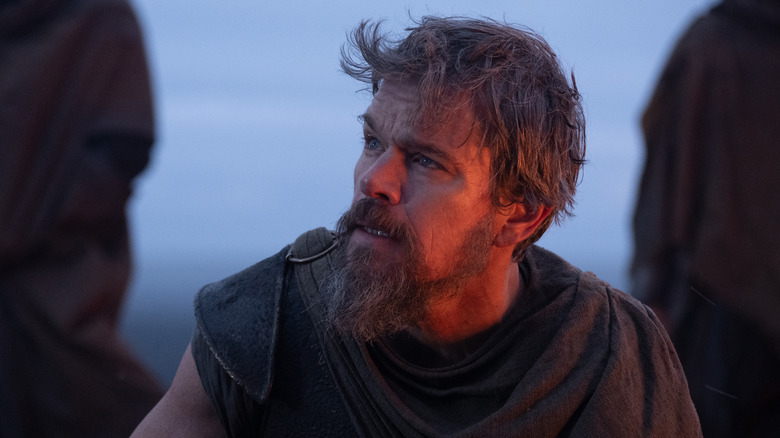
Christopher Nolan's adaptation of "The Odyssey" is an epic in every sense of the word. It's a remarkably multi-layered film — as much a contemporary social commentary as it is a ripping adventure yarn. The latter aspect is hardly a surprise, as the classic epic poem by Homer is one of the cornerstones of Greek mythology, and has been a major influence on the adventure story ever since its creation. The story is so foundational that there are glimpses of "The Odyssey" to be found in everything from the works of Alexandre Dumas to the "John Wick" films.
In Nolan's case, "The Odyssey" may have had a bigger influence on the filmmaker than previously thought. While Nolan's film adaptation of "The Odyssey" contains a lot of thematic material and tropes that the director has explored or utilized in his earlier work (including, most intriguingly, "Oppenheimer"), it's now possible to see the reverse, too. Many of Homer's themes are peppered throughout Nolan's previous movies, and nowhere is this more apparent than in 2012's "The Dark Knight Rises."
That film, the close of Nolan's Batman trilogy, has generally been regarded as the least of the three "Dark Knight" movies. Yet with the new benefit of looking back at it through an "Odyssey" lens, it's much more apparent how Nolan was boldly utilizing the mythological traditions of Homer to wrap up his take on the Batman legend. Really, "The Odyssey" is Nolan's second adaptation of the classic story.
The Odyssey is The Dark Knight Rises redux
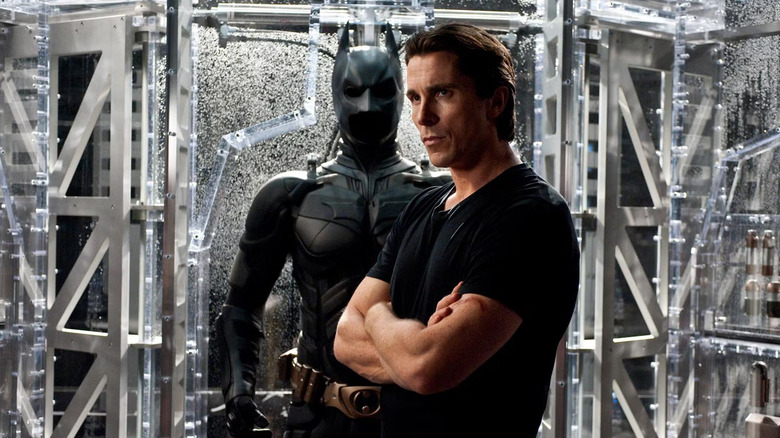
The biggest point of comparison between "The Dark Knight Rises" and "The Odyssey" lies in its protagonists, Bruce Wayne/Batman (Christian Bale) and Odysseus (Matt Damon). While both men are examples of the guilty hero, a common archetype in Christopher Nolan movies, their kinship goes even deeper.
Both Bruce and Odysseus prize honor highly, and dedicate their lives to their mission of justice and duty. They each come to believe their mission a devastating failure. For Bruce, his defeat at the hands of Bane (Tom Hardy) and the villain's subsequent takeover of Gotham City is literally and figuratively crippling. For Odysseus, his role in helping the Achaeans win the Trojan War with the gambit of hiding soldiers in a gift horse makes him feel personally responsible for the breaking of Zeus' law of hospitality and the subsequent pillaging of Troy. For these sins, both Bruce and Odysseus find themselves barred from returning home, a barrier that's partially self-imposed due to their guilt and despair.
Eventually, the heroes find the courage to try and put things right. In "The Dark Knight Rises," Bruce returns to Gotham after a five-year absence, while Odysseus returns to his home of Ithaca after nearly 20 years away. The men disguise themselves upon their return, the better to help suss out who their allies still are, and make a plan to reinstate order in a now-chaotic land. This choice allows both heroes to find not just victory, but redemption. The villains are removed from power and slain. Bruce and Odysseus are then rewarded, able to travel to a distant land with their companions, Selina and Penelope (both played by Anne Hathaway), while having their figurative and literal sons Robin (Joseph Gordon-Levitt) and Telemachus (Tom Holland) keep their mission of honor alive.
Bits of Homer's Odyssey can be seen throughout Nolan's movies
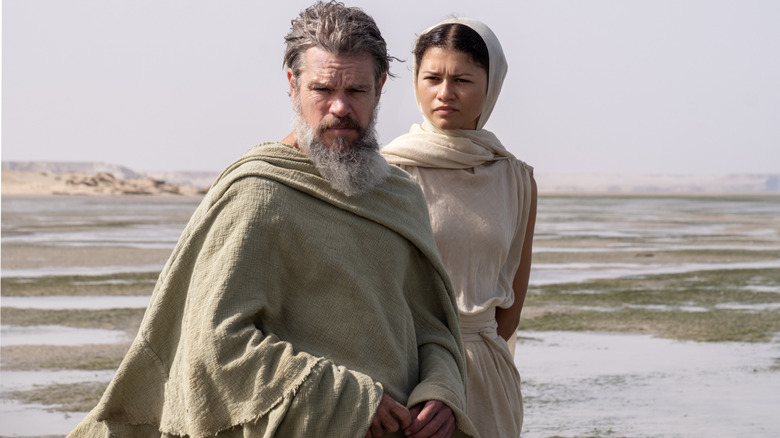
Of course, Christopher Nolan wasn't using "The Odyssey" as his primary influence when making "The Dark Knight Rises." As he has said numerous times, he was mostly thinking of Charles Dickens' "A Tale of Two Cities" while making it. The influence of that novel can easily be seen in the movie, as well as other Nolan films (especially "The Prestige"). That said, now that we can see how much of "The Odyssey" exists within "The Dark Knight Rises," it's also possible to see how much of the epic poem, especially Homer's theme of homecoming ("nostos" being the Greek word for the concept), runs throughout Nolan's work.
The theme of wandering found in Homer's "Odyssey" can also be seen in other Nolan characters, especially the protagonists of "Following," "Memento," and "Batman Begins." The notion of godlike figures watching out for the well being of their mortal allies by manipulating events is all over "Inception" and "Tenet." The concept of nostos is definitely the most common in Nolan's work, as so many of his characters are actively seeking to return home (see: "Inception," "Interstellar," and "Dunkirk"). Nolan's body of work is rich with recurring motifs, and this is why each subsequent film of his feels more cumulative than the last.
Which begs the question: Was "The Odyssey" always in Nolan's cinematic DNA, or is Homer's epic so malleable that Nolan was able to smoothly graft his own tropes onto it? No matter the answer, it's certain that we haven't seen the last echo of Odysseus in Nolan's work.
"The Odyssey" is in theaters everywhere.