

Why Disney Turned Down An Adaptation Of J.R.R. Tolkien's The Hobbit In The '70s
We may receive a commission on purchases made from links.
Peter Jackson's "The Lord of the Rings" is the definitive cinematic adaptation of the J.R.R Tolkien Legendarium, but it wasn't the first.
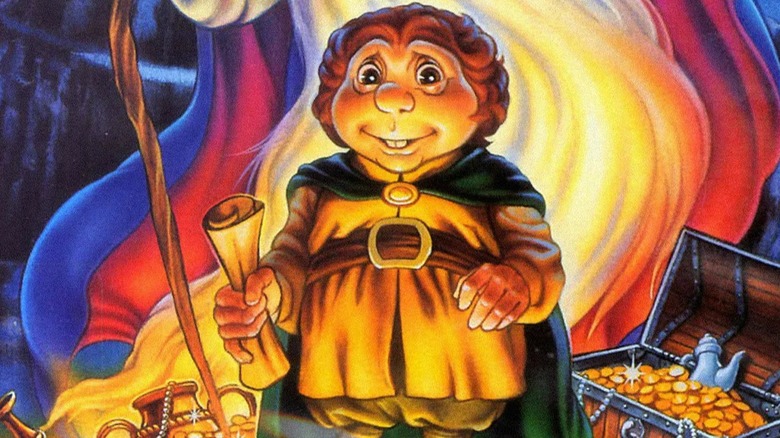
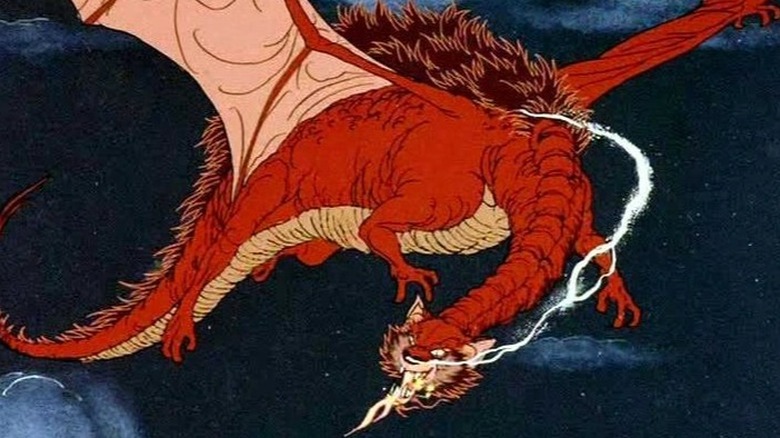
Rankin/Bass Productions, famous for its stop-motion Christmas specials, produced an animated "The Hobbit" in 1977. Animator Ralph Bakshi then directed an animated "The Lord of the Rings" in 1978, employing rotoscoping techniques (i.e. shooting in live-action then layering animation over it — technically Bakshi did "Lord of the Rings" in live-action before Jackson). Bakshi's film only reached halfway through "The Two Towers," with a sequel never to be made. Meanwhile, Rankin/Bass returned to Middle-Earth for 1980's animated "Return of the King," which can be taken as the de facto finale for an unintended trilogy.
Other animators had dreamed of bringing Tolkien's stories to cinema, among them Walt Disney. His benchmark film is a fairy tale featuring a group of dwarves like "The Hobbit." According to "Middle-earth Envisioned: The Hobbit and The Lord of the Rings: On Screen, On Stage, and Beyond" by Brian J. Robb and Paul Simpson, the Disney Studio considered (in 1938) using "The Hobbit" as the basis for a segment in "Fantasia."
The same book, citing claims by influential Disney animator Wolfgang Reitherman, reports that Walt Disney considered animating "Lord of the Rings" in the 1950s but concluded it was "too unwieldy." Tolkien would've never approved of it, either. In a 1937 letter to his publishers, he forbade illustrations in "The Hobbit" from even resembling the Disney style, for which he had "heartfelt loathing."
Disney's inheritors apparently agreed that their films and Tolkien would mix poorly. Per a 1977 report by The New York Times, Disney killed a pitch to animate "The Hobbit" due to the story's lack of Disney-ish humor. Trying to add some would've only infuriated Tolkien's loyal readers, Disney reportedly decided.
The Hobbit didn't have the right sense of humor for Disney
The Disney "Hobbit" pitch, preserved in a few digital scans (including by blogger Prydain on Film), was crafted in 1972 by storyboard artist Vance Gerry and animator Frank Thomas. The pitch, including concept art of Bilbo Baggins by Gerry, compares "The Hobbit" to other Disney projects, attempting to show how it could combine them all into a single great work:
"In considering 'The Hobbit' as material for a cartoon, one should think first of the rich characters of 'Snow White,' the power and drama of 'Night on Bald Mountain,' the excitement and adventure of 'Treasure Island' (we've never done a cartoon with this much story), all combined with the variety of characters and warmth of their relationships that we had in 'Jungle Book.'"
The pitch subsequently states, though, that there are "far more incidents in the story than we could ever use" and that "many sections are too frightening for our purposes." That right there is a concession that a true, uncompromised version of "The Hobbit" doesn't fit the Disney brand. Look forward to 1985, when Disney's dark-ish fantasy novel adaptation "The Black Cauldron" eschewed its films' usual tone to disastrous results. If Disney had pushed forward with "The Hobbit," it could've been "The Black Cauldron" a decade early.
Conversely, the Rankin/Bass Middle-earth films offer a broad picture of what a sanded down Disney-produced J.R.R. Tolkien cartoon could've looked like. Both films were musicals with broad comic songs miles away from Tolkien's poetry. For example, "Return of the King" gives the Orcs a song ("Where There's A Whip, There's A Way"), where they begrudgingly accept their enslavement to Sauron and his warmongering. It's probably for the best that Tolkien, who died in 1973, never lived to hear that.