

Clint Eastwood Once Explained Why He's So Drawn To Making War Movies
We may receive a commission on purchases made from links.
Clint Eastwood has no shortage of war movies in his filmography, which, considering his conservative leanings, might suggest the screen legend is pro-war. Well, the man himself claims the opposite, and in fact says he's only made war movies because he's drawn to their inherent "drama and conflict."
Eastwood's politics are hard to pin down. As Allen Barra of the Los Angeles Times wrote in 2002, "How did the man who made government a dirty word in 'The Outlaw Josey Wales' and whose philosophy of law and order as expressed by 'Dirty Harry' Callahan delighted so many right-wingers seduce so many limousine liberals?" It's true that Eastwood has carefully managed his public profile to seem agreeable to liberals while holding plenty of conservative opinions. He endorsed Mitt Romney back in 2012 before giving an infamous speech at the Republican National Convention in which he spoke to an empty chair supposedly representing Barack Obama. In 2016, he told Esquire that Donald Trump was "onto something." Then, there's "American Sniper," Eastwood's adaptation of Navy SEAL Chris Kyle's book of the same name. It chronicles Kyle's (Bradley Cooper) experiences both at home in the United States and during four tours of Iraq. To say "American Sniper" is slightly inaccurate is putting it mildly.
Though the film earned six Academy Award nominations, winning for Sound Editing, Eastwood also faced a backlash. Kyle, who died in 2013, was accused of embellishing his own military record, and the film didn't exactly interrogate those claims. What's more, Vox accused the movie of "deeply misrepresent[ing] why America went to war in Iraq and how the war actually went down." All of this suggests Eastwood is at least sympathetic to the kind of pro-war jingoism that simmers beneath the surface of his movie. Not so, according to him.
Clint Eastwood likes war movies for the built-in drama, but there's more to it
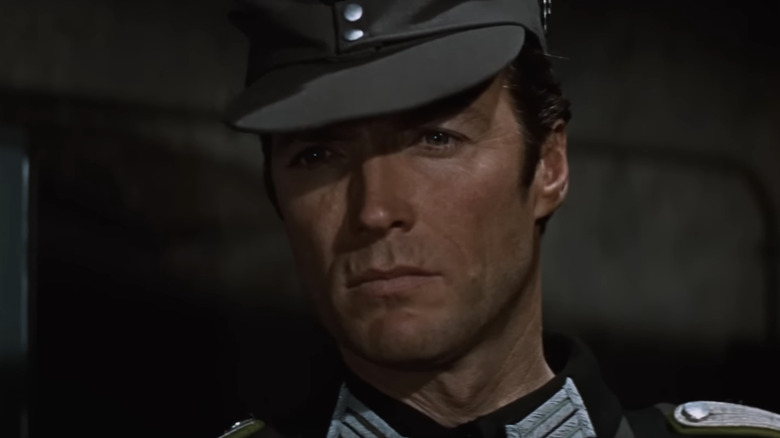
While there are plenty of examples of Clint Eastwood expressing conservative opinions via his films, the director has also made movies with apparent anti-war messages. Most notable are his 2006 films "Flags of our Fathers" and "Letters from Iwo Jima" — two movies that showed the same battle from different perspectives and together represented the most ambitious war movie project Eastwood ever oversaw. So, what's the deal? Is this guy pro or anti-war? Well, according him, it's the former. Yet, questions remain...
In a 2015 interview with The Hollywood Reporter, Eastwood was asked whether he is, in fact, anti-war. "Yes," he said. "I've done war movies because they're always loaded with drama and conflict. But as far as actual participation [...] it's one of those things that should be done with a lot of thought, if it needs to be done. Self-protection is a very important thing for nations, but I just don't like to see it." In this response, Eastwood seemingly encapsulates that strange area of the political spectrum where the right overlaps with the anti-war left. That is, Eastwood appears to articulate an isolationist view that embraces the idea that the United States needs to focus exclusively on domestic issues and avoid military intervention.
Again, Eastwood manages to confound more than clarify. Is he anti-war because of the very horrors he depicted in "Letters from Iwo Jima?" Or is he anti-war because he's pro-America First? More than that, is he really anti-war? His record is fascinatingly opaque in that regard, but it matters in terms of defining why he's drawn to war movies.
Is there more behind Clint Eastwood's war movies?
Dubbed a "political wanderer" by The Atlantic, Clint Eastwood's views have always been hard to define. That makes his claim about why he's drawn to war movies similarly difficult to interpret. Back in 1971, Eastwood's "Dirty Harry" caused major controversy for what many viewed as its pro-police brutality ethos. By that point, the actor had already endorsed Richard Nixon, who, after campaigning for "peace with honor" in Vietnam, initially instructed his forces to increase their aggression in Indochina and authorized the bombing of North Vietnamese base camps in Cambodia. Eastwood's support for the President only ended with Watergate.
As Patrick McGilligan writes in his Eastwood biography, "Clint: The Life and Legend," "The pro-Nixon Clint made his endorsement of the war tacit, and refused to be pinned down." In McGilligan's account, Eastwood wasn't as straightforwardly anti-war as the actor would later claim. "American Sniper" certainly seemed to speak to that tacit support of American military endeavors.
That said, Eastwood remained adamant that he was, in fact, anti-war. "I was not a big fan of going to war in Iraq or Afghanistan, for several reasons, several practical reasons," he told The Hollywood Reporter in 2015, pointing to how the British and Russians had struggled in the region. "Iraq, I know, was a different deal, because there was a lot of intelligence that told us that bad things could happen there, and we're never sure how that ended up, whether it was pro or con. [But] I tend to err on the side of less is best." Once again, Eastwood "refused to be pinned down." All of this suggests there might be more than the allure of inherent "drama and conflict" that has drawn Eastwood back to the war movie time and time again.