

What Happens To Star Trek's Prisoners? Federation Penal Colonies Explained
We may receive a commission on purchases made from links.
Welcome to Trekspertise, a series where we break down the technology, history, details, and decisions that make the Star Trek universe so complex — and so fun.
As Sigmund Freud pointed out in his book "Civilization and its Discontents," humans will, by dint of their own uncontrollable instincts, always rail against the conformity demanded by an organized civilization. Our pleasure principle is always going to be butting heads with the frustrations of reality. This proves to be true even in the utopian future of "Star Trek," as evidenced by the franchise's many mentions of Federation penal colonies. "Star Trek" may take place in a time when money and war have been replaced by diplomacy and working for the common good, but it seems that there will still be those who are driven into a life of crime.
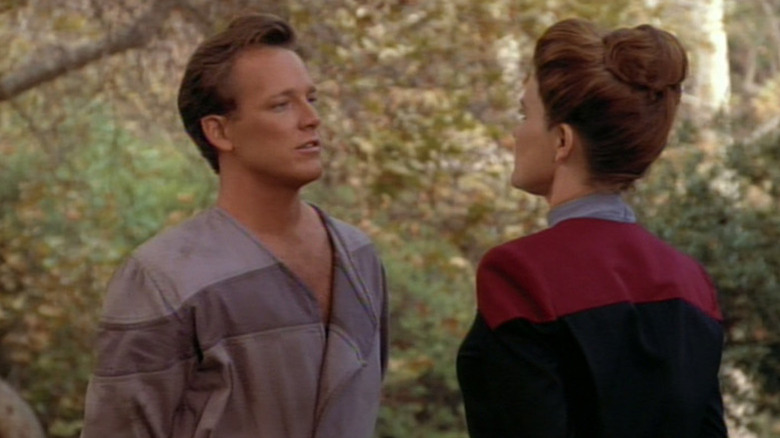
Little screen time has been devoted to Federation penal colonies. In the original series episode "Dagger of the Mind," the Enterprise visits a colony for the criminally insane, for instance, but that wasn't a common prison. In the (mistake-riddled) pilot episode of "Star Trek: Voyager," Captain Janeway (Kate Mulgrew) visits Tom Paris (Robert Duncan McNeill) in a penal colony, and it looks pastoral and comfy, like it was filmed in Los Angeles's Griffith Park. The fact that the makers of "Star Trek" rarely spent time in Federation prisons was, perhaps, a sign that civilization had fewer discontents in the future.
Of course, one cannot tell exciting crime stories without a prison system in place. This article will delve into the nature of Federation penal colonies, and how they are devoted not to punitive measures, but rehabilitation — at least within the Federation. Other non-Federation worlds have rather harsh prisons and labor camps still in operation.
Federation penal colonies are about rehabilitation, not punishment
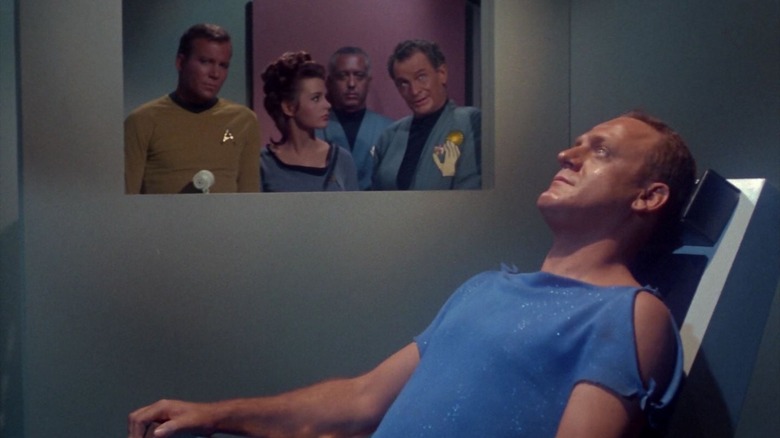
Even on the early days of "Star Trek," it was established that prisons were geared toward rehabilitation. "Dagger of the Mind" was about a brilliant psychiatrist named Dr. Adams (James Gregory) who developed a specialized (and aggressive) hypnosis machine that can implant new impulses into patients' brains. Naturally, Kirk (William Shatner) will find that Dr. Adams has been using the machine to essentially brainwash people and make them into docile servants. Dr. Adams' means were corrupt, but they were based in a genuine need to cure people. The machine is eventually dismantled.
Other prisons on "Star Trek" appear to be pretty cushy. On "Voyager," Tom Paris is in prison for his association with the Maquis, a group of anti-Federation freedom fighters, and sentenced for treason. The prison is like a park where Paris is allowed to do engineering work and live in comfort. That is the New Zealand Penal Settlement. It's mentioned again on "Star Trek: Deep Space Nine," when Dr. Bashir's father (Brian George) goes there for illegal genetic tampering.
In the future of "Star Trek," you're given psychiatry, natural sunlight, and a task to perform. It seems that the Federation believes in a puritan work ethic, and that prisoners can do light labor as a form of rehabilitation. In extreme cases, criminal hospitals offer games, gardening, and therapy, as glimpsed in the "Star Trek: Lower Decks" episode "A Few Badgeys More" (which boasted the franchise's most powerful villain).
Because most of "Star Trek" takes place on starships, however, we usually see prisoners when they have been confined to a ship's brig. Brigs are essentially just little one-bed cabins with small food replicators. Prisoners are then taken from brigs to penal colonies. Although Federation prisons are comfy, they're not places you want to end up.
Outside the Federation, banishment seems to be common

It seems that a Federation prison sentence, in most cases, ends one's Starfleet career. In the world of "Star Trek," prestige is the only currency. Committing a major crime is enough to display your lack of character.
There is no capital punishment in the future. There are no fines.
Of course, other worlds don't care as much about their prisoners. In "Star Trek VI: The Undiscovered Country," Kirk and McCoy (DeForest Kelley) are framed for assassinating a Klingon diplomat and sent to Rura Penthe, a Klingon mining camp on a distant frozen planet. Prisoners were expected to do heavy mining and often fought among themselves. For the most part, a lot of prisoners are left abandoned on distant worlds; banishment from civilization seems to be the ultimate punishment in "Star Trek." (See also the "Next Generation" episode "Power Play.")
Additionally, "Star Trek" has featured remote prison ships, as seen in the "Voyager" episode "The Chute." That episode saw Paris and Harry Kim (Garrett Wang) in an Akritirian prison ship wherein they had been implanted with mood-altering chips to make them more aggressive and cagey.
Other creative prisons have been seen in other non-Federation worlds. Tom Paris seems to be in trouble often, as in the episode "Ex Post Facto," he was accused of murder. His punishment was to accept an implant that would force him to relive his crime at regular intervals. In the "Deep Space Nine" episode "Hard Time," Argrathan authorities implanted a decades-long prison sentence into the brain of Miles O'Brien (Colm Meaney), experienced in only a few hours.
And don't get me started on the Romulans or Cardassians, who kill and torture prisoners regularly. By contrast, the Federation therapy prisons are much more humane.