

Why 'The Burn' Caused All Of Star Trek's Dilithium Crystals To Explode At The Same Time
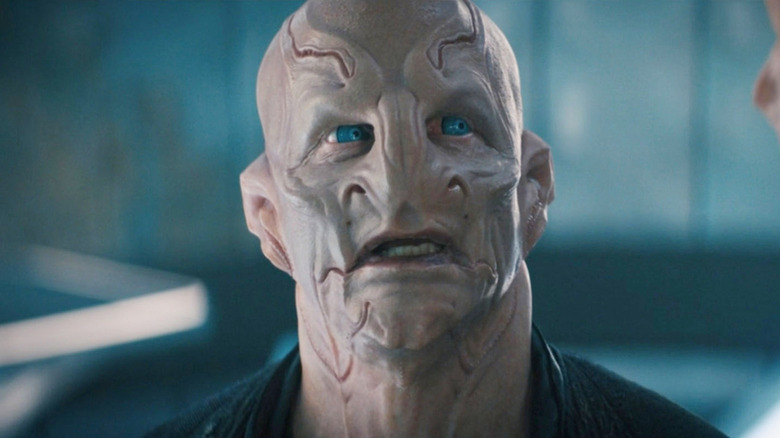
At the end of "Star Trek: Discovery" Season 2, which takes place in the year 2258, the USS Discovery sailed through a time portal to the year 3188, never to return. The galaxy of the 32nd Century was very, very different from the one its crew left behind. For one, the Federation seemed to no longer exist. In its place, the crew of the Discovery found an enormous criminal syndicate called the Emerald Chain, along with a vicious web of trade and slavery.
They, and viewers, eventually learned that the whole of galactic society was interrupted and hindered by a galaxy-wide cataclysm known as The Burn, a mysterious phenomenon that caused all the dilithium crystals being actively used to explode. And since Starfleet vessel engines use dilithium crystals, this caused many, many spacecrafts to blow up at once, with the remaining crystals being rendered useless. With all faster-than-light starship tech suddenly rendered inert, the Federation fell by the wayside. No one appeared to know what caused The Burn, either.
From there, vast swaths of the galaxy fell into isolationism, and some species, like the Klingons, lost their home planets and became nomads. The Burn also happened at a time when dilithium crystals were already in dwindling supply, being one of the rarest and most useful resources in the "Star Trek" franchise. The final three seasons of "Discovery" and all of "Star Trek: Starfleet Academy" take place in a post-Burn period of reconstruction.
The Burn itself wasn't fully explained until the episodes "Su'Kal" and "The Hope That Is You, Part 2" premiered at the end of the third season of "Discovery." As it turned out, The Burn was caused, via a bizarre set of circumstances, by a mental outburst by a single young Kelpien named Su'Kal (Bill Irwin).
The Burn was accidentally caused by a single Kelpien boy
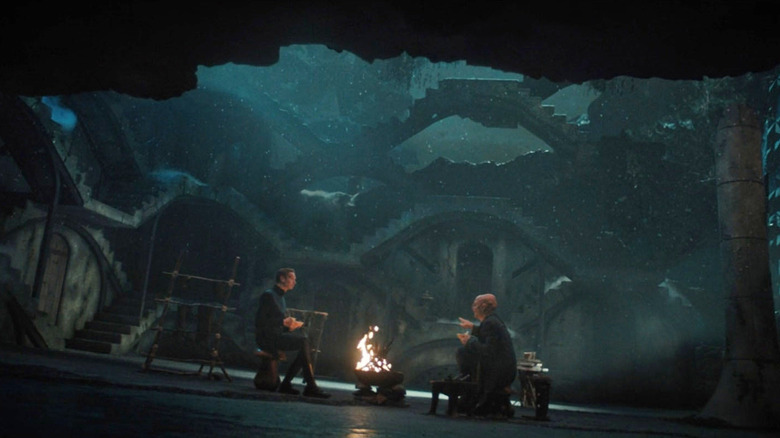
At some point, the USS Discovery's crew learned that the explosions during The Burn didn't all happen simultaneously; rather, they radiated out from a traceable point. The Discovery traveled to that location and found a large floating holodeck occupied by a single Kelpien named Su'Kal. It seems that when Su'Kal was still in his mother's womb, his parents accidentally crashed their starship on a nearby planet. The planet was lousy with dilithium, and being exposed to it somehow mutated the mind of the unborn Su'Kal, causing him to develop a kind of psychic connection to it.
After Su'Kal was born, his mother found that she would die soon, so the young Su'Kal, still a toddler, was placed inside a special, long-lived holodeck program that would cater to his every need. As one might imagine, being raised in an artificial environment that an individual can change at will would mess with the mind of a four-year-old. Indeed, when his mother died, the toddler Su'Kal screamed in anguish, and his psychic anguish reached the dilithium crystals nearby ... and throughout the entire galaxy. Essentially, The Burn was caused by a sad toddler who couldn't yet regulate.
In "Su'Kal" and "The Hope That Is You, Part 2," the crew of the Discovery met Su'Kal, now an adult, and learned about his plight. First Officer turned Captain Saru (Doug Jones), another Kelpien, was able to talk to Su'Kal, explaining that Kelpiens were previously bred to be prey for another species and had evolved a highly sharpened sense of fear. Saru had, through an arc of his own, escaped his in-bred fear and become a much more confident, empathetic figure. He talked Su'Kal into leaving the holodeck and returning to the Kelpien homeworld of Kaminar.
What happened after The Burn?
Su'Kal ultimately declared that he was emotionally healthy enough to never cause another Burn, and everyone else on "Discovery" was fine with that. It's a little odd, though, given that the show basically repeated the drama with The Burn at the end of its fourth season as well. There, however, the cataclysm was called the Dark Matter Anomaly, a destructive gravitational wave that traveled around the galaxy, wiping out everything in its path. As with The Burn, it was eventually discovered that the Dark Matter Anomaly was created by accident, built by a mysterious species of giant sentient octopus-like creatures called Species 10-C. They were mining an ore called boronite and using it to create a security field around their home planet, accidentally unleashing the anomaly. in the process. It was yet another cataclysm caused by a lonely, distant alien that was just trying to protect itself.
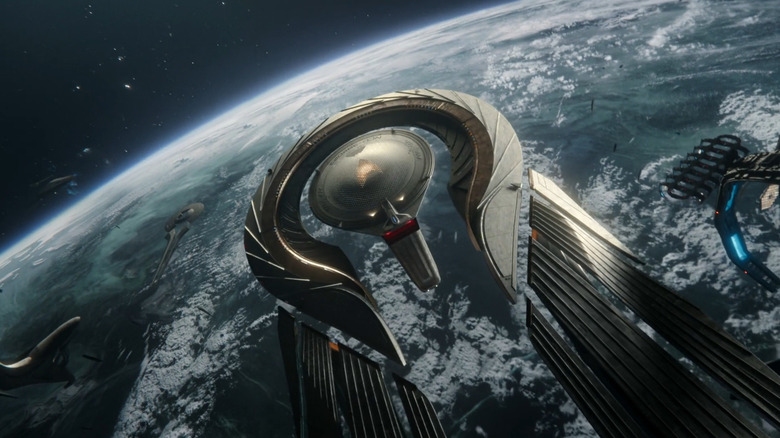
Much of the final three seasons of "Star Trek: Discovery" were devoted to rebuilding the Federation. It's eventually revealed that Starfleet still exists in the 32nd Century, albeit in a very limited capacity and operating in secret. The USS Discovery was retrofitted soon after reaching the 32nd Century and joined the fleet, hoping to coax the local species out of isolationism. From there, scenes of diplomacy began to appear on "Discovery," a show that had previously been defined almost exclusively by violence. Indeed, "Discovery" never quite worked because it clashed with "Star Trek" principles.
From there, "Star Trek: Starfleet Academy" picked up in the wake of "Discovery" at the titular school, which featured students from across the galaxy. That series focused even more on the idea of post-Burn reconstruction, with its characters learning to get along after a generation of being isolated. (Draw your own COVID-19 parallels here.)