

Paul Newman Starred In A Forgotten Remake Of A Classic Akira Kurosawa Movie
In the history of awful artistic decisions, it is hard to top playwrights Fay and Michael Kanin opting to remake Akira Kurosawa's "Rashomon" as a Broadway show with American and English actors in yellowface. The 1959 production starred Rod Steiger and Claire Bloom in the roles originated by Toshiro Mifune and Machiko Kyō, and if you're so inclined, you can find images online of what this looked like. It isn't pretty.
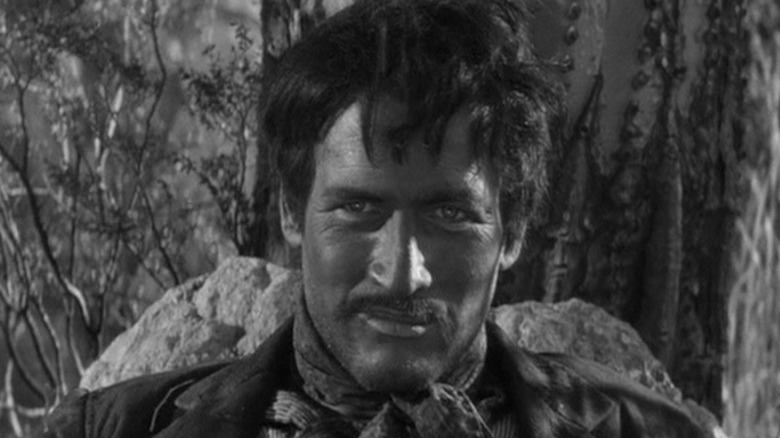
Given the surprise success of Kurosawa's film in the United States and the buzz generated by the play, Hollywood expressed interest in an American film adaptation. Though yellowface would remain acceptable in movies well into the 1980s (Carl Fullerton earned a Best Makeup Oscar nomination for transforming Joel Grey into an Asian man in 1985's "Remo Williams: The Adventure Begins"), Kanin sought to change the setting of the play so that white actors could play, y'know, white folks. He settled on the idea of setting the narrative in the Southwestern U.S. in the 1870s. In the retitled "The Outrage," the central conflict would involve a wealthy Southerner (Laurence Harvey), his not-quite-loving wife (Bloom), and a Mexican bandit (Paul Newman). Yes, you read that correctly.
Getting a big name for the Mifune role was obviously a priority for the filmmakers, but it's my understanding that numerous white bandits were wreaking havoc in this region during the 1870s. If they were hellbent on casting Newman, why not just have him play a white American outlaw instead of putting him in brownface? This was just one of the many puzzling decisions made by director Martin Ritt, who was known for his commitment to authenticity, and it's absolutely why many people have no idea this movie exists.
The Outrage is outrageously awful
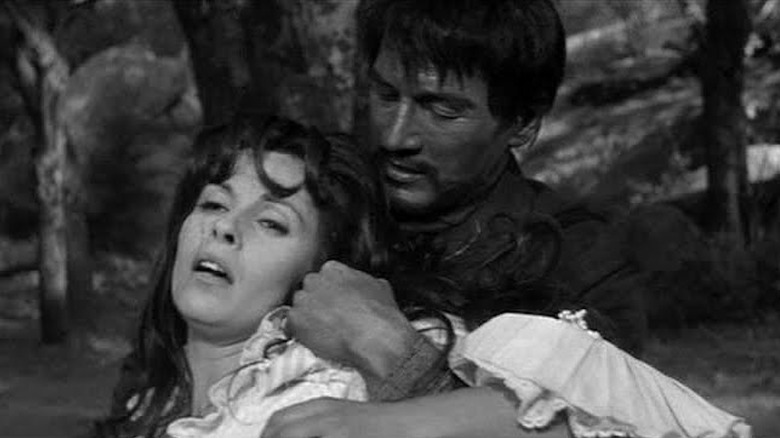
The framing device of "Rashomon" is so effective that it's become a well-worn trope over the years. What we know for certain is that the bandit lures the married couple into a trap with the promise of a precious treasure. The bandit ties the husband up and is intimate with his wife. Eventually, the husband is stabbed with a bejeweled dagger. But who did what and why gets muddy as four different people offer their versions of events.
As in "Rashomon," "The Outrage" makes it clear that the bandit raped the wife. As for who stabbed the husband, that's where things get murky. It's possible that the bandit or the wife stabbed him — or possibly the husband took his own life. But while this is incredibly gripping drama in Kurosawa's film, "The Outrage" is undone by a bad accent competition between the three main actors. Newman apparently spent time in Mexico to absorb the culture so that he could convincingly play a Mexican, but he looks and sounds ridiculous. Ironically, the only culturally insensitive accent work that might be worse is Steiger playing a Cuban in "The Specialist."
Ritt and Newman knocked out a classic in 1963 with "Hud," but this subsequent collaboration is lousy almost all the way around. You do get Edward G. Robinson mowing down on the scenery as a con man, and William Shatner giving a nuanced-for-Shatner performance as a preacher. And then there's legendary cinematographer James Wong Howe working his black-and-white magic. But these are not reasons to waste your time on "The Outrage."